Animals
| Kingdom | Animalia |
|---|---|
| Phylum | Arthropoda |
| Class | Diplopoda |
| Order | Polydesmida |
| Family | Pyrgodesmidae |
| Genus | Iomus |
| Species | Iomus thibaudi |
Meet a creature that walks through the hidden soil layers of Guadeloupe on dozens of delicate legs—Iomus thibaudi, a tiny millipede that embodies the intricate complexity of tropical forest ecosystems. This diminutive arthropod, first scientifically described in 1980, represents a lineage of some of the oldest land animals on Earth, yet remains largely unknown to the world beyond the Caribbean island where it makes its home.
Members of the Pyrgodesmidae family, which includes Iomus thibaudi, are small millipedes, typically ranging from 3 to 16 millimeters in length, with most species between 6 and 10 millimeters. Like its relatives, this species displays the characteristic flat-backed body shape that distinguishes pyrgodesmids from other millipede families.
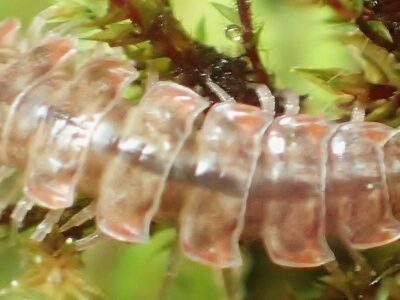
These millipedes are usually uniformly grayish or brownish in coloration. The body structure reflects adaptations for life in soil and leaf litter—a flattened form that allows the animal to navigate through tight spaces in the forest floor. The collum, or first body ring, mostly or completely covers the head from above and is usually shaped like a fan, with a dorsal surface ornamented with distinct radiating lines or small lobes at the front.
The tergites nearly always slope downward and feature conspicuous lobes or tubercles that are usually arranged in rows, while the ozopores often open on short columns and usually deviate from the distribution among segments normally observed in the order Polydesmida. These specialized structures serve as openings for chemical defense glands—a crucial adaptation for surviving in a world full of predators.
Most millipedes are slow-moving detritivores, eating decaying leaves and other dead plant matter. Iomus thibaudi follows this pattern, spending its life in the shadowy realm beneath the forest canopy, breaking down organic matter and contributing to the nutrient cycling that sustains tropical ecosystems.
As a member of the Pyrgodesmidae family, Iomus thibaudi shares behavioral traits with its relatives. Several species within the family Pyrgodesmidae contain “obligate myrmecophiles”, species which have only been found in ant colonies. While the specific behavior of Iomus thibaudi remains poorly documented, some members of its family may form fascinating associations with ant colonies, living within the protected confines of these organized insect societies.
The primary defence mechanism of millipedes is to curl into a tight coil, thereby protecting their legs and other vital delicate areas on the body behind a hard exoskeleton. Additionally, most millipedes defend themselves with a variety of chemicals secreted from pores along the body. For such a tiny creature, these defenses represent critical survival strategies against predators.
Iomus thibaudi is endemic to Guadeloupe, making this small Caribbean island its only known home in the world. The species inhabits the tropical forest environment of the Lesser Antilles, where it thrives in the moist, warm conditions characteristic of Caribbean islands.
Guadeloupe is characterized by annual rainfall averaging 1,300 millimeters, with February and March being the driest months with less than 60 millimeters per month on average. These conditions create an ideal habitat for a soil-dwelling millipede that requires moisture to prevent desiccation. The species likely occurs in the leaf litter and upper soil layers of Guadeloupe’s secondary dry forests, where it feeds on decomposing vegetation.
As a detritivore, Iomus thibaudi sustains itself by consuming the endless supply of decaying organic matter found on the forest floor. The millipede’s role as a decomposer is essential—it helps fragment dead leaves and plant material, accelerating the breakdown process and returning nutrients to the soil.
Research in Guadeloupe’s secondary dry forests has demonstrated that litter nitrogen content strongly influences millipede distribution, with millipede abundance and species richness being significantly related to the chemical characteristics of plant foliage. This suggests that Iomus thibaudi may show feeding preferences based on the nutritional quality of available leaf litter, preferring vegetation with higher nitrogen content that provides better nutrition for growth and reproduction.
Like all millipedes, Iomus thibaudi reproduces through sexual mating. Reproduction in most millipede species is carried out by modified male legs called gonopods, which transfer packets of sperm to females. The specific details of courtship and mating behavior in this species remain undocumented, representing an exciting frontier for future research.
The developmental process in millipedes typically involves eggs that hatch into juveniles, which then undergo a series of molts as they grow. Each molt adds new body segments, gradually transforming the young millipede into an adult. The exact timeline for Iomus thibaudi remains unknown, but the species likely follows the general millipede pattern of slow, steady growth over several months to a year or more.
Very little is known about the population status or conservation needs of Iomus thibaudi. As an endemic species with an extremely limited range, it deserves conservation attention. The species faces potential threats from habitat loss, though the specific pressures affecting this millipede remain largely unquantified.
Few species of millipede are widespread; they have very poor dispersal abilities, depending as they do on terrestrial locomotion and humid habitats, which have favored genetic isolation and rapid speciation, producing many lineages with restricted ranges. This fundamental characteristic of millipede biology means that Iomus thibaudi, with its single-island distribution, represents a unique evolutionary lineage that cannot easily recolonize areas if its habitat is destroyed.
The preservation of Guadeloupe’s tropical forests remains crucial for the survival of this species and countless other endemic invertebrates. Further research into the distribution, ecology, and population dynamics of Iomus thibaudi would provide valuable insights for conservation planning.
Millipedes first appeared in the Silurian period and are some of the oldest known land animals, making Iomus thibaudi a living descendant of creatures that walked the Earth over 400 million years ago.
The name “millipede” derives from Latin for “thousand feet,” and each double-legged segment is a result of two single segments fused together, giving these creatures their distinctive paired-leg anatomy.
Despite being among the smallest millipedes, with most species between 6 and 10 millimeters long, Iomus thibaudi is a fully functional predator-resistant, nutrient-cycling powerhouse in its ecosystem.
Some species within the Pyrgodesmidae family are “obligate myrmecophiles” found exclusively in ant colonies, suggesting that Iomus thibaudi may have fascinating, yet-to-be-discovered relationships with Guadeloupe’s ant fauna.
Millipedes in the Pyrgodesmidae family are not capable of volvation—unlike pill millipedes, this species cannot curl into a protective ball, relying instead on its chemical defenses and armor-like exoskeleton.
There are approximately 12,000 named millipede species classified into 16 orders and around 140 families, yet Iomus thibaudi remains one of the least-studied members of this ancient and diverse group.
The species was discovered and formally described during a systematic survey of Guadeloupe’s millipede fauna, highlighting how much remains unknown about Caribbean invertebrate biodiversity.
Mauriès, J.-P. (1980). Diplopdes Chilognathes de la Guadeloupe et ses dépendances. Bulletin Du Muséum National D’histoire Naturelle, 4e Série, Section A, Zoologie, 2: 1059–1111.
Hoffman, R. L. (1999). Checklist of the millipedes of North and Middle America. Virginia Museum of Natural History, special publication 8: 1-584.
Wikipedia Contributors. (2025). Millipede. In Wikipedia, The Free Encyclopedia. Retrieved from https://en.wikipedia.org/wiki/Millipede
Loranger-Merciris, G., Imbert, D., Périé, F., & Lavelle, P. (2008). Litter N-content influences soil millipede abundance, species richness and feeding preferences in a semi-evergreen dry forest of Guadeloupe (Lesser Antilles). Biology and Fertility of Soils, 45(2), 151-161.