Fungi
| Kingdom | Fungi |
|---|---|
| Phylum | Basidiomycota |
| Class | Pucciniomycetes |
| Order | Pucciniales |
| Family | Pucciniaceae |
| Genus | Puccinia |
| Species | Puccinia albulensis |
Across the windswept tundra of Greenland and the alpine slopes of the Alps, a microscopic master of parasitism weaves its complex life story. Puccinia albulensis Magnus represents one of nature’s most intricate fungal systems—a rust fungus that has perfected the art of obligate parasitism across multiple continents and diverse host plants. Though invisible to the naked eye, this organism shapes the health of its plant communities in profound ways, demonstrating the hidden complexity of fungal ecology in northern and montane regions.
Puccinia albulensis belongs to the vast genus Puccinia, a group of obligate plant pathogens known as rusts, with the genus containing about 4000 species. Like all rust fungi, this fungus commonly appears as yellow-orange or brown pustules on healthy and vigorously growing plant parts such as leaves, petioles, tender shoots, stems, and fruits, with infection pustules often associated with chlorotic lesions that may cause premature wilt and senescence of infected leaves in cases of severe infection.
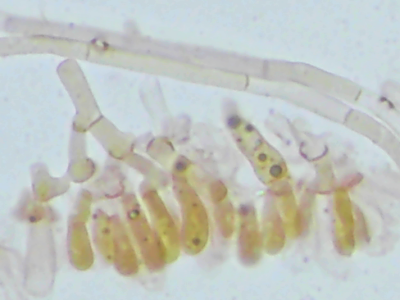
Identification tip: Rust fungi require microscopic examination of spore structures for precise species identification. Most species of rust fungi are able to infect two different plant hosts in different stages of their life cycle, and may produce up to five morphologically and cytologically distinct spore-producing structures: spermogonia, aecia, uredinia, telia, and basidia in successive stages of reproduction. The distinctive spore types serve as the primary diagnostic features for separating Puccinia albulensis from related species.
These are obligate parasites that spread through spores and infect the aerial parts of the host, with spread and further infection sometimes complete on a single host, or another host required to complete the life cycle of the rust fungus. The reproductive strategy of Puccinia albulensis demonstrates the remarkable complexity that evolution has crafted into fungal biology.
The fungi start infection with the formation of asexual urediniospores on the main host (primary infection), which further infect neighboring plants of the same host plant, with infection by these urediniospores generally occurring during summer, while sexual teliospores are normally produced near the end of the season and overwinter on plant debris, then germinate in spring season and produce basidiospores, which ultimately disseminate all over again and start infecting the secondary or alternate host for heteroecious rusts. This sophisticated cycling allows Puccinia albulensis to spread rapidly during the growing season while ensuring survival through harsh winters via dormant teliospores.
The fungus cannot grow independently—it exists solely as a parasite within living plant tissue. Most rust fungi cannot be grown easily in pure culture, making them among the most specialized organisms in nature. This obligate relationship with their hosts has shaped their evolution for millions of years.
Puccinia albulensis displays a distinctly northern and montane distribution pattern, reflecting its adaptation to cooler climates. The species has been documented across an impressive geographic range spanning from Greenland and Iceland in the far north to the Alps and Carpathians in central Europe, with additional populations in northern Russia, Scandinavia, and scattered locations in North America including Canada and the northern United States. This wide distribution, documented through over 1,310 occurrence records, suggests a fungus well-adapted to alpine and subarctic environments.
Each species has a range of hosts and cannot be transmitted to non-host plants. The specific host plants for Puccinia albulensis remain incompletely documented in readily available sources, though like other Puccinia species, some genera of rust fungi, especially Puccinia and Uromyces, comprise species that are capable of parasitizing plants of many families. The fungus thrives in regions where moisture and cool temperatures favor fungal growth, particularly in alpine meadows, tundra margins, and high-elevation grasslands.
Puccinia albulensis functions as a biotrophic parasite, deriving nutrients directly from living plant cells through specialized feeding structures called haustoria. Rust fungi decrease photosynthesis and elicit the emissions of different stress volatiles with increasing severity of infection. By reducing the photosynthetic capacity of its hosts, this fungus indirectly influences energy flow through entire plant communities, potentially altering competitive dynamics between plant species and affecting the animals that depend on those plants for food.
Rusts generally do not kill the host but repeated infection may ultimately lead to death. This balance—harming without immediately destroying—allows Puccinia albulensis to persist in populations over multiple generations. The fungus represents a critical selective pressure on its host plants, potentially favoring the evolution of disease resistance traits. Additionally, the spores of rust fungi may be dispersed by wind, water or insect vectors, making Puccinia albulensis an agent of long-distance connectivity between plant populations across the northern landscape.
Puccinia albulensis is not edible and has no culinary applications. As an obligate parasite, this fungus exists entirely within plant tissues and cannot be harvested or consumed. The species has no known medicinal uses or cultural significance in human societies.
Important note: This is a plant pathogen. Any presence of rust fungi on economically important crops or ornamental plants should be managed through disease control strategies, including removal of infected tissue and, where applicable, removal of alternate hosts. However, each species has a range of hosts and cannot be transmitted to non-host plants, and in addition, most rust fungi cannot be grown easily in pure culture, making Puccinia albulensis difficult to study in laboratory settings.
Ancient enemy of agriculture: Puccinia spp. have afflicted wheat for thousands of years, as references to rust can be found in the literature of classical Greece and Rome and in the Bible. Puccinia albulensis represents part of this ancient lineage of plant-fungal conflict.
Microscopic spore factories: A single rust pustule can contain hundreds of thousands of spores. A single lesion may contain 350,000 spores. This extraordinary reproductive capacity explains how rust epidemics can spread across entire regions in a single growing season.
Wind-borne wanderers: Urediniospores can be wind-disseminated and infect host plants hundreds of kilometres from their source plant, which can result in wheat leaf rust epidemics on a continental scale. Puccinia albulensis spores ride atmospheric currents across entire continents, connecting distant plant populations.
Obligate parasite extraordinaire: Unlike most fungi that can survive as saprophytes (decomposers), rusts are obligate parasites that show phenotypic and genetic plasticity because of their complete dependency on the presence of living host plants to complete their life cycles. Puccinia albulensis cannot exist without its host—a testament to extreme specialization.
Five-stage life cycle: The species of Puccinia may produce up to five morphologically and cytologically distinct spore-producing structures. This complexity rivals the life cycles of insects and small animals, compressed into a microscopic organism.
Alternate host strategy: Like many Puccinia species, heteroecious rust fungi require two unrelated hosts to complete their life cycle, with the primary host being infected by aeciospores and the alternate host being infected by basidiospores. This strategy allows the fungus to exploit different ecological niches and spread its genetic material across diverse plant families.
Climate-driven distribution: The northern and alpine distribution of Puccinia albulensis reflects its adaptation to cool climates. Temperature and moisture directly influence spore germination and infection success, making this fungus an indicator of specific climatic conditions across its range.