Animals
| Kingdom | Animalia |
|---|---|
| Phylum | Arthropoda |
| Class | Diplopoda |
| Order | Polydesmida |
| Family | Polydesmidae |
| Genus | Pseudopolydesmus |
| Species | Pseudopolydesmus serratus |
Beneath the fallen leaves and rotting logs of eastern North American forests lives a creature so small it often goes unnoticed—yet so perfectly adapted to its decomposing world that it has thrived for millions of years. Pseudopolydesmus serratus is a flat-backed millipede that embodies the hidden beauty of the forest floor, a tiny architect of decomposition that plays an essential role in breaking down the very fabric of woodland ecosystems.
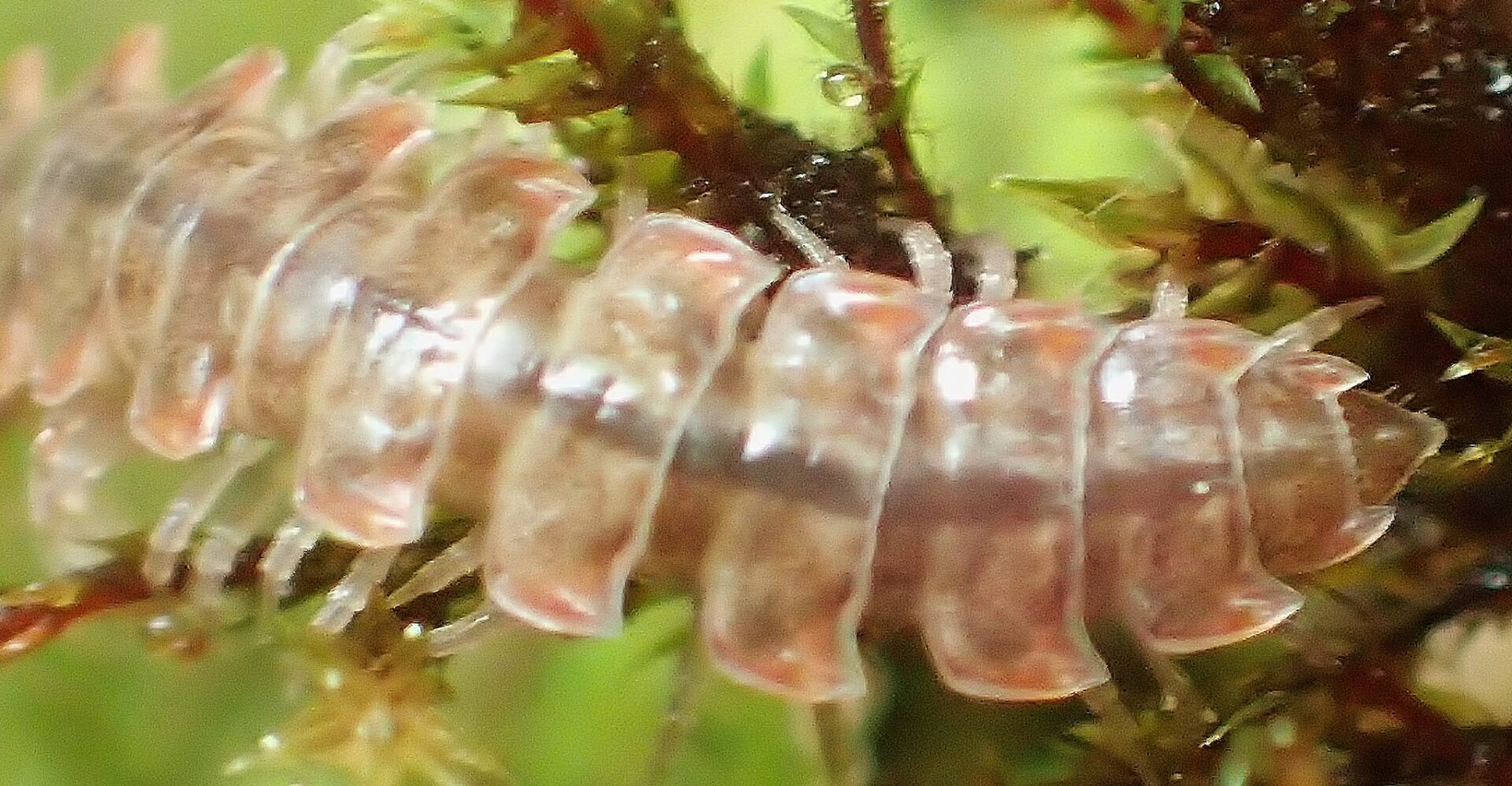
These medium-sized millipedes reach up to approximately 35 mm in length, making them a modest presence in the soil world. Yet what they lack in size, they compensate for with striking coloration. Described as a pretty pink millipede, Pseudopolydesmus serratus displays remarkable color variation across its range. Their coloration varies from pink to brick red to brown, and their shallowly raised dorsal blisters give them the flat-backed appearance typical of other millipedes in the order Polydesmida.
The defining characteristic of this species lies in its flattened body profile, which distinguishes it from the cylindrical millipedes more commonly encountered. Its paranota taper back more on the segments closer to the millipede’s posterior, creating a distinctive silhouette. Pseudopolydesmus serratus was first discovered by the American entomologist Thomas Say while collecting on the eastern shore of Virginia, where it remains abundant today.
These millipedes are common in forests throughout the eastern and central USA and are among the widest ranging of the North American millipede genera. They can be found under rocks, under the bark of dead logs, and in leaf litter, so they are cosmopolitan in their habitat as far as millipedes go.
The lifestyle of Pseudopolydesmus serratus centers entirely around one fundamental activity: the careful, methodical consumption of decomposing organic matter. Polydesmids are very common in leaf litter, where they burrow by levering with the anterior end of the body, and these millipedes feed on decaying vegetation. Flat-backed millipedes in the order Polydesmida tend to insert their front end, like a wedge, into a horizontal crevice, and then widen the crack by pushing upwards with their legs, the paranota in this instance constituting the main lifting surface. This elegant burrowing technique allows them to navigate through the dense, compressed layers of the forest floor with remarkable efficiency.
Ecological engineers: These millipedes play a vital role in nutrient cycling. The leaf litter is fragmented in the millipede gut and excreted as pellets of leaf fragments, algae, fungi, and bacteria, which facilitates decomposition by the microorganisms. In this way, they accelerate the return of nutrients to the soil, supporting the growth of the very trees whose leaves they consume.
The geographic range of Pseudopolydesmus serratus spans much of eastern North America, from the Atlantic coast westward to the Great Lakes and beyond. Recent observation data indicates a robust presence throughout the eastern United States and parts of Canada, with documented occurrences stretching from New England to the Carolinas, and extending westward through the Ohio Valley and into the mid-Atlantic states. The species shows a particular affinity for moist, deciduous forest environments where fallen leaves accumulate in thick layers.
This millipede thrives in the cool, humid microhabitats characteristic of temperate forests. It avoids both the desiccating conditions of open, sunny areas and the flooding of wetland centers, preferring instead the stable moisture and moderate temperatures found beneath leaf litter and decaying wood. In the temperate regions, most millipede species are found in moist deciduous forests, and Pseudopolydesmus serratus exemplifies this preference perfectly.
Most species are typically detritivores, feeding on rotting leaves, wood, and other decomposing plant debris. Pseudopolydesmus serratus fits this pattern precisely, spending its life processing the endless supply of dead plant matter that falls to the forest floor. The millipede’s diet consists primarily of:
Some species also consume fungal hyphae, mosses, and algae growing on damp surfaces. This diverse diet allows Pseudopolydesmus serratus to exploit the full spectrum of decomposing material available in its forest home, making it a generalist detritivore capable of thriving wherever sufficient organic matter accumulates.
The feeding process itself is methodical and continuous. These millipedes spend much of their active period moving through leaf litter, consuming as they go, their digestive systems working to break down resistant plant fibers and extract nutrients. This constant feeding, multiplied across countless individuals in a single forest, contributes significantly to the decomposition process that sustains forest ecosystems.
Reproduction in Pseudopolydesmus serratus follows the typical pattern for flat-backed millipedes. Reproduction in most species is carried out by modified male legs called gonopods, which transfer packets of sperm to females. Males possess specialized reproductive structures on their seventh segment that allow them to transfer sperm packets directly to receptive females.
Millipedes in this order typically develop through a series of eight stages, hatching with only 7 segments (including the telson) and 3 pairs of legs, then molting seven times. These eight stages feature 7, 9, 12, 15, 17, 18, 19, then finally 20 segments. The adults then reproduce and die without another molt. This deterministic development—where growth stops at a fixed adult size—distinguishes polydesmids from many other millipede orders that continue molting throughout life.
Females lay eggs in the soil, protected within hardened capsules that shield developing juveniles from environmental threats. Young millipedes emerge as miniature versions of adults, progressively acquiring additional body segments and leg pairs through successive molts. This gradual transformation takes place over the course of a year or more, with the timing influenced by temperature, photoperiod, and food availability. Once reaching adulthood, Pseudopolydesmus serratus enters a brief reproductive phase before the cycle ends.
Pseudopolydesmus serratus remains abundant throughout much of its range, with no conservation concerns currently documented. The species has not been formally assessed by the IUCN, but its widespread distribution, ecological success, and apparent population stability suggest it faces no immediate threats. The abundance of its preferred habitat—moist deciduous forests with thick leaf litter—across eastern North America provides ample resources for thriving populations.
This millipede’s ecological role as a decomposer makes it valuable to forest health. Healthy populations of Pseudopolydesmus serratus and related species help maintain the nutrient cycling processes that sustain forest productivity. Unlike many arthropods facing habitat loss and fragmentation, this species has proven adaptable to various forest types and management practices, from old-growth stands to younger secondary forests.
Conservation note: While the species itself requires no special protection, the preservation of moist deciduous forests and the maintenance of healthy leaf litter layers ensures that Pseudopolydesmus serratus continues to thrive and perform its essential ecological functions. These millipedes serve as bioindicators of forest health—their presence and abundance suggesting adequate moisture, organic matter, and microbial activity in the soil.
Ancient lineage: First appearing in the Silurian period, millipedes are some of the oldest known land animals—meaning ancestors of Pseudopolydesmus serratus were among the first creatures to colonize land over 400 million years ago.
Chemical defense: Like other polydesmids, Pseudopolydesmus serratus produces defensive chemicals to deter predators. Hydrogen cyanide derived from mandelonitrile and related compounds are among the compounds found in flat-backed millipede secretions, making them unpalatable to most would-be predators.
Decomposition accelerators: A single Pseudopolydesmus serratus may consume and process its body weight in leaf litter over the course of a season, fragmenting it into smaller particles that microorganisms can more easily break down.
Leg mechanics: Despite their numerous legs, these millipedes move with surprising grace, using their legs in coordinated waves that propel them smoothly through the soil and leaf litter.
Moisture dependence: These millipedes cannot survive in dry conditions and must remain in environments where relative humidity stays high—they literally breathe through their exoskeleton and lose water rapidly in dry air.
Nocturnal preference: Like most millipedes, Pseudopolydesmus serratus is primarily active during night hours and in the darkest parts of the day, emerging to feed when moisture levels are highest and predation risk is lower.
Historical significance: Pseudopolydesmus serratus was one of the first North American millipedes formally described by science, recognized and named by Thomas Say in 1821, making it a historically important species in the study of American arthropods.
Sierwald, P., Hennen, D. A., Zahnle, X. J., Ware, S., & Marek, P. E. (2019). “Taxonomic synthesis of the eastern North American millipede genus Pseudopolydesmus (Diplopoda: Polydesmida: Polydesmidae), utilizing high-detail ultraviolet fluorescence imaging.” Zoological Journal of the Linnean Society, 187(1), 117-142.
Wikipedia Contributors. (2025). “Pseudopolydesmus serratus.” In Wikipedia, The Free Encyclopedia. Retrieved from https://en.wikipedia.org/wiki/Pseudopolydesmus_serratus
Hoffman, R. L. (1999). “Checklist of the millipedes of North and Middle America north of the Panama Canal.” Virginia Museum of Natural History Special Publication, 8, 1-236.
Shelley, R. M. (1988). “The millipedes of North America.” Proceedings of the Biological Society of Washington, 101(4), 833-846.