
Animals
In the shadowy depths of tropical rainforests and across sun-baked savannas spanning two continents, one of nature’s most formidable predators moves with silent, muscular grace. The boa constrictor (Boa constrictor) is a legend wrapped in scales—a creature so perfectly engineered for hunting that it has remained virtually unchanged for millions of years. With its powerful coils, heat-sensing pits, and ancient lineage dating back to the age of dinosaurs, this remarkable snake represents one of evolution’s greatest success stories. From the humid Amazon basin to the island territories of the Caribbean, the boa constrictor commands respect and fascination wherever it dwells.
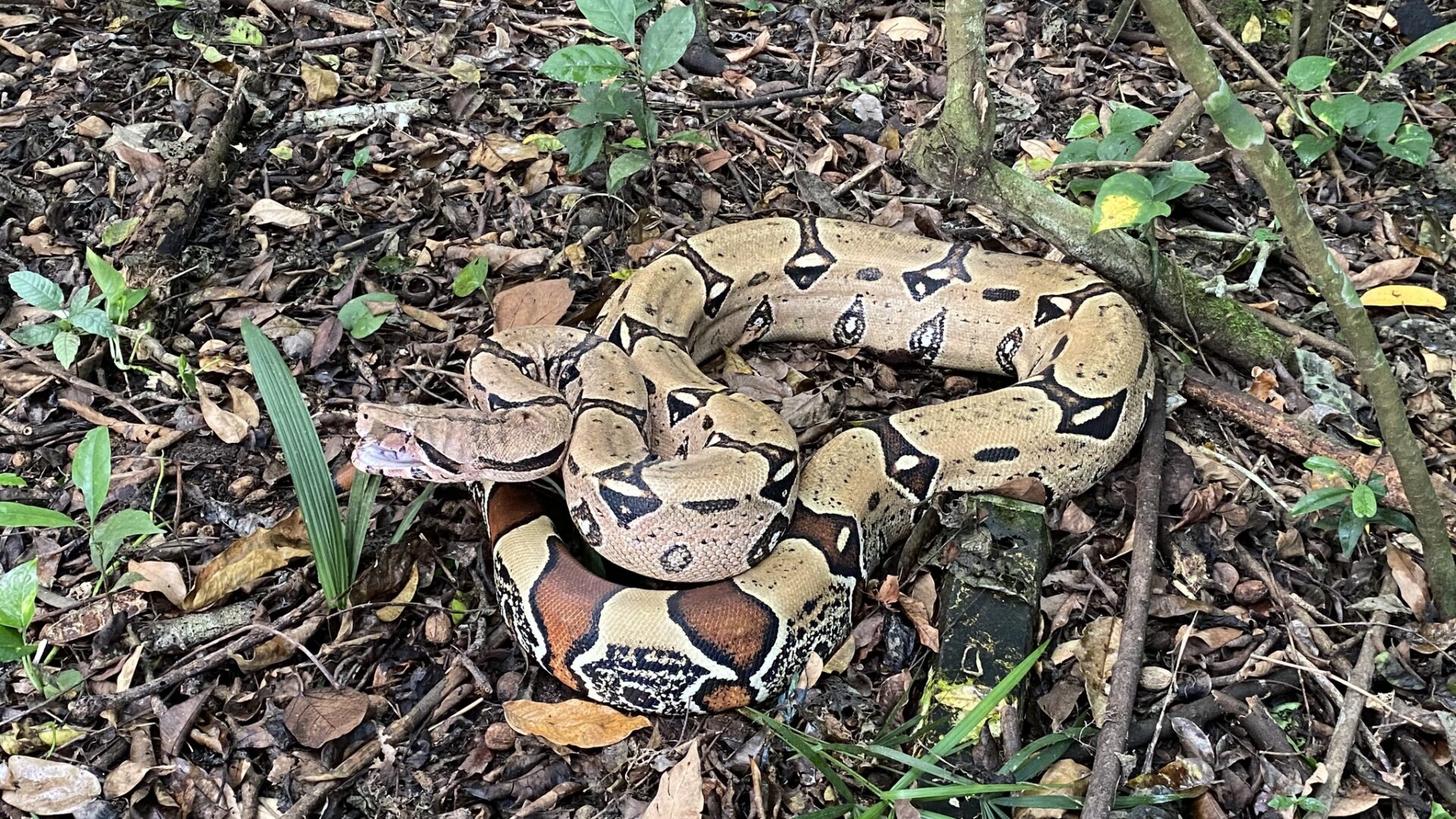
The boa constrictor is a vision of muscular power and cryptic beauty. These impressive snakes typically measure between 1.2 and 2 meters in length, with some exceptional individuals stretching beyond 2.5 meters from nose to tail—though females consistently outgrow their male counterparts in this species.
Their coloration tells a story of camouflage perfected over millennia. Most individuals display a stunning palette of tan, gray, or reddish-brown base coloring overlaid with darker diamond-shaped or saddle-like blotches that run the length of their body. This distinctive patterning breaks up their outline against dappled forest floors and rocky outcrops, rendering them nearly invisible to unsuspecting prey. The head is notably triangular, equipped with a pair of heat-sensing pits along the labial scales—sensory organs of extraordinary sophistication that detect the infrared radiation emitted by warm-blooded prey.
Key identification features include:
Females are notably larger and heavier than males, a sexual dimorphism that provides them with the additional body mass needed to produce and carry developing offspring.
The boa constrictor is a creature of patient ambition, embodying the philosophy that true power requires no haste. These snakes are primarily nocturnal hunters, though they may bask during daylight hours to thermoregulate—a critical behavior for maintaining metabolic processes necessary for digestion and movement. As twilight descends and the forest awakens with the calls of insects and small mammals, the boa stirs from its daytime refuge.
These are largely solitary, territorial animals that spend much of their time coiled around branches or concealed within hollow logs and rocky crevices. They are semi-arboreal, equally comfortable hunting in trees as they are on the ground, though they tend to become more terrestrial as they age and grow heavier. When threatened, a boa will assume a characteristic defensive posture, coiling tightly and striking with surprising speed—a behavior that has earned it respect throughout its range.
Notable behavioral characteristics:
Notable behavior: Boa constrictors possess a remarkable ability to go weeks or even months without feeding, an adaptation that reflects their status as apex predators in ecosystems where prey availability can be unpredictable.
The boa constrictor’s range spans vast territories across Central and South America, from southern Mexico through the Amazon Basin and into Argentina, as well as numerous Caribbean islands. This impressive geographic distribution reflects the species’ remarkable adaptability to diverse environmental conditions. They thrive across a spectrum of habitats, from humid tropical rainforests to drier scrubland and even semi-desert regions.
Their presence has been documented across multiple countries including Brazil, Peru, Ecuador, Colombia, Venezuela, Bolivia, Paraguay, Suriname, French Guiana, Trinidad and Tobago, Puerto Rico, and the U.S. Virgin Islands. The species shows a remarkable ability to inhabit forests, desert margins, and freshwater wetland areas—demonstrating the behavioral flexibility that has allowed them to persist for millions of years. With over 8,000 documented occurrences in scientific databases, the boa constrictor remains one of the most widely distributed large snakes in the Americas, a testament to both their ecological success and human fascination with the species.
As an obligate carnivore, the boa constrictor is an apex predator perfectly designed for hunting warm-blooded prey. Their diet reflects their size and hunting prowess, encompassing rodents, birds, small mammals, and occasionally larger prey such as rabbits and opossums. Juvenile boas begin their hunting careers targeting small lizards and juvenile rodents, gradually progressing to larger prey as their bodies grow and strengthen.
The boa’s hunting strategy is a masterclass in patience and precision. Using their heat-sensing pits to detect the body warmth of nearby prey, they remain coiled and motionless until an unsuspecting animal ventures within striking range. With lightning-fast reflexes, the boa strikes, sinking its curved teeth into the prey to secure a grip. Then comes the signature move that gives the species its name—the constricting coils. The snake rapidly entwines itself around the prey’s body, tightening its grip with each exhalation until the prey can no longer breathe. This method is remarkably efficient, causing minimal injury to the boa itself while ensuring a quick kill.
Feeding characteristics include:
The reproductive cycle of boa constrictors is a fascinating interplay of chemical communication and seasonal timing. These snakes are ovoviviparous—meaning females retain eggs internally and give birth to fully-formed, live young rather than laying eggs. Mating typically occurs during the dry season, usually between April and December depending on geographic location, triggered by seasonal changes in temperature and photoperiod.
Male boas locate receptive females by following the pheromone trails they leave behind, a chemical communication system of remarkable sophistication. Males engage in elaborate courtship displays, undulating alongside females and vibrating their tails in a behavior known as “combat dancing”—though despite the name, these interactions are rarely aggressive. After successful mating, the female carries her developing offspring for approximately 100-120 days before giving birth to 10-60 live young, depending on her size and condition.
Reproductive details:
Newborn boa constrictors are miniature versions of their parents, fully equipped with functional heat-sensing pits and hunting instincts. They immediately disperse to find their own territories, beginning a solitary existence that will characterize their entire lives.
The boa constrictor presents a complex conservation picture that defies simple categorization. While the species is not currently listed as threatened by the IUCN (International Union for Conservation of Nature), certain populations face localized pressures that warrant careful monitoring. The species’ broad geographic distribution and adaptability to various habitats have granted it a measure of resilience that many other large reptiles lack.
However, the boa constrictor does face genuine conservation challenges in specific regions. Habitat loss remains the primary threat, as tropical forests are cleared for agriculture, logging, and urban development. In some areas, persecution by humans who fear the species—often based on myths and misunderstandings—results in unnecessary killings. Additionally, the illegal pet trade has historically captured wild individuals, though captive-bred specimens now dominate the international trade, reducing pressure on wild populations.
Conservation considerations:
Conservation note: The boa constrictor’s success as a species demonstrates that large predators can coexist with human populations when public attitudes shift toward understanding and coexistence rather than fear and persecution.
Ancient lineage: Boa constrictors have remained virtually unchanged for over 60 million years, surviving the mass extinction event that eliminated the dinosaurs and outlasting countless other species.
Infrared vision: The heat-sensing pits along their jaw contain specialized organs that can detect temperature differences as small as 0.03 degrees Celsius, allowing them to hunt in complete darkness with precision.
Incredible squeeze: A boa constrictor’s coils exert pressure equivalent to several hundred pounds per square inch, yet the snake possesses an uncanny ability to sense exactly how much pressure is needed—they don’t crush prey unnecessarily.
Island colonizers: Boa constrictors have successfully colonized numerous Caribbean islands, likely arriving via natural rafting on vegetation during storms, demonstrating their remarkable survival abilities.
Scent-tracking masters: Female boa constrictors leave pheromone trails that males can follow for distances exceeding 100 meters, showcasing a chemical communication system of extraordinary sophistication.
Longevity champions: In captivity, boa constrictors regularly live 20-30 years, with some individuals exceeding 40 years—making them long-term companions for dedicated keepers.
Docile giants: Despite their fearsome appearance and predatory prowess, boa constrictors are remarkably calm and are frequently kept as pets, with many individuals becoming accustomed to regular human handling.
Enge, K. M., Wood, K. N., & Krysko, K. L. (2004). Distribution, Natural History, and Impacts of the Introduced Boa constrictor in Florida. Herpetological Review, 35(4), 346-348.
Henderson, R. W., & Powell, R. (2009). Natural History of West Indian Reptiles and Amphibians. University of Florida Press.
IUCN SSC Boa and Python Specialist Group. (2023). Boa constrictor. The IUCN Red List of Threatened Species. Retrieved from www.iucnredlist.org
Pizzatto, L., Marques, O. A. V., & Facure, K. (2008). Food Habits of Brazilian Snakes: Neglected Trophic Relationships Provide Managers with Insights on Assemblage Patterns. Biotropica, 40(3), 295-303.
Shine, R., & Slip, D. J. (1990). Biological Aspects of the Ecology of Australian Elapid Snakes. In S. Seigel, J. Collins, & S. Novak (Eds.), Snakes: Ecology and Evolutionary Biology (pp. 299-333). Macmillan Publishing Company.