Fungi
| Kingdom | Animalia |
|---|---|
| Phylum | Bryozoa |
| Class | Gymnolaemata |
| Order | Cheilostomatida |
| Family | Candidae |
| Genus | Notoplites |
| Species | Notoplites scutatus |
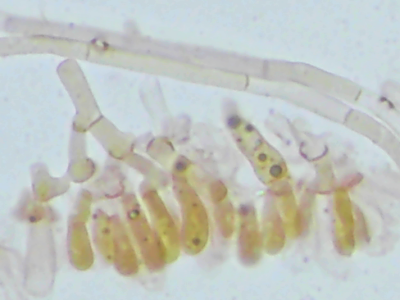
In the twilight waters of the South Pacific, where coral reefs meet continental shelves and ancient currents weave through island archipelagos, there exists a creature of extraordinary delicacy that few eyes have ever beheld. Notoplites scutatus is not a fungus at all—a correction that reveals the beautiful complexity of life’s taxonomy and reminds us that nature’s categories are far more intricate than our initial assumptions. This remarkable bryozoan, a colonial animal of microscopic proportions, represents one of the ocean’s most underappreciated marvels, dwelling in the shadowed depths where few scientists venture and fewer still have documented its existence.
Notoplites scutatus belongs to the bryozoan class Gymnolaemata, a group of colonial organisms that construct delicate, lace-like structures from calcium carbonate—nature’s own architecture rendered in miniature. Members of the family Candidae, to which this species belongs, are characterized by their distinctive shield-shaped zooids, the individual animal units that comprise the colony. The genus Notoplites itself features organisms with specialized defensive structures and ornate colony formations that speak to millions of years of evolutionary refinement.
Though specific morphological details for N. scutatus remain sparse in the scientific literature, bryozoans of this family typically display:
Identification tip: Observing bryozoan specimens requires a hand lens or microscope; the shield-shaped zooids and colony architecture are the defining characteristics that distinguish Notoplites scutatus from related species in the Candidae family.
The life story of Notoplites scutatus unfolds as an epic of colonial cooperation, where thousands of genetically identical zooids work in perfect synchrony to build their shared home. These bryozoans begin life as free-swimming larvae, drifting through ocean currents until they discover a suitable substrate—typically hard surfaces like rocks, shells, or coral rubble where they can establish their permanent settlement. Once settled, a single larva metamorphoses into the founding zooid, which then begins budding to create the colony’s expanding network of specialized individuals.
Each zooid within the N. scutatus colony performs distinct roles: some filter-feed, drawing microscopic plankton and organic particles from the water column through their retractable tentacle crowns called lophophores; others specialize in reproduction, producing either sperm or eggs that will eventually create the next generation of free-swimming larvae. The colony grows through the season, its calcified skeleton accumulating layer upon layer, creating a living record of growth rings that rival trees in their temporal documentation. Growth rates vary with water temperature, food availability, and environmental conditions, but these resilient organisms can persist for years, their colonies potentially reaching several centimeters in extent—a vast city in the microscopic realm.
Notoplites scutatus claims the southwestern Pacific as its domain, with documented occurrences painting a map of marine wonder across New Zealand, New Caledonia, and the Indonesian archipelago. These three geographic regions represent distinct marine ecosystems—from the temperate waters surrounding New Zealand’s coasts to the tropical and subtropical seas of New Caledonia, and the biodiverse Indonesian waters where the Indian and Pacific Oceans converge in a spectacular collision of currents and life.
This bryozoan favors rocky substrates and hard surfaces in shallow to moderate depths, where water movement brings a steady supply of food and oxygen. The species appears to thrive in areas with:
The scattered distribution pattern suggests that N. scutatus occupies a specialized ecological niche, perhaps requiring specific water conditions or substrate characteristics that limit its range to these particular regions. The relative rarity of recorded observations hints at either genuine scarcity or simply the challenge of surveying microscopic marine life in the vast ocean depths.
Within its marine ecosystem, Notoplites scutatus plays the role of a diligent filter-feeder, drawing sustenance from the ocean’s microscopic bounty and thereby participating in the grand cycle of energy transfer that sustains all life. As the colony’s tentacle crowns extend into the water column, they capture tiny planktonic organisms, diatoms, and organic detritus—the microscopic rain that falls continuously through the sea. By consuming these particles, N. scutatus helps regulate plankton populations and converts minute food sources into living biomass that can support larger predators.
The bryozoan colony itself becomes habitat and food source for a community of specialized organisms. Tiny amphipods, copepods, and other meiofauna shelter within the colony’s intricate architecture, while predatory nudibranchs and other small gastropods graze upon the tender zooids. The calcified skeleton, even after the colony’s death, persists as a substrate for algae, diatoms, and other encrusting organisms, continuing to provide ecological services long after the living colony has passed. In this way, N. scutatus exemplifies how even the smallest creatures ripple through their ecosystems, creating cascades of ecological consequence that reach far beyond their microscopic proportions.
The question of edibility holds no practical relevance for Notoplites scutatus, as these microscopic bryozoans exist at a scale utterly divorced from human consumption. A single colony would require collecting thousands of specimens to accumulate even a gram of biomass—a pursuit as impractical as it would be scientifically pointless. Yet this does not diminish the organism’s value, for its true worth lies not in nourishment but in knowledge.
Scientific significance: Bryozoans like N. scutatus serve as invaluable indicators of marine environmental health and historical ocean conditions. Paleontologists study fossil bryozoan colonies to reconstruct ancient seascapes, understanding how oceans changed across geological timescales. Contemporary researchers examine living bryozoan communities to assess water quality, pollution levels, and ecosystem integrity—these tiny colonial animals are sentinels of the sea, their presence or absence speaking volumes about the health of their marine home.
The study of N. scutatus contributes to our understanding of biodiversity, colonial biology, and the intricate networks that maintain ocean ecosystems. Every specimen examined, every observation recorded, adds another thread to the grand tapestry of marine science.
Microscopic cities: A single Notoplites scutatus colony can contain hundreds or thousands of individual zooids, each performing specialized functions—a living metropolis that rivals human cities in organizational complexity, yet fits comfortably under a microscope lens.
Calcified architecture: Bryozoans construct their skeletons from calcium carbonate, the same material that forms seashells and coral reefs; Notoplites scutatus essentially builds its home from stone, creating structures that can persist for centuries after the living colony dies.
Genetic clones: All zooids within a colony are genetically identical clones, budded from the original founder zooid; this means an entire colony is essentially one organism distributed across hundreds of individual bodies—a biological puzzle that challenges our definitions of “individual” and “organism.”
Specialized defense: Many bryozoan species possess avicularia—modified zooids that resemble tiny bird heads with snapping jaws—that defend the colony from parasites and predators; these microscopic guardians have inspired awe in scientists for centuries.
Ocean time travelers: Bryozoan larvae drift through ocean currents for weeks or months before settling, potentially traveling hundreds of kilometers; N. scutatus individuals found in distant locations may have originated from a single source population, voyaging across vast oceanic distances.
Living water filters: A single bryozoan colony can filter thousands of liters of seawater, removing plankton and organic particles; in areas with dense bryozoan communities, these tiny animals collectively process enormous volumes of ocean water, making them significant players in marine nutrient cycling.
Ancient lineage: Bryozoans have existed for over 500 million years, surviving multiple mass extinctions; Notoplites scutatus represents an unbroken evolutionary line stretching back to the Paleozoic era, a living connection to Earth’s ancient oceans.
Harmer, S. F. (1926). “The Polyzoa of the Siboga Expedition.” Siboga-Expeditie Monographs, comprehensive taxonomic treatment of Indo-Pacific bryozoans.
Hayward, P. J., & Ryland, J. S. (1998). Cheilostomatous Bryozoa: Part 2. Hippothooidea – Celleporoidea. Synopses of the British Fauna, authoritative guide to bryozoan identification and systematics.
Ryland, J. S. (2005). “Bryozoa: A Living Fossil.” Biological Reviews, peer-reviewed examination of bryozoan ecology and evolution.
Gordon, D. P. (Ed.). (2014). New Zealand Inventory of Biodiversity: Number 2. Kingdom Animalia. Canterbury University Press, comprehensive regional bryozoan documentation.
International Bryozoology Association. Scientific resources and taxonomic databases for bryozoan research and identification.