Animals
| Kingdom | Animalia |
|---|---|
| Phylum | Chordata |
| Class | Aves |
| Order | Apodiformes |
| Family | Trochilidae |
| Genus | Archilochus |
| Species | Archilochus alexandri |
Picture a jewel no larger than your thumb, hovering motionless before a flower with wings beating so fast they blur into invisibility—this is the Black-chinned Hummingbird (Archilochus alexandri), one of North America’s most enchanting avian acrobats.
Named for the distinctive black gorget that adorns the male’s throat, this diminutive dynamo represents a triumph of evolutionary engineering, packing extraordinary metabolic power and aerial mastery into a body that weighs barely half a gram. From the deserts of the southwestern United States to the tropical regions of Mexico, these remarkable birds have captured the imagination of naturalists and casual observers alike, their presence transforming gardens and wild spaces into theaters of biological wonder.
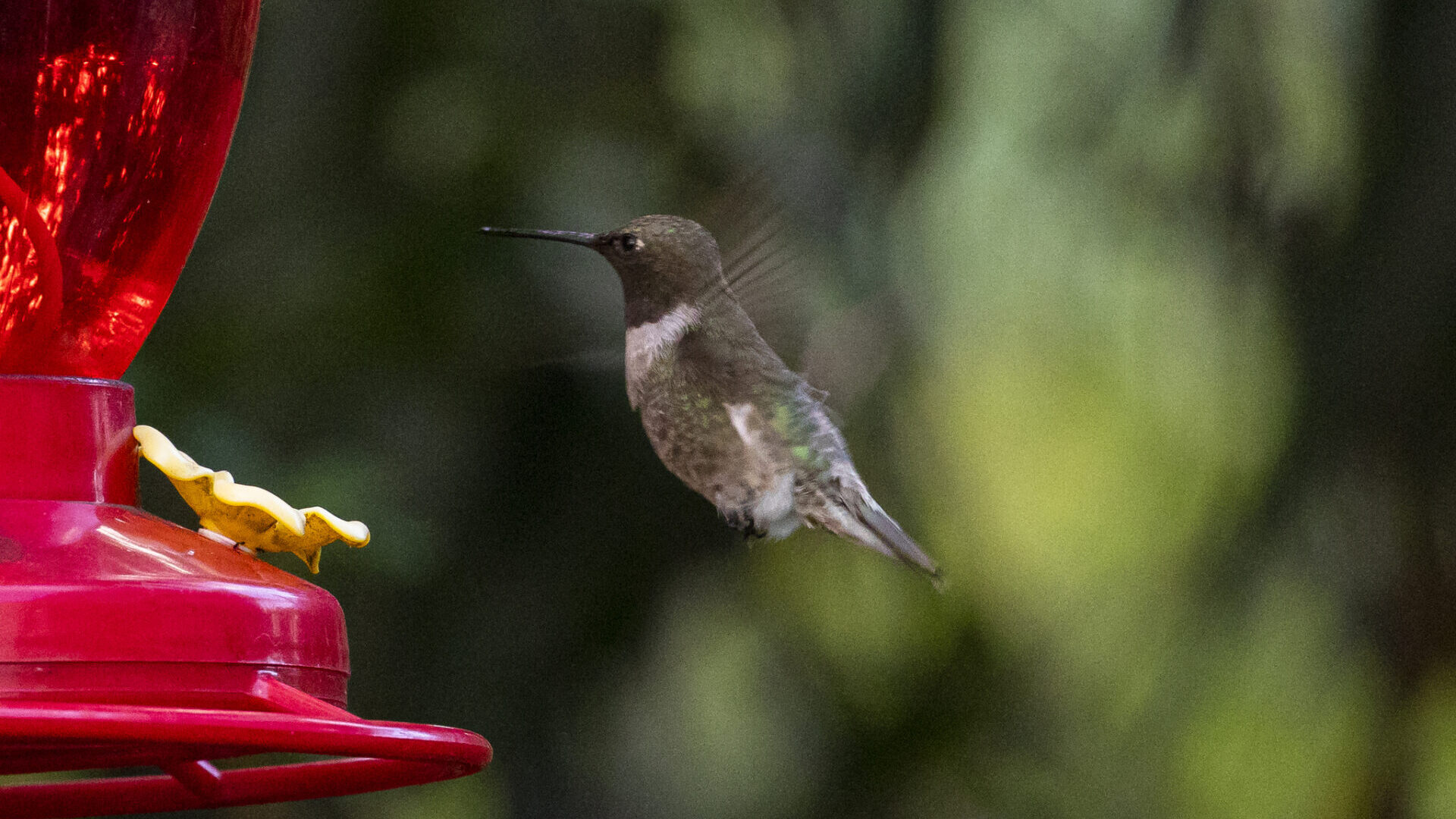
The Black-chinned Hummingbird is a study in elegant minimalism, measuring a mere 8-10 centimeters in length—smaller than many insects yet perfectly proportioned for its aerial lifestyle. Males display the species’ most striking feature: a brilliant iridescent black gorget (throat patch) that catches the light like polished obsidian, creating flashes of deep purple when the sun strikes it at the right angle. The body itself wears a coat of shimmering green on the back and crown, while the belly remains pale gray, creating a striking contrast that aids in identification.
Females, by contrast, adopt a more understated palette of green and gray, with a spotted throat that lacks the male’s dramatic gorget. This sexual dimorphism reflects the intense competition among males, where the bold black chin serves as a visual declaration of dominance and breeding readiness. Both sexes possess the characteristic long, needle-like bill perfectly designed for probing deep into flowers, and their wings beat at an astonishing 40-50 times per second—a frequency that produces the distinctive high-pitched whine that announces their presence before they’re even visible.
Notable feature: The male’s gorget appears black in most light but flashes brilliant purple-violet when viewed from certain angles, a phenomenon caused by the structural arrangement of feather barbs rather than pigmentation.
These hummingbirds are creatures of perpetual motion, their entire existence calibrated around the relentless demands of maintaining their hyperactive metabolism. A Black-chinned Hummingbird must consume approximately half its body weight in nectar daily—an equivalent to a human eating 150 hamburgers in a single day—simply to fuel the extraordinary energy demands of its lifestyle. They are fiercely territorial, with males establishing and defending feeding territories with aggressive displays and dive-bombing attacks that seem impossibly bold given their diminutive size.
The birds are primarily diurnal, most active during the warm daylight hours when flowers are open and insect prey is abundant. During cooler evenings or periods of food scarcity, they enter a state called torpor—a controlled hibernation-like condition where their metabolic rate drops dramatically and body temperature plummets, allowing them to survive the night without exhausting their energy reserves. Males are particularly aggressive during breeding season, performing elaborate courtship dives that reach speeds of 60 kilometers per hour, producing a loud chirp at the bottom of the dive through tail feather vibrations—nature’s own aerial performance art.
The Black-chinned Hummingbird claims the southwestern United States and Mexico as its primary domain, with breeding populations found from California and Nevada eastward to Texas, and southward through Mexico to Jalisco and Guerrero. These birds show remarkable adaptability, thriving in diverse habitats ranging from desert scrublands and chaparral to oak woodlands and urban gardens where flowering plants provide sustenance. They favor elevations between sea level and 2,500 meters, though they occasionally venture higher during migration periods.
These hummingbirds exhibit migratory behavior, with northern populations undertaking impressive journeys to wintering grounds in central Mexico. Recent observations document increasing records from unexpected locations, including the Pacific Northwest and even eastern North America, suggesting a gradual range expansion—possibly in response to climate change and the proliferation of hummingbird feeders maintained by enthusiastic birders. Spring arrivals typically occur in March and April in the United States, while fall migrations carry birds southward from August through October.
The Black-chinned Hummingbird is an obligate nectarivore, deriving the vast majority of its calories from flower nectar—a high-energy carbohydrate source that fuels its demanding lifestyle. However, nectar alone cannot sustain these birds; they must supplement their diet with small insects and spiders, particularly when breeding or during periods when flowers are scarce. This dual dietary strategy provides essential proteins and micronutrients unavailable in nectar alone.
Feeding highlights:
Their feeding behavior is remarkably efficient, with each bird developing intimate knowledge of its territory and the flowering phenology of plants within it. They demonstrate impressive memory, returning to previously visited flowers even after weeks away, and can estimate nectar production rates with astonishing accuracy.
Black-chinned Hummingbirds engage in a breeding system that prioritizes male competitive display over pair bonding. Males establish small breeding territories, performing spectacular courtship dives for females passing through their airspace. These dives reach velocities exceeding 60 kilometers per hour, with the male pulling up sharply at the bottom of the descent—a maneuver that produces the characteristic chirping sound through rapid tail feather vibrations. This acoustic display, combined with the visual spectacle of the iridescent gorget catching sunlight, represents one of nature’s most impressive courtship performances.
Females are the sole architects of reproduction, building tiny cup-shaped nests from plant down, spider silk, and lichen—structures no larger than a thimble that somehow accommodate two pea-sized eggs. Incubation lasts approximately 14-19 days, and fledglings remain in the nest for another 18-26 days before taking flight. Females may raise two or even three broods in a single breeding season, an exhausting reproductive effort that demands constant foraging to fuel both their own metabolism and the insatiable appetites of growing chicks.
Breeding note: Males play no role in nest building, incubation, or chick rearing—their sole reproductive contribution is the initial mating encounter, after which they return to defending their territory and attempting to mate with additional females.
The Black-chinned Hummingbird maintains a healthy population status, classified as Least Concern by the International Union for Conservation of Nature (IUCN). With an estimated population in the hundreds of thousands and a range that appears to be expanding rather than contracting, this species currently faces no immediate existential threats. Recent decades have witnessed increasing sightings in areas beyond their traditional range, suggesting that human-maintained hummingbird feeders and climate-driven range expansions may be benefiting the species.
However, like all hummingbirds, Black-chinned Hummingbirds remain vulnerable to habitat degradation, particularly the loss of native flowering plants to urban development and agricultural conversion. Climate change poses an emerging concern, potentially disrupting the delicate timing between hummingbird migrations and peak flower availability—a mismatch that could create energy crises for migrating birds. The widespread use of pesticides also threatens the insect populations these birds depend upon for breeding season protein.
Conservation outlook: The species’ adaptability to human-modified landscapes, including gardens and urban parks, provides a buffer against habitat loss. Continued protection of key breeding and wintering habitats, combined with public appreciation fostered by hummingbird feeders and wildlife observation, suggests a positive long-term outlook for this remarkable species.
Heartbeat extraordinary: A Black-chinned Hummingbird’s heart beats up to 500 times per minute at rest and can exceed 1,000 beats per minute during flight—a rate that would be instantly fatal for any other vertebrate.
Backwards flyer: These hummingbirds are the only birds capable of sustained backward flight, achieved through a figure-eight wing motion that generates lift on both forward and backward strokes.
Gorget illusion: The male’s black gorget isn’t actually black—it’s composed of iridescent feathers that appear black when light strikes them from most angles but flash brilliant purple-violet when viewed head-on, a trick of light that confuses predators and impresses females.
Memory champions: Black-chinned Hummingbirds possess extraordinary spatial memory, remembering the location of hundreds of flowers and the precise timing of nectar replenishment at each bloom.
Aerial acrobats: Males can pull up to 9 Gs during their courtship dives—a force that would render human fighter pilots unconscious—yet experience no apparent discomfort.
Torpor survival: During torpor, a hummingbird’s body temperature can plummet from 40°C to just 12°C, and its heart rate drops to a mere 36 beats per minute—a physiological state that borders on the miraculous.
Feeder pioneers: The explosive popularity of hummingbird feeders in North America over the past 50 years has coincided with significant range expansions and population increases in Black-chinned Hummingbirds, demonstrating how human intervention can occasionally benefit wildlife.
Baltosser, W. S., & Scott, P. (1996). “Costa’s Hummingbird (Calothorax costae).” In The Birds of North America, No. 251 (A. Poole and F. Gill, Eds.). Academy of Natural Sciences, Philadelphia.
International Union for Conservation of Nature (IUCN). (2023). Red List of Threatened Species. Retrieved from www.iucnredlist.org
Waltman, J. R., & Beissinger, S. R. (1992). “Breeding and Wintering Ranges of North American Hummingbirds.” Condor, 94(1), 126-138.
Ridgely, R. S., & Tudor, G. (1989). The Birds of South America: The Passerines. University of Texas Press.
Cornell Lab of Ornithology. (2023). All About Birds: Hummingbirds. Retrieved from www.allaboutbirds.org