Animals
| Kingdom | Animalia |
|---|---|
| Phylum | Arthropoda |
| Class | Diplopoda |
| Order | Polydesmida |
| Family | Polydesmidae |
| Genus | Utadesmus |
| Species | Utadesmus henriensis |
From the arid landscapes of Utah comes Utadesmus henriensis, a remarkable millipede that represents one of North America’s most enigmatic arthropods. This creature belongs to an ancient lineage of multi-legged invertebrates that have crawled across our planet for over 300 million years, yet remains largely unknown to the general public. With its intricate body structure and mysterious ecology, this species exemplifies the hidden wonders that thrive in the American Southwest’s rugged terrain.
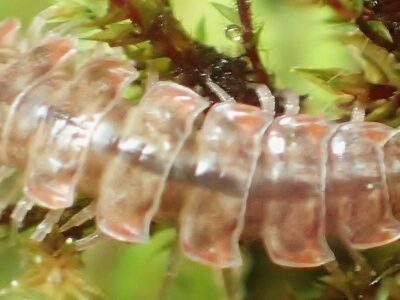
Utadesmus henriensis is a member of the family Polydesmidae, commonly known as flat-backed millipedes, a name that perfectly captures their most distinctive feature. Unlike their round-bodied relatives, these millipedes possess a characteristically flattened dorsal surface, giving them a sleek, streamlined appearance perfectly suited for navigating through leaf litter and soil crevices.
As a polydesmid millipede, U. henriensis exhibits the typical body structure of its family: a segmented exoskeleton composed of numerous body rings, each bearing two pairs of legs. The flattened body plan allows this creature to slip through impossibly tight spaces in the soil and beneath decomposing vegetation—a remarkable adaptation that makes it an expert at exploiting microhabitats unavailable to bulkier arthropods. The species displays the characteristic dark coloration common to many polydesmids, ranging from deep brown to nearly black, providing excellent camouflage in its native Utah habitat.
Key identification features include:
Notable feature: Like all polydesmids, this species possesses paranota—lateral extensions of the body segments that enhance their flattened appearance and provide additional protection.
Utadesmus henriensis leads a cryptic existence, spending most of its time hidden away in the complex world beneath the soil surface and within decomposing organic matter. This millipede is primarily a creature of darkness, emerging most actively during periods of high moisture when conditions favor activity and reduce water loss through their permeable exoskeleton.
The daily rhythm of this species is intimately tied to environmental moisture and temperature. During the hot, dry daylight hours of Utah’s climate, U. henriensis remains sequestered in humid refugia—deep within soil profiles, beneath logs, or within the protective embrace of leaf litter. As evening approaches and humidity rises, this industrious arthropod becomes active, methodically foraging through decomposing material with patient, deliberate movements.
Behavioral characteristics include:
Conservation note: The species’ cryptic nature means that documented observations remain extremely limited, making field studies challenging but scientifically invaluable.
Utadesmus henriensis is endemic to the southwestern United States, with confirmed records from Utah. The species appears to be associated with the unique ecological zones of the Colorado Plateau region, where it inhabits areas characterized by semi-arid conditions and specific soil compositions that provide suitable microhabitats for survival.
The known occurrence near the coordinates (38.1089°N, 110.814°W) places this species in a fascinating transition zone of Utah’s diverse topography. This region experiences dramatic seasonal variations, with hot, dry summers and cold winters, yet maintains pockets of moisture-rich microhabitats essential for millipede survival. The species likely inhabits elevations where woodland and desert ecosystems meet, exploiting the unique soil conditions and vegetation patterns found in these ecotonal areas. Understanding the full geographic range of U. henriensis remains an important research priority, as the single documented occurrence may represent only a fraction of its actual distribution.
As a member of the Polydesmidae family, Utadesmus henriensis is a detritivore—a crucial player in nature’s recycling system. This millipede feeds primarily on decomposing plant material, fallen leaves, decaying wood, and the rich fungal communities that colonize these substrates. By consuming dead organic matter, these millipedes break down complex plant structures and facilitate nutrient cycling, returning essential elements to the soil where they become available to living plants.
The feeding strategy of U. henriensis reflects an animal perfectly adapted to its ecological role:
This species’ role as a detritivore makes it an ecological engineer of considerable importance. By fragmenting and processing dead plant material, U. henriensis accelerates decomposition rates and enhances soil structure, benefiting the entire community of organisms that depend on healthy, nutrient-rich soil.
The reproductive biology of Utadesmus henriensis remains largely undocumented in scientific literature, reflecting the species’ cryptic nature and the challenges of studying underground invertebrates. Like other polydesmid millipedes, this species likely follows the general reproductive patterns characteristic of its family, involving complex courtship rituals and specialized reproductive structures.
Polydesmid millipedes are known for their elaborate mating systems. Males typically deposit spermatophores—packets of sperm—which females must locate and retrieve to fertilize their eggs. This process often involves chemical signaling, with males detecting female pheromones and responding with their own chemical advertisements. The courtship likely involves tactile interactions, with males using their specialized sensory antennae to communicate with receptive females.
Reproductive characteristics likely include:
Research gap: Direct observations of U. henriensis mating behavior would provide invaluable insights into this species’ life cycle and reproductive success factors.
Utadesmus henriensis presents a fascinating conservation puzzle. With only a single documented occurrence in scientific records, the species’ true population status, distribution extent, and conservation needs remain largely mysterious. This lack of data reflects not necessarily rarity, but rather the extreme difficulty in surveying cryptic soil-dwelling arthropods in remote Utah landscapes.
The species faces potential threats common to many invertebrates in the American Southwest:
Without comprehensive surveys and monitoring, determining appropriate conservation strategies remains challenging. The cryptic nature of this species means that it could be more common than current records suggest, or it could be genuinely rare and restricted to specific microhabitats. Future research priorities should include targeted surveys in suitable Utah habitats, documentation of habitat requirements, and assessment of threats to ensure this remarkable creature receives appropriate conservation attention. Conservation outlook: The species’ status as “Data Deficient” underscores the urgent need for field research to inform evidence-based conservation decisions.
Ancient lineage: Millipedes like U. henriensis represent an arthropod group that has existed for over 300 million years, surviving multiple mass extinction events and witnessing the rise and fall of dinosaurs.
Leg-counting challenge: Despite their common name, millipedes never actually have 1,000 legs—but polydesmids like U. henriensis can have over 200 legs, making them incredibly efficient underground travelers.
Chemical defense arsenal: When threatened, polydesmid millipedes like this species produce chemical secretions from specialized glands that can deter predators and even repel competing arthropods.
Soil architects: By fragmenting dead plant material, U. henriensis plays a crucial role in soil formation and structure development, making it an essential ecosystem engineer in its Utah habitat.
Cryptic specialists: The extreme rarity of documented observations reflects not the species’ actual abundance, but rather its extraordinary ability to remain hidden—a testament to millions of years of evolutionary refinement.
Moisture-dependent: This species must maintain careful water balance, as its permeable exoskeleton makes it vulnerable to desiccation—a challenge that shapes every aspect of its behavior and ecology.
Taxonomic significance: The species name “henriensis” reflects its geographic origin, while the genus Utadesmus represents a distinct lineage of North American polydesmid millipedes adapted to semi-arid conditions.
Chamberlin, R. V. (1930). “A checklist of the millipeds of North America north of Mexico.” Bulletin of the Museum of Comparative Zoology, 69(12): 1-236.
Hoffman, R. L. (1999). “Checklist of the millipeds of North and Middle America.” Virginia Museum of Natural History, Special Publication 8: 1-236.
GBIF (Global Biodiversity Information Facility). Utadesmus henriensis occurrence data. Retrieved from www.gbif.org
Shelley, R. M. (2003). “A synopsis of the North American millipeds of the family Polydesmidae (Polydesmida).” Virginia Museum of Natural History, Special Publication 11: 1-114.
iNaturalist. Utadesmus henriensis observations. Retrieved from www.inaturalist.org