Plants
| Kingdom | Plantae |
|---|---|
| Phylum | Bryophyta |
| Class | Bryopsida |
| Order | Splachnales |
| Family | Splachnaceae |
| Genus | Splachnum |
| Species | Splachnum luteum |
What if you could witness nature’s most audacious strategy for reproduction—a moss so specialized it has abandoned the conventional world to thrive exclusively on animal droppings? Splachnum luteum, commonly known as yellow moosedung moss, is one of the bryophyte world’s most extraordinary innovations. This tiny moss has evolved an intricate partnership with flies, complete with fake flowers and deceptive scents, to ensure its survival in one of nature’s most unlikely habitats. Found across the boreal forests and tundra regions of the Northern Hemisphere, from Scandinavia to Alaska, this diminutive plant tells a story of ecological specialization that borders on the impossible.
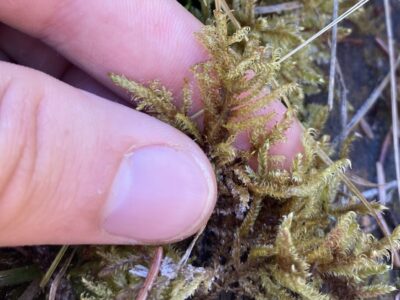
The vibrant yellow-green coloration and distinctive umbrella-shaped capsules make it a sight to behold. The gametophyte—the leafy, photosynthetic portion—grows in small tufts, typically reaching only a few centimeters tall. Leaves are somewhat crowded at stem apices, oblong-obovate, 5–6 mm, with margins bluntly serrate to subentire distally and apex slender-acuminate.
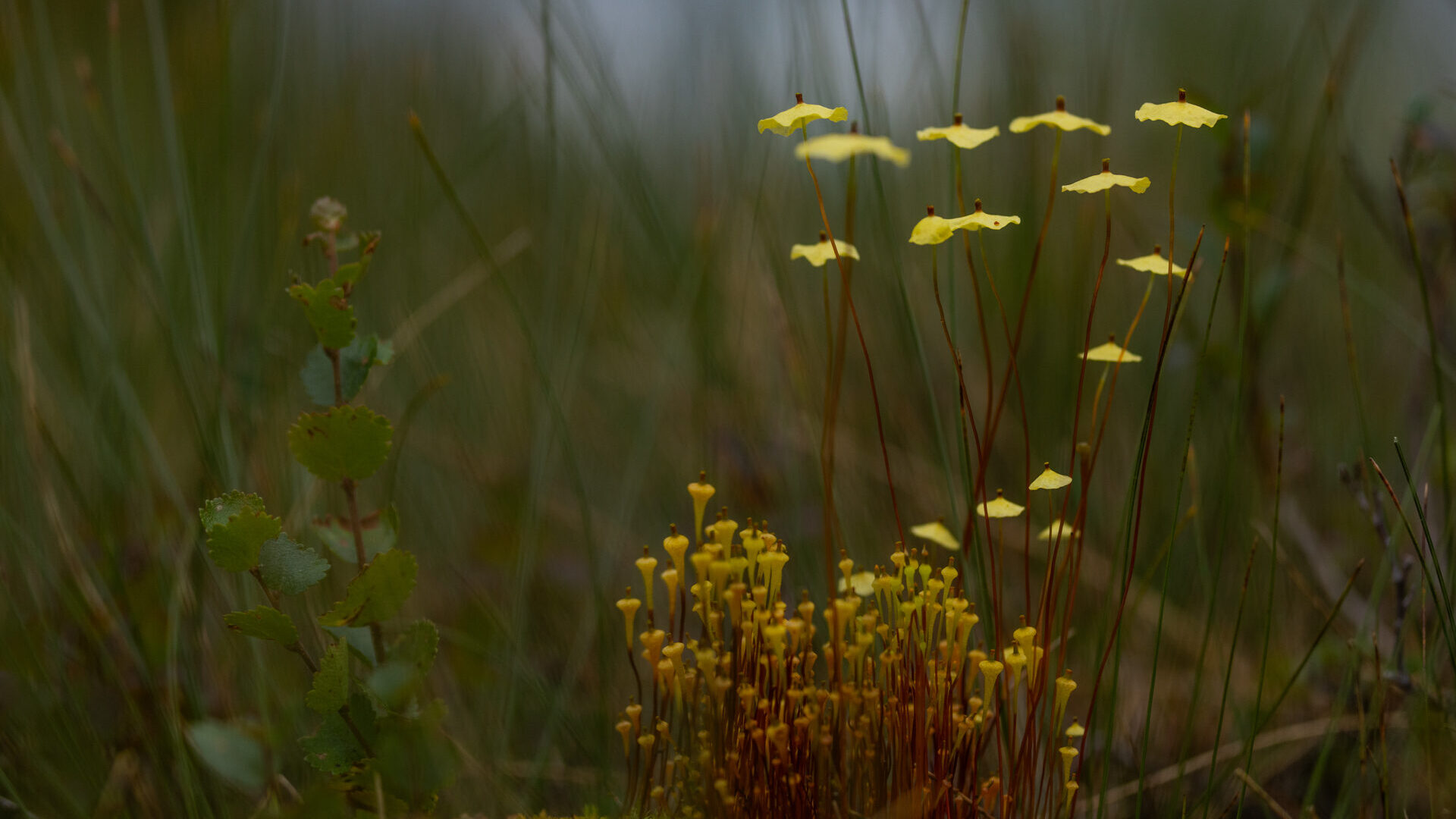
The true marvel lies in the sporophyte, the reproductive structure that emerges from the gametophyte like an improbable flower. The seta ranges from greenish yellow to orange-red, 2–15.5 cm long and slightly twisted, topped with an orange-brown capsule urn (1–1.5 mm) and a bright yellow, discoid-umbrelliform hypophysis that is much wider than the urn. The bright yellow hypophysis on long seta gives this moss the appearance of a flower. Spores are subspheric, 7–9 µm, and yellow-green.
Notable adaptation: The hypophysis serves as both a visual lure and scent-producing organ—a dual deception that would make any predatory flower jealous.
Splachnum luteum exhibits a life cycle unlike most mosses, with growth intimately tied to its extraordinary ecological niche. The moss begins its life when spores germinate on fresh herbivore droppings, particularly those of moose and other large boreal mammals. Capsules mature in spring–summer. Growth is relatively rapid during the warm months when suitable substrate is available, but the moss faces a critical challenge: its habitat is temporary and unpredictable.
Growth of Splachnum occurs primarily via asexual reproduction, spreading through spores released from their sporophytes. The gametophyte stage can reach modest heights—typically 1–3 centimeters—before producing its remarkable sporophyte. Once established on dung, the moss works to break down organic matter while simultaneously preparing its spores for dispersal. The entire lifecycle is a race against time, as the nutrient-rich substrate gradually decomposes and becomes unsuitable for growth.
From boreal forests to alpine meadows, Splachnum luteum can be found in areas rich in decaying organic matter, particularly those associated with animal dung or carcasses. The species has a circumpolar distribution across the Northern Hemisphere, with records from Norway, Sweden, Finland, Canada, Alaska, and Russia. Its range closely follows the distribution of moose and other large herbivores in subarctic and boreal regions.
The moss grows on dung of large boreal herbivores (such as moose), muskeg, and boggy habitats at low to high elevations. The moss’s tolerance for high levels of ammonia and other compounds found in decaying matter allows it to flourish in environments that would be inhospitable to many other plant species. This specialization is so extreme that species in the genus Splachnum grow exclusively in herbivore dung, and yellow moosedung moss is also confined to bogs.
Key habitat characteristics:
The reproductive strategy of Splachnum luteum is nothing short of botanical deception. All Splachnum species are entomophilous—a pollination strategy in which pollen or spores are distributed by insects—and they attract the flies by emitting scents that only flies can love from an area on the capsule of the sporophyte called the apophysis. This area is often enlarged and brightly colored in yellow, magenta, or red, giving it a flower-like appearance which acts as a visual attractant.
Yellow moosedung moss attracts the blue bottle fly (Calliphora vomitoria) with the seductive double whammy of odor from a butyl compound and the bright yellow color of its spore cap. When a fly visits these plants, the spores adhere to its body in clumps, and the fly then moves on to its substrate of choice to lay its eggs, where the spores are deposited and will then germinate and grow into new moss plants. The apophysis is believed to attract insects through its vibrant colors and enticing scents, aiding in spore dispersal and ensuring the continuation of this remarkable species.
Ecological insight: In the boreal forests of Scandinavia, the moss plays a crucial role in the decomposition of reindeer and caribou dung, facilitating the release of nutrients back into the ecosystem and supporting the growth of other plant species.
While Splachnum luteum has no significant economic or medicinal applications, its ecological importance is profound. The moss plays a vital role in nutrient cycling and decomposition processes, with its ability to colonize and thrive on dung and carcasses facilitated by specialized adaptations. For bryologists and naturalists, the moss represents a window into the hidden complexity of boreal ecosystems and the remarkable evolutionary innovations that drive survival in extreme niches.
Cultivation in captivity is virtually impossible due to the moss’s absolute requirement for fresh herbivore dung. However, researchers studying decomposition, nutrient cycling, and insect-plant interactions have found this species invaluable for understanding how specialized organisms function within their ecosystems. Moose droppings contain about 2.5 percent nitrogen, which is more nitrogen than cow dung, and nitrogen is an important element for plants as it is a component of chlorophyll essential to photosynthesis, while water is also contained as moisture within moose scat.
The ultimate specialist: Splachnum luteum has abandoned life as a “normal” moss and evolved to grow exclusively on moose and other large herbivore droppings—a strategy so specialized that it borders on biological recklessness.
A moss that mimics flowers: The bright yellow, umbrella-shaped hypophysis is so flower-like that early botanists were confused by its appearance, yet it serves no pollination purpose—instead, it’s a deceptive lure for flies.
Chemical deception: The moss emits compounds that mimic the smell of decomposing dung, specifically butyl compounds that trigger the feeding and egg-laying behavior of blow flies, creating one of nature’s most elaborate chemical hoaxes.
Spore hitchhikers: When a fly lands on the moss to lay eggs, sticky spore masses adhere to its body. The fly then carries these spores to the next pile of droppings, completing an extraordinary dispersal cycle that depends entirely on insect behavior.
Ancient origins: Bryophytes like Splachnum luteum are part of an ancient lineage that has existed for over 450 million years, making them among the oldest land plants on Earth.
Nitrogen-powered growth: Herbivore dung is extraordinarily nutrient-rich, containing concentrated nitrogen that allows the moss to grow rapidly during the brief window before the substrate decomposes and becomes unsuitable.
Circumpolar wanderer: This moss thrives across an enormous range spanning from Scandinavia to Alaska, wherever boreal herbivores roam, making it one of the most geographically distributed specialized mosses in the world.