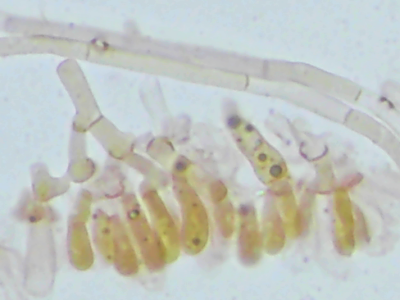
Fungi
| Kingdom | Fungi |
|---|---|
| Phylum | Basidiomycota |
| Class | Agaricomycetes |
| Order | Polyporales |
| Family | Meruliaceae |
| Genus | Phlebia |
| Species | Phlebia coccineofulva |
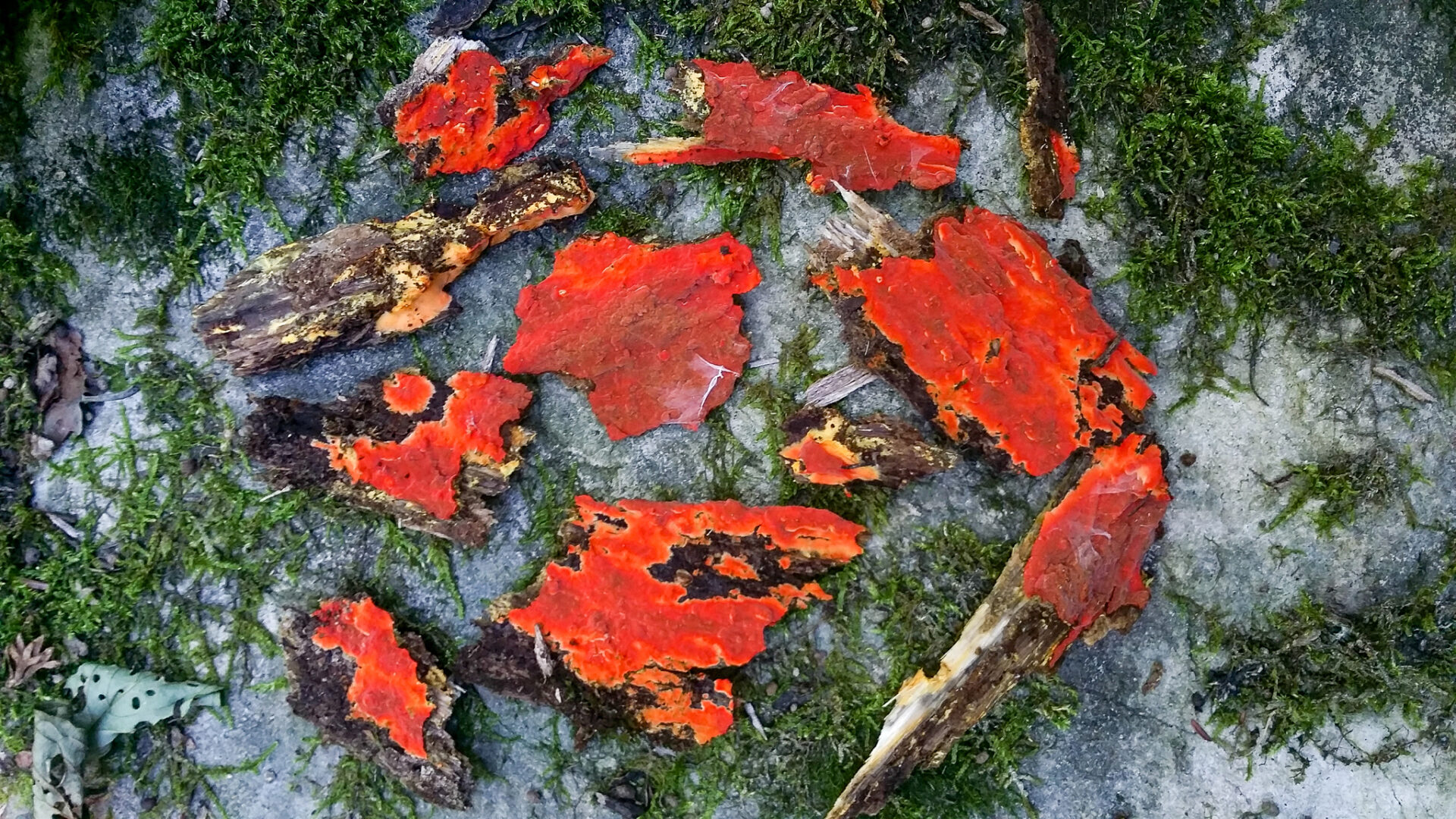
Phlebia coccineofulva reveals itself as one of nature’s most vibrant wood-decay specialists, a brilliant crimson-to-orange fungus that transforms dead timber into living art. This remarkable basidiomycete belongs to the Meruliaceae family, a group of fungi distinguished by their intricate poroid or ridged undersurfaces rather than true gills. Found across temperate forests from North America to Scandinavia and Japan, this species stands as a testament to the hidden beauty of fungal decomposition.
Spotting Phlebia coccineofulva in the field feels like discovering a precious gem hidden within the forest. The fruiting bodies display a striking range of colors—brilliant scarlet, vivid orange-red, and warm russet tones that seem to glow against weathered wood. The surface texture varies from smooth to slightly wrinkled, creating a delicate, almost velvety appearance that invites closer inspection.
The underside reveals the fungus’s most distinctive feature: a hymenium of fine ridges or shallow pores rather than true gills, a characteristic that distinguishes it from many similar species. These ridges are typically the same vibrant color as the cap surface, sometimes with subtle yellow or orange margins. The fruiting bodies are typically small to medium-sized, forming thin, shelf-like or bracket-like structures, often in overlapping clusters that create stunning geometric patterns across rotting wood.
Identification tips:
The journey of Phlebia coccineofulva begins long before its colorful fruiting bodies appear. The vegetative mycelium colonizes dead hardwood and softwood substrates, working invisibly through the wood fibers, breaking down complex polymers and gradually transforming solid timber into crumbly, nutrient-rich material. This patient decomposition can take months or even years before conditions align for fruiting.
Fruiting occurs when moisture levels rise and temperatures moderate—typically during autumn and spring when rainfall saturates the forest floor. The fungus responds rapidly to these conditions, pushing forth its brilliant fruiting bodies in waves. A single log or branch can produce multiple flushes of fruiting bodies throughout the season, each generation releasing countless microscopic spores into the damp air to colonize new wood sources.
The fruiting bodies themselves are ephemeral structures, persisting for weeks to a few months before decomposing back into the wood. Yet their biological mission is already complete—by then, millions of spores have dispersed, carried on air currents and water droplets to begin new colonies elsewhere in the forest.
Phlebia coccineofulva is a citizen of temperate woodlands across the Northern Hemisphere. Its range spans from the eastern and central United States and Canada through Scandinavia, with populations documented in Sweden, Norway, Estonia, and the Russian Federation. Remarkably, this fungus has also established itself in Japan and Taiwan, suggesting either ancient dispersal patterns or more recent human-mediated transport of infested wood.
This species is a wood specialist, fruiting exclusively on dead hardwoods and occasionally on softwoods in advanced stages of decay. It thrives in moist forest environments where fallen logs and branches accumulate—old-growth forests, mixed deciduous woodlands, and areas with substantial deadwood. The fungus appears indifferent to wood species, colonizing oak, maple, birch, and countless other trees with equal enthusiasm. It prefers wood that has already been partially colonized by other decay fungi, often appearing as a secondary colonizer in the later stages of decomposition when the wood has softened considerably.
Phlebia coccineofulva is a crucial architect of forest nutrient cycling, one of the essential decomposers that transforms dead wood back into soil. By breaking down cellulose and lignin—the toughest polymers in nature—this fungus liberates locked-away nutrients, making them available to plants, bacteria, and countless other organisms. Without fungi like this species, forests would choke under their own fallen timber, and nutrient cycles would grind to a halt.
Beyond its role as a decomposer, Phlebia coccineofulva creates microhabitats that support entire communities of organisms. The crumbly, decayed wood it produces becomes home to beetles, mites, springtails, and other arthropods. These creatures, in turn, become food for salamanders, birds, and mammals. The fungus essentially transforms a piece of dead wood into a miniature ecosystem, demonstrating how decomposition is not an ending but a transformation—a beautiful recycling of life itself.
Edibility status: Inedible. While Phlebia coccineofulva is not poisonous, it offers no culinary value. The fruiting bodies are far too thin and delicate to harvest meaningfully, and the texture and flavor hold no appeal to mushroom foragers. This fungus is best appreciated for what it does—its ecological work—rather than for any human consumption.
In traditional mycology and fungal ecology, Phlebia coccineofulva holds significance as a model organism for studying wood decay and decomposition processes. Its brilliant coloration and reliable fruiting patterns make it a favorite for teaching mycology students about fungal identification and ecological roles. Researchers have studied this species to understand how fungi break down woody substrates and how decomposition rates vary across different wood types and environmental conditions.
The fungus has no known medicinal properties or traditional uses in folk medicine. Its true value lies in its ecological services—the invisible work it performs day after day, year after year, maintaining the health and function of forest ecosystems across the globe.
A color-changing decomposer: The brilliant scarlet fruiting bodies of Phlebia coccineofulva fade over time, gradually becoming paler and more orange-yellow as they age—a visual record of the fungus’s life cycle written in pigment.
Globally distributed but locally common: With over 730 recorded occurrences documented across North America, Scandinavia, and Asia, this fungus demonstrates the remarkable ability of wood-decay fungi to establish populations wherever suitable dead wood accumulates.
A secondary colonizer’s strategy: Phlebia coccineofulva rarely arrives first at freshly fallen wood; instead, it waits for other fungi to soften the substrate before making its appearance—a patient ecological strategy that reduces competition.
Microscopic spore clouds: A single fruiting body releases millions of spores, creating invisible clouds of genetic material that drift through autumn forests, capable of traveling hundreds of meters on wind currents.
Wood-type generalist: Unlike some wood-decay fungi that specialize in specific tree species, Phlebia coccineofulva colonizes an impressive array of hardwoods and softwoods, making it one of the forest’s most adaptable decomposers.
Rapid response fruiter: Under ideal conditions of moisture and temperature, this fungus can produce fruiting bodies within days of colonizing suitable substrate—a rapid-response strategy that maximizes spore dispersal opportunities.
Ancient lineage: The Meruliaceae family to which this fungus belongs dates back millions of years, making Phlebia coccineofulva a representative of an ancient fungal lineage that has been decomposing wood since before humans walked the Earth.