
Plants
Pireella pohlii is a moss that thrives in the humid tropics and subtropics of the Americas, from Florida to Paraguay. This delicate bryophyte inhabits the bark of living trees in moist forests, where it forms intricate green carpets that glisten with moisture. Though small and easily overlooked, this species plays a vital ecological role in maintaining the health and biodiversity of forest canopies across the Western Hemisphere.
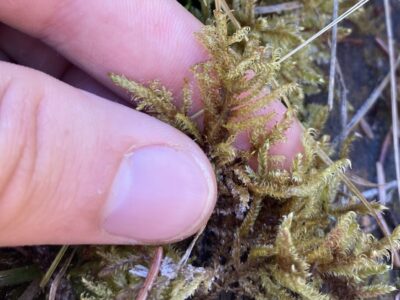
Pireella pohlii is a moss belonging to the family Pterobryaceae, characterized by its feathery, pinnate branching pattern that distinguishes it from many other bryophytes. The stems are slender and delicate, bearing small leaves arranged in two rows along the main axis, with additional leaves on lateral branches creating a fern-like appearance.
The leaves are narrow and lance-shaped, typically less than 2 millimeters in length, with a distinctive costa (central vein) that extends partway up the leaf blade. Under magnification, the cell structure reveals elongated cells that help the moss absorb and retain moisture from the humid air. The color ranges from bright green in actively growing specimens to yellowish-green in drier conditions.
When fertile, Pireella pohlii produces sporophytes—the spore-bearing structures characteristic of mosses. These small capsules develop at the tips of specialized branches, releasing thousands of microscopic spores into the air. The overall delicate structure makes this moss particularly sensitive to environmental changes and an excellent indicator of air quality and humidity levels in forest ecosystems.
Pireella pohlii follows the typical moss life cycle, alternating between two distinct generations: the gametophyte (the visible green moss) and the sporophyte (the spore-producing structure). The gametophyte dominates the visible plant body and can persist for many years in suitable conditions. Growth occurs slowly but steadily, with new shoots emerging from the base and lateral branches extending outward.
This moss grows as an epiphyte, establishing itself on the bark of living trees where moisture and organic matter accumulate. It thrives in conditions of high humidity and moderate shade, making tropical and subtropical forests ideal habitats. The species shows remarkable resilience, capable of drying out completely during dry seasons and reviving rapidly when moisture returns—a survival strategy called desiccation tolerance.
The moss requires consistent moisture for active growth and reproduction. In its native range, seasonal rainfall patterns trigger periods of rapid growth and sporulation. The ability to survive in small crevices and on rough bark allows Pireella pohlii to colonize microhabitats that larger plants cannot access, making it an important pioneer species in forest canopy communities.
Pireella pohlii displays a wide distribution across the Americas, with documented occurrences spanning from the southeastern United States through Central America and into South America. Records indicate the species is present in:
The species shows a strong preference for humid, tropical, and subtropical forest environments. It typically colonizes the bark of shade-tolerant trees in primary and secondary forests, particularly in areas with high rainfall and consistent moisture. The moss thrives at various elevations, from lowland rainforests near sea level to montane cloud forests at higher altitudes. It demonstrates particular affinity for areas with stable humidity and minimal direct sunlight, making it common in the understory and mid-canopy zones of intact forest ecosystems.
As a moss, Pireella pohlii does not produce flowers in the traditional sense, but rather reproduces through spores released from specialized structures called sporangia. The gametophyte produces both male and female reproductive organs on the same plant (monoecious) or on different plants (dioecious). When moisture is abundant, flagellate sperm swim through water films on the moss surface to fertilize eggs, initiating the development of sporophytes.
The sporophytes develop over several weeks to months, eventually releasing millions of microscopic spores into the air. These lightweight spores are carried by wind currents over considerable distances, allowing the species to colonize new substrates and maintain genetic exchange among distant populations. The timing of sporulation is closely tied to seasonal rainfall patterns, with maximum spore release typically occurring during or shortly after the wettest months. This reproductive strategy, refined over millions of years of evolution, enables Pireella pohlii to persist and thrive across its broad geographic range.
While Pireella pohlii lacks direct commercial or medicinal applications, its ecological significance is profound. The moss plays a crucial role in forest canopy ecosystems by:
For bryophyte enthusiasts and moss gardeners, Pireella pohlii can be cultivated in controlled conditions that mimic its natural habitat. The species thrives in terrariums or moss gardens maintained at high humidity with indirect light and moist growing media. Cultivation requires patience and attention to moisture levels, as the delicate fronds are easily damaged by excessive disturbance or drying.
Ancient lineage: Mosses like Pireella pohlii are among Earth’s oldest land plants, with fossil evidence suggesting bryophytes colonized terrestrial environments over 450 million years ago—long before flowering plants evolved.
Tiny but mighty: Despite its microscopic spores, this moss can spread across entire forests. A single sporophyte can release over 4 million spores, each capable of germinating and establishing new colonies under favorable conditions.
Water wizards: Pireella pohlii lacks true roots and instead absorbs water and nutrients directly through its leaf cells. This adaptation allows it to thrive on tree bark where soil is unavailable, creating entire ecosystems in the forest canopy.
Living air filters: The dense mats of moss actively capture airborne particles, dust, and pollutants, making them excellent natural air purifiers. Bryophytes are so effective at this that scientists use them to monitor air quality in environmental studies.
Resurrection moss: When conditions become dry, Pireella pohlii can lose up to 95% of its water content and enter a dormant state, yet revive completely within hours of rewetting—a remarkable survival strategy.
Canopy architects: By accumulating organic matter and creating moist microhabitats, epiphytic mosses like Pireella pohlii support entire communities of plants, fungi, and animals that would not exist without them.
Climate sentinels: The presence and abundance of Pireella pohlii and related species serve as reliable indicators of forest health, humidity stability, and the integrity of tropical ecosystems.