Fungi

| Kingdom | Fungi |
|---|---|
| Phylum | Basidiomycota |
| Class | Agaricomycetes |
| Order | Agaricales |
| Family | Physalacriaceae |
| Genus | Armillaria |
| Species | Armillaria mellea |
Picture this: deep in a forest, a mycelial network sprawls silently beneath the soil—sometimes covering acres, sometimes spanning miles—waiting to transform dead wood into nourishment and life. Armillaria mellea, the honey fungus, is one of nature’s most paradoxical organisms: a culinary delicacy in European kitchens, a devastating forest pathogen, and a bioluminescent wonder that glows faintly in the dark. This remarkable basidiomycete bridges the gap between predator and scavenger, simultaneously weakening living trees and recycling the forest’s dead wood into fertile soil.
The mushroom’s cap spans 3 to 15 centimeters in diameter, convex when young but flattening with age, often developing a central raised umbo that may later become dish-shaped. The cap margins often arch at maturity and the surface becomes sticky when wet. Though typically honey-colored, this fungus is rather variable in appearance and sometimes displays a few dark, hairy scales near the centre.
Identifying this fungus requires attention to several key features:
Identification tip: The spore print of honey fungus is white to pale cream, while the deadly galerina’s spore print is rusty brown. This distinction alone can save your life when foraging.
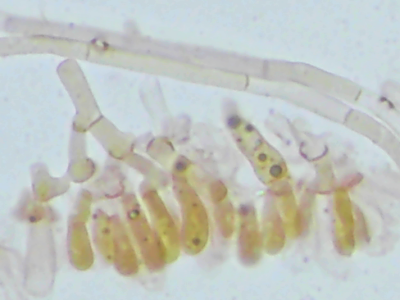
The true marvel of Armillaria mellea lies beneath the forest floor. The main part of the fungus is underground where a mat of mycelial threads may extend for great distances, bundled together in rhizomorphs that are black in this species. Individual rhizomorphs are typically 2 millimeters across, but sometimes they bunch up and form more substantial threads up to 5 centimeters in diameter. These “bootlace” structures are not merely transport highways—they are weapons of conquest, capable of penetrating soil and wood to seek new hosts.
Armillaria mellea infects both through basidiospore and penetration of host species by rhizomorphs which can grow up to 1 meter long per year to find new, living tissue to infect. However, infection of living host tissue through basidiospores is quite rare; two basidiospores must germinate and fuse to be viable and produce mycelium. In the late summer and autumn, Armillaria mellea produces mushrooms with notched gills, a ring near the cap base, and a white to golden color. They do not always appear, but when they do they can be found on both living and dead trees near the ground. These mushrooms produce and release the sexually created basidiospore which is dispersed by the wind.
A bioluminescent secret lies hidden in the mycelium itself. The mycelium is capable of producing light via bioluminescence, though the fungal body is not bioluminescent but its mycelia are luminous when in active growth. This ghostly glow, invisible to the human eye in most forest conditions, represents one of fungi’s most ancient and mysterious adaptations.
Armillaria mellea is widespread in northern temperate zones. It has been found throughout North America, and in Europe and northern Asia. It has been introduced to South Africa. The distribution data shows this fungus thriving across diverse landscapes—from California’s redwood forests to the woodlands of Eastern Europe, from Canadian temperate zones to the Mediterranean.
It grows parasitically on a large number of broadleaf trees. It fruits in dense clusters at the base of trunks or stumps. Armillaria mellea prefers moist soil and lower soil temperatures but it can also withstand extreme temperatures, such as forest fires, due to the protection of the soil. This resilience explains its success as an invasive species—it thrives where other fungi perish.
It is a plant pathogen and part of a cryptic species complex of closely related and morphologically similar species. It causes Armillaria root rot in many plant species and produces mushrooms around the base of trees it has infected. The symptoms of infection appear in the crowns of infected trees as discoloured foliage, reduced growth, dieback of the branches and death.
Yet this pathogen plays a crucial role in forest ecology. Honey fungus is a white-rot fungus, which is a pathogenic organism that affects trees, shrubs, woody climbers and rarely, woody herbaceous perennial plants. Honey fungus can grow on living, decaying, and also dead plant material (being a facultative saprophyte). This means it can kill its host with little consequence, unlike parasites that must moderate their growth to avoid host death. In essence, Armillaria mellea is a forest’s cleanup crew—breaking down wood, recycling nutrients, and preparing the landscape for new growth.
Armillaria mellea is an edible basidiomycete fungus in the genus Armillaria. However, its edibility comes with important caveats. Honey fungus are regarded in Ukraine, Russia, Poland, Germany and other European countries as one of the best wild mushrooms. They are commonly ranked above morels and chanterelles and only the cep/porcini is more highly prized. However, honey fungus must be thoroughly cooked as they are mildly poisonous raw.
Armillaria mellea is considered a good edible mushroom, but is not preferred by some, and the tough stalks are usually excluded. They are best collected when young and thoroughly cooked. The mushrooms have a taste that has been described as slightly sweet and nutty, with a texture ranging from chewy to crunchy, depending on the method of preparation. Parboiling mushrooms before consuming removes the bitter taste present in some specimens and may reduce the amount of gastrointestinal irritants.
Edibility warning: Specimens such as those growing on buckeye or hemlock can cause gastrointestinal upset. Honey mushrooms are one of four UK species that can cause sickness when ingested with alcohol. For those unfamiliar with the species, it is advisable not to drink alcohol for 12 hours before and 24 hours after eating this mushroom to avoid any possible nausea and vomiting. This fungus is not considered deadly poisonous but is classified as conditionally edible, meaning its consumption carries risks and requires specific handling. Species within this complex possess compounds that act as gastrointestinal irritants, which must be neutralized before consumption. These irritants are the reason many people experience unpleasant reactions when the mushrooms are not prepared correctly.
The mycelium is capable of producing light via bioluminescence—making honey fungus one of the few fungi that literally glows in the dark, a phenomenon still not fully understood by mycologists.
When growing through soil, these rhizomorphs are capable of linking the Honey Fungus mycelium in an infected tree to a new host tree several metres away. (Rhizomorphs up to nine metres in length have been recorded.) This makes honey fungus a master of long-distance conquest.
Armillaria mellea infects both through basidiospore and penetration of host species by rhizomorphs which can grow up to 1 meter (39 in) long per year to find new, living tissue to infect. However, infection of living host tissue through basidiospores is quite rare. The fungus has evolved to rely on physical invasion rather than chance spore colonization.
A 2001 study showed that Entoloma abortivum can parasitize Armillaria mellea, creating bizarre malformed fruiting bodies called carpophoroids—a reminder that even predatory fungi can become prey.
Some colonies span several miles in diameter, making certain honey fungus colonies among the largest living organisms on Earth.
Although all Armillaria species were for many years generally considered edible when thoroughly cooked, members of the honey fungus group that occur on hardwoods are considered by some to be suspect, as cases of poisoning have been linked to eating these fungi. This explains why European foragers revere it while some North American sources recommend caution.