Fungi
| Kingdom | Fungi |
|---|---|
| Phylum | Basidiomycota |
| Class | Agaricomycetes |
| Order | Hymenochaetales |
| Family | Hymenochaetaceae |
| Genus | Coltricia |
| Species | Coltricia montagnei |
Coltricia montagnei stands as one of the most unusual polypores in North American forests—a fungus that defies classification and rewards careful observation with a truly astonishing discovery. This uncommon bracket fungus transforms our understanding of how polypores grow, revealing that the line between pores and gills is far more blurred than mycologists once believed. Found scattered across eastern North America from Canada to the Carolinas, and surprisingly extending to Japan, Mexico, and France, this fungus harbors a secret that only becomes apparent when you flip it over.
Coltricia montagnei forms hoof-shaped to semicircular brackets with a velvety to hairy upper surface and pores on the underside. The cap typically spans 5-10 centimeters, displaying hairy brown, rust-brown or yellow-brown coloration with distinctive concentric zones that catch the light beautifully. The texture is remarkably tough and resilient—a quality that becomes apparent as you handle specimens.
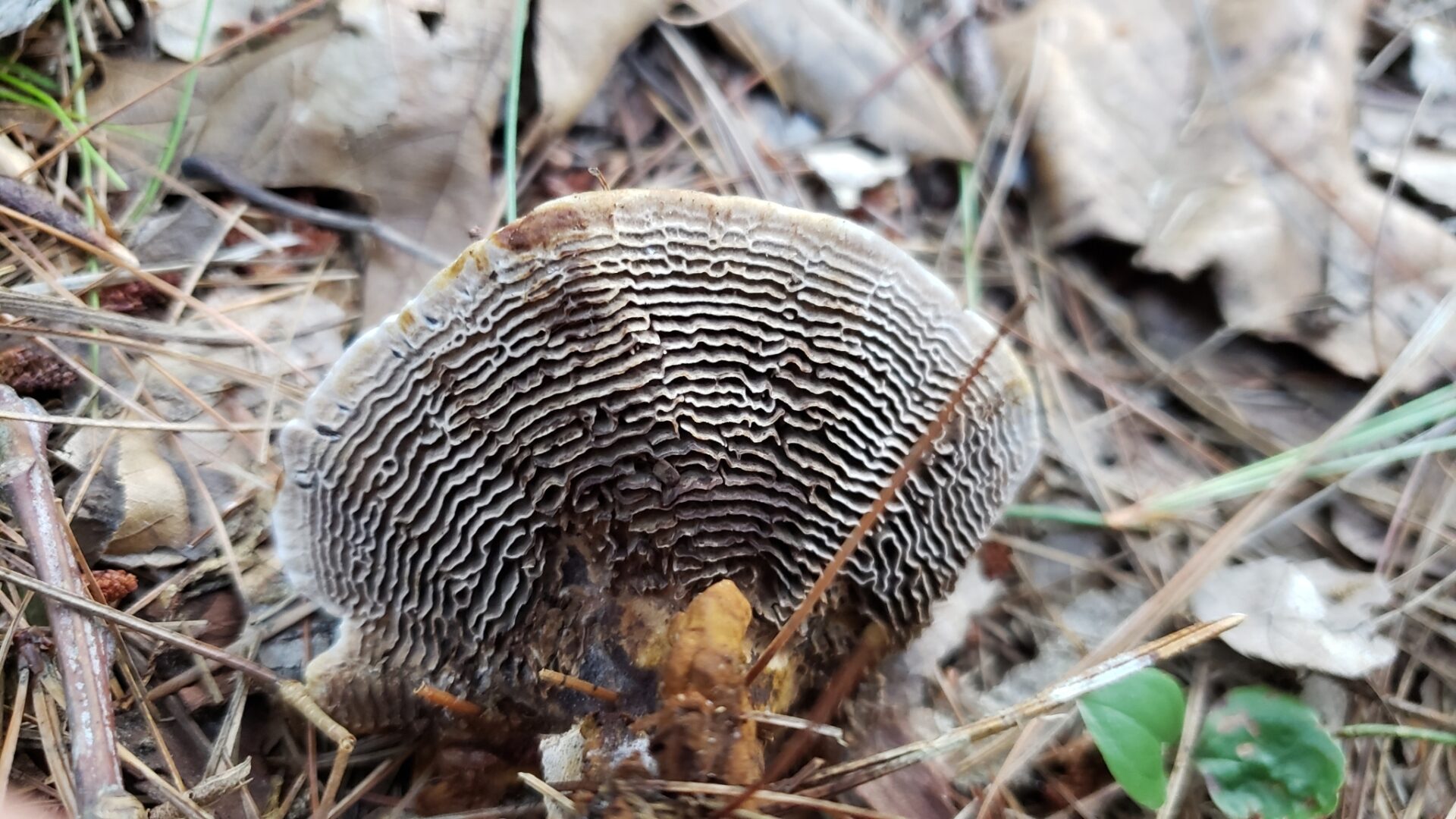
Identification tip: The magic lies beneath. When flipped over, the mushroom reveals fascinating concentric gills (officially termed “cyclomycoid tubes”) that are quite a surprise. Unlike typical polypores where pores radiate outward from the stem, the pores break up into concentric plate-like structures, giving the impression of gills which run around the stipe instead of radiating from the stipe to the edge of the cap. The spore print is light brown.
The species exhibits an annual to biennial growth habit, meaning individual fruiting bodies persist for one to two growing seasons. This longevity sets it apart from many ephemeral fungi, allowing the mushroom to produce spores across an extended period. The mycelium works patiently beneath the forest floor, breaking down woody material and building the structural networks that will eventually push fruiting bodies upward.
The growth strategy of Coltricia montagnei emphasizes toughness over speed. Rather than producing soft, quickly decomposable fruiting bodies, this fungus invests energy in creating dense, resilient structures that resist weathering and insect damage. This toughness serves a purpose—it extends the fruiting season and ensures spore dispersal across multiple seasons. The fungus fruits primarily in summer and autumn, when moisture levels in the forest floor remain adequate for mycelial activity.
In East and Central Texas, Coltricia montagnei typically grows on deciduous trees, particularly oak and elm, often in clusters or solitary individuals, and can be found in areas with rich soil and adequate moisture, such as along streams and rivers. The fungus shows a preference for hardwood ecosystems, though it sometimes grows under conifers.
This species displays a broad geographic range, with observations documented across the United States (particularly concentrated in the Appalachian region), Canada, Japan, Mexico, and France. The eastern North American distribution suggests a preference for temperate forests with adequate summer rainfall. It is found solitary or in groups, sometimes fused, on ground under hardwoods or in mixed woods.
As a wood-decay fungus, Coltricia montagnei serves as a crucial decomposer in forest ecosystems. The fungus colonizes fallen branches, buried wood, and soil-embedded timber, slowly breaking down cellulose and lignin—the structural molecules that give wood its strength. This decomposition process releases nutrients locked within dead wood, making them available to living plants and other organisms. Without fungi like this, forests would accumulate impassable layers of dead wood, and nutrient cycling would grind to a halt.
The ecological relationships surrounding this fungus extend beyond simple decomposition. The tough fruiting bodies themselves become microhabitats for other organisms. Insects, mites, and smaller fungi colonize the pores and flesh of mature specimens, creating miniature ecosystems within the mushroom itself. The spores, dispersed by wind and water, drift through the forest, establishing new mycelial networks wherever suitable woody substrates exist. In this way, Coltricia montagnei becomes a vector for fungal diversity and a keystone organism in woodland nutrient cycles.
Edibility warning: Coltricia montagnei is inedible. The tough, woody texture and lack of culinary appeal make this fungus unsuitable for consumption. Like most polypores in the Hymenochaetaceae family, it contains compounds that render it unpalatable and potentially harmful if ingested. The fungus is best appreciated for its ecological role and its remarkable morphology rather than as a food source.
The fungus holds no known medicinal applications, though the Hymenochaetaceae family includes some species with traditional uses in Asian medicine. Coltricia montagnei itself remains unstudied in this regard. Its true value lies in its function as a decomposer and its role in maintaining healthy forest ecosystems. Mycologists and naturalists prize it primarily as a fascinating example of fungal diversity and as a teaching specimen that challenges our assumptions about how fungi grow and reproduce.
A polypore pretending to be a gill fungus: Coltricia montagnei is one of the few polypores that develops concentric gill-like structures instead of radiating pores, blurring the traditional taxonomic boundaries between polypores and agarics. This unusual feature earned it the scientific name “cyclomycoid” for its concentric pore arrangement.
Tougher than leather: The fruiting bodies are so resilient and woody that they resist decomposition far longer than most mushrooms. This toughness actually helps the fungus—the longer-lasting fruiting bodies mean extended spore release and greater reproductive success.
A forest floor architect: By breaking down buried wood and fallen branches, Coltricia montagnei transforms dense, compacted wood into nutrient-rich soil. A single fruiting body may represent years of mycelial work breaking down timber that would otherwise accumulate on the forest floor.
Vulnerable to secondary infection: Coltricia montagnei is susceptible to mold fungus infestations on its pores and cap, suggesting that other fungi actively compete for the same ecological niche and woody substrates.
A rare find: Despite its wide geographic range, Coltricia montagnei remains uncommon throughout its distribution, making each discovery a special moment for mycologists and nature enthusiasts. With over 1,200 documented observations, it remains one of the less frequently encountered polypores in eastern North America.
Ancient taxonomy: This fungus has been renamed and reclassified numerous times, with historical names including Polyporus montagnei, Cyclomyces greenei, and Coltricia greenei. Its complex taxonomic history reflects the challenges early mycologists faced in categorizing fungi with unusual features.
Cosmopolitan distribution: The presence of Coltricia montagnei across multiple continents—from North America to Japan to Europe—suggests either ancient dispersal routes or multiple independent origins, a question that modern DNA analysis may yet resolve.