Animals
| Kingdom | Animalia |
|---|---|
| Phylum | Arthropoda |
| Class | Pauropoda |
| Order | Tetramerocerata |
| Family | Pauropodidae |
| Genus | Stylopauropus |
| Species | Stylopauropus brito |
From France comes a creature so minuscule that it measures less than 1.5 mm long—Stylopauropus brito, a member of the enigmatic pauropod class that represents one of nature’s most overlooked marvels. Despite its diminutive size and elusive nature, this arthropod embodies remarkable adaptations that reveal the extraordinary complexity hidden within the soil’s smallest inhabitants. First recognized as new to Great Britain in recent decades, this species demonstrates how much remains unknown about the invertebrate world.
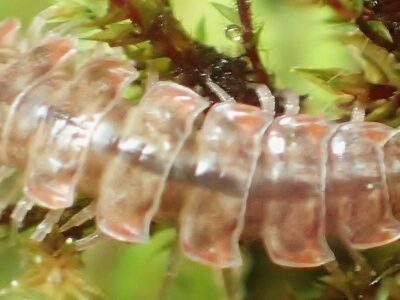
Pauropods are soft, cylindrical animals with bodies measuring only 0.3 to 2 mm in length, and Stylopauropus brito exemplifies this diminutive form. The creature’s pale coloration blends seamlessly with the soil environment it inhabits, making visual detection nearly impossible to the naked eye. The antennae are branching, biramous, and segmented, which is distinctive for the group, serving as sophisticated sensory instruments that probe the darkness of the soil.
Adults in the order Tetramerocerata have a scarcely telescopic antennal stalk with four segments, five or six tergites, and eight to ten pairs of legs, with most species having nine pairs of legs as adults. The body segments are fused in pairs, creating a distinctly segmented appearance when viewed from above. Pauropods can be identified because of their distinctive anal plate, which is unique to pauropods, and different species of pauropods can be identified based on the size and shape of their anal plate.
They have neither eyes nor hearts, although they do have sensory organs which can detect light. Instead of vision, Stylopauropus brito relies on vibration-sensitive organs (pseudoculi) instead of eyes, allowing it to navigate the subterranean world through touch and vibration alone.
The lifestyle of Stylopauropus brito centers on the hidden realm beneath leaf litter and soil. Pauropods have distinctive locomotory pattern characterized by rapid burst of movement and frequent abrupt changes in direction, moving in quick, erratic darts rather than steady progression. Pauropods are shy of light and try to disappear in crevices and soil clumps as soon as possible.
The behavior of these creatures reveals a fastidious nature. The preening behavior of pauropods is unusual and noteworthy, as they lift their antennae and legs and then begin cleaning themselves with their jaws. This meticulous grooming suggests an animal acutely aware of its surroundings and the importance of maintaining its delicate exoskeleton.
The antennae rotate constantly with an unusually high rapidity to examine the environment, creating an almost perpetual state of sensory scanning. Vertical migration occurs when there are changes in soil moisture, allowing Stylopauropus brito to seek optimal conditions within the soil profile.
Stylopauropus brito is known from France, where it inhabits the soil and leaf litter ecosystems. Pauropoda are associated with soil and litter habitats and can occur under moss and rocks, in decaying wood, or under the bark of decaying logs, and they are generally most abundant in moist soils that have high levels of organic matter.
They are particularly species-rich and abundant in forest soils and have been reported to have several thousand specimens per square meter in wild and agricultural habitats, and they inhabit many plant communities and soil types and are most abundant in a zone about 10–20 cm deep. While individual records of Stylopauropus brito remain sparse, this reflects the cryptic nature of pauropods rather than true rarity.
The feeding ecology of Stylopauropus brito centers on the decomposing matter and fungi that permeate the soil environment. The food habits of most species are unknown, but some can eat mold or suck out fungal hyphae; at least one species even eats root hairs. This dietary flexibility allows Stylopauropus brito to exploit the rich resources of the detrital food web.
The creature likely plays a role in nutrient cycling, breaking down organic material and contributing to soil formation. They eat decaying leaves and wood, as well as fungi, some pauropoda eat the root structures of fungi and plants as well, and others mostly consume mold. This omnivorous approach to feeding reflects an organism perfectly adapted to the variable conditions of soil habitats.
Pauropods, like all other myriapods, are gonochoric, male pauropods place small packets of sperm on the ground, which the females use to impregnate themselves, and the females then deposit the fertilized eggs on the ground. This reproductive strategy, while unusual to human observers, represents an efficient mechanism for reproduction in the soil environment where direct contact is often impractical.
Parthogenesis can occur in some species, especially when environmental conditions are unfavourable, and the embryo goes through a short pupoid stage before the egg hatches and the first larval instar emerges. Juveniles then develop into adults through a series of molts, adding legs at each stage, and juveniles in the order Tetramerocerata start with three pairs of legs and progress through instars with five, then six, and then eight leg pairs.
The conservation status of Stylopauropus brito remains undocumented, reflecting the broader knowledge gap surrounding pauropod populations worldwide. Although these animals are not rare, they often have small population sizes with patchy distributions. The species likely faces no immediate threats, as pauropods are soil-dwelling organisms relatively insulated from human activities.
Conservation note: The minute Pauropoda are of little direct agricultural importance, which paradoxically may work in their favor, as they are rarely targeted for control measures. However, habitat destruction through soil disturbance, compaction, and contamination could impact populations. Continued research into pauropod ecology and distribution remains essential for understanding these cryptic arthropods and their role in soil ecosystems.
The first pauropod species to be discovered and described was Pauropus huxleyi, found by Lord Avebury in his own garden in London in 1866, and he wrote of the creature: “Pauropus huxleyi is a bustling, active, neat and cleanly creature”
The name Pauropoda derives from the Greek pauros (meaning “small” or “few”) and pous, genitive podos (meaning “foot”), because most species in this class have only nine pairs of legs as adults
Although these animals cannot burrow, they can follow root canals and crevices down to the groundwater surface
According to Ulf Scheller, the best way to spot them on the underside of a stone is to blow gently over the surface, as pauropods run rapidly forwards, and when they stop they run backwards or twist their bodies in many directions
The family Pauropodidae is especially large, with 27 genera and 814 species, including most of the genera and species in the class Pauropoda
Only one known fossil pauropod is Eopauropus balticus, a prehistoric species known from mid-Eocene Baltic amber, and because pauropods are normally soil-dwelling, their presence in amber (fossilized tree sap) is unusual, and they are the rarest known animals in Baltic amber
They have no eyes, so they typically sense aspects of their environment with special organs that react to vibrations in their environment, called pseudoculi and located on the top of the antennae
Scheller, U. (1990). A list of the British Pauropoda with description of a new species of Eurypauropodidae (Myriapoda). Journal of Natural History, 24(5), 1179-1195.
Barber, A.D., Blower, J.G., & Scheller, U. (1992). Pauropoda, the smallest myriapods. Bulletin of the British Myriapod Group, 8, 13-24.
Remy, P. (1938). Pauropodes de France, d’Allemagne et des Balkans, avec description de quatre formes nouvelles. Bulletin de la Société d’histoire naturelle de la Moselle, 35, 153-178.
Scheller, U. (2008). A reclassification of the Pauropoda (Myriapoda). International Journal of Myriapodology, 1(1), 1-38.