Fungi
| Kingdom | Fungi |
|---|---|
| Phylum | Basidiomycota |
| Class | Pucciniomycetes |
| Order | Pucciniales |
| Family | Pucciniaceae |
| Genus | Puccinia |
| Species | Puccinia longissima |
Puccinia longissima stands as a testament to the hidden complexity of rust fungi, those microscopic masters of parasitism that have shaped plant evolution for millions of years. This basidiomycete, a member of the vast Pucciniaceae family, represents one of nature’s most intricate biological dramas—a fungus so specialized in its host relationships that it has become invisible to most observers, yet profoundly influential in the ecosystems where it thrives. Found across the temperate regions of Europe and North Africa, Puccinia longissima embodies the sophisticated strategies that rust fungi employ to survive and reproduce.
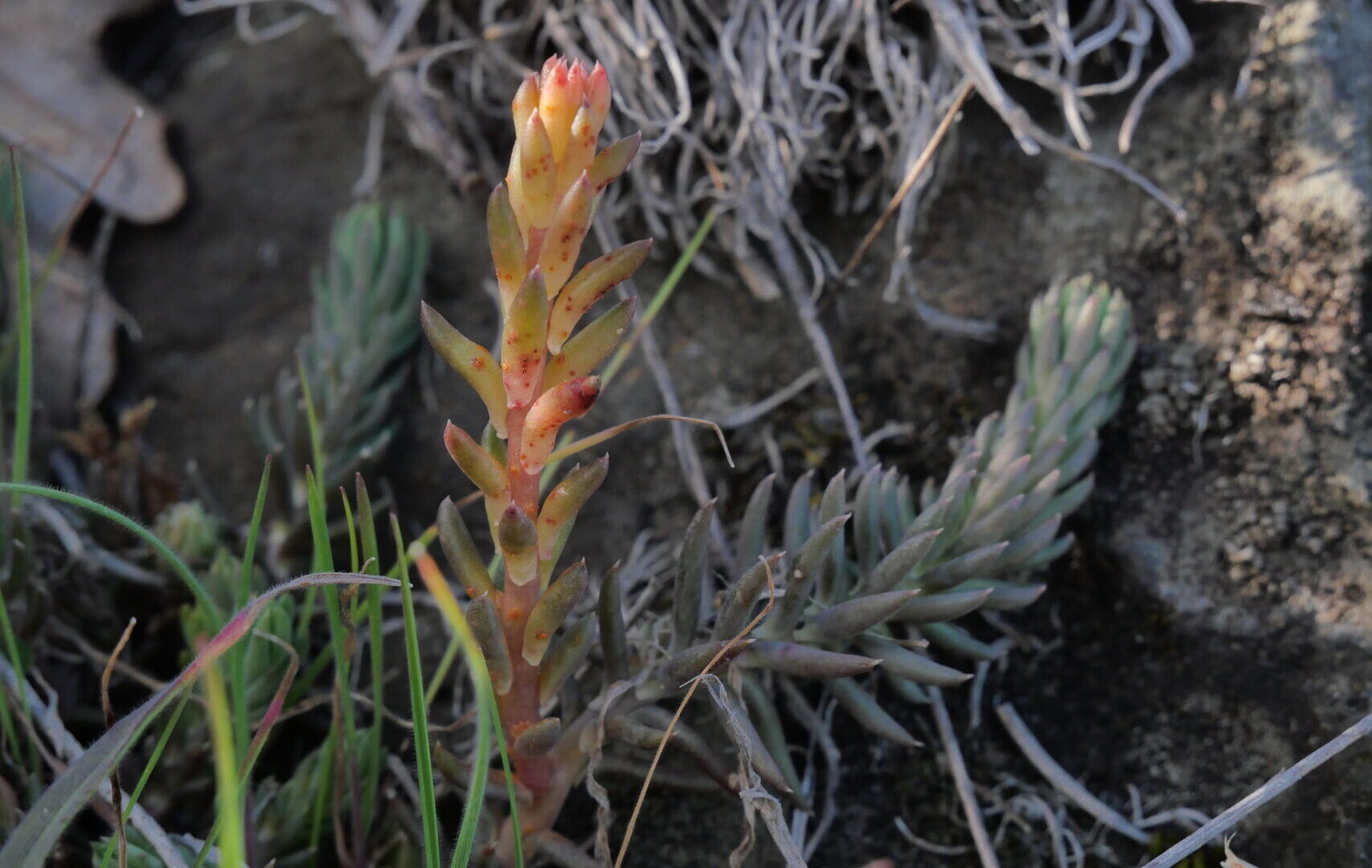
Rust fungi like Puccinia longissima occupy a realm of biology that challenges traditional fungal identification. Unlike the familiar mushrooms with their visible caps and gills, rust fungi exist largely as microscopic structures within the tissues of their host plants, manifesting themselves only as rust-colored pustules or lesions on leaf surfaces.
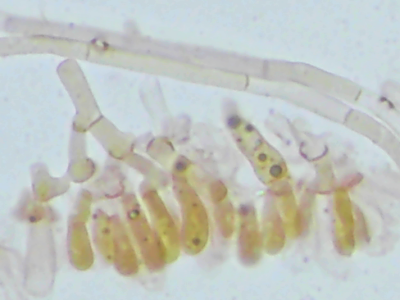
The defining characteristic of Puccinia longissima lies in its specialized spore structures:
Identification tip: Without microscopic examination, rust fungi are best identified by their host plant associations and the characteristic rust-colored or dark pustules they create on leaves and stems.
The lifecycle of Puccinia longissima unfolds across multiple spore stages, each perfectly adapted to different environmental conditions and seasonal rhythms. This complexity reflects an evolutionary arms race between fungus and host spanning countless generations.
The existence of Puccinia longissima represents one of mycology’s greatest marvels: the heteroecious rust lifecycle. This fungus requires two different host plants to complete its reproductive cycle—a biological necessity that demonstrates how intimately rust fungi have become entangled with plant communities.
The fungal year begins when overwintering teliospores germinate in spring, producing basidiospores that float on wind currents seeking the first host plant. Once established, the fungus produces uredospores throughout the growing season, each generation capable of infecting new leaves and spreading the infection with remarkable efficiency.
As autumn approaches and temperatures drop, the fungus shifts its strategy, producing thick-walled teliospores designed to endure winter’s harshest conditions. These survival structures can persist beneath bark, in plant debris, or in protected microsites, waiting patiently for spring’s return. The timing is exquisite—the fungus must complete its cycle before frost arrives, yet delay long enough to ensure adequate spore production.
Puccinia longissima has established itself across a broad swath of the temperate world, with documented occurrences spanning from the British Isles and Scandinavia south to North Africa, and from the Atlantic coast eastward through Central Europe into the Caucasus region. This distribution reflects the fungus’s adaptation to temperate climates where its host plants flourish.
The fungus thrives in environments where moisture and host plant availability converge:
Geographic records from scientific databases document 326 documented occurrences across Europe, with particular concentrations in Germany, France, and the broader Central European region. Recent observations from Georgia and France suggest the fungus continues to maintain its ecological presence across its historical range.
Puccinia longissima occupies a critical niche in plant community dynamics, functioning as a natural regulator of host plant populations. As a biotrophic parasite, it extracts nutrients from living plant tissues without immediately killing its host—a relationship refined through millions of years of coevolution.
The ecological implications of this fungus ripple through entire ecosystems:
The presence of Puccinia longissima in a landscape tells a story of ecological balance—where plants and fungi have negotiated an ancient compromise, each constraining the other’s expansion while together maintaining the complex web of life.
As a microscopic rust fungus, Puccinia longissima presents no culinary interest or edibility considerations. Rust fungi are not consumed by humans and are far too small and numerous to harvest as food. Instead, this species is significant primarily to plant pathologists and ecologists studying host-parasite relationships.
Important note: The significance of Puccinia longissima lies not in human consumption but in its ecological and agricultural importance. In agricultural contexts, rust fungi can reduce crop yields and plant vigor, making them subjects of intensive study for disease management.
The scientific value of Puccinia longissima extends to researchers investigating fungal evolution, host specificity, and the mechanisms by which parasitic fungi have become so perfectly adapted to their plant hosts. Understanding rust fungi helps us comprehend the intricate relationships that structure natural ecosystems and inform agricultural practices.
Ancient coevolution: Rust fungi like Puccinia longissima have been infecting plants for over 100 million years, making them among the oldest plant parasites on Earth
Heteroecious mystery: The requirement for two different host plants creates a biological puzzle that mycologists are still unraveling—how does the fungus “know” which plant to infect at each stage?
Microscopic abundance: A single infected leaf can produce millions of uredospores, creating clouds of fungal cells invisible to the naked eye but visible under the microscope as brilliant rust-colored dust
Wind travelers: Rust spores are among the most efficient aerial dispersers in the fungal kingdom, capable of traveling hundreds of kilometers on air currents to find new hosts
Winter survival masters: Teliospores can survive temperatures far below freezing and remain viable for years, making rust fungi nearly impossible to eradicate once established
Genetic diversity engine: The sexual stage of rust fungi creates genetic variation that allows populations to evolve resistance to plant defenses with remarkable speed
Invisible ecosystem engineers: Though invisible to casual observation, rust fungi profoundly shape plant communities by controlling which species thrive and which remain suppressed