Fungi
| Kingdom | Fungi |
|---|---|
| Phylum | Basidiomycota |
| Class | Agaricomycetes |
| Order | Trechisporales |
| Family | Sistotremataceae |
| Genus | Trechispora |
| Species | Trechispora cohaerens |
Across temperate forests from the Arctic reaches of Greenland to the beech woodlands of New Zealand, a microscopic architect quietly transforms the landscape—Trechispora cohaerens, a wood-decay fungus of remarkable subtlety and ecological importance. This species belongs to the ancient family Sistotremataceae, a lineage of decomposers that has been breaking down dead wood for millions of years. What makes this fungus so special is not its size or visibility, but its essential role in forest renewal and nutrient cycling.
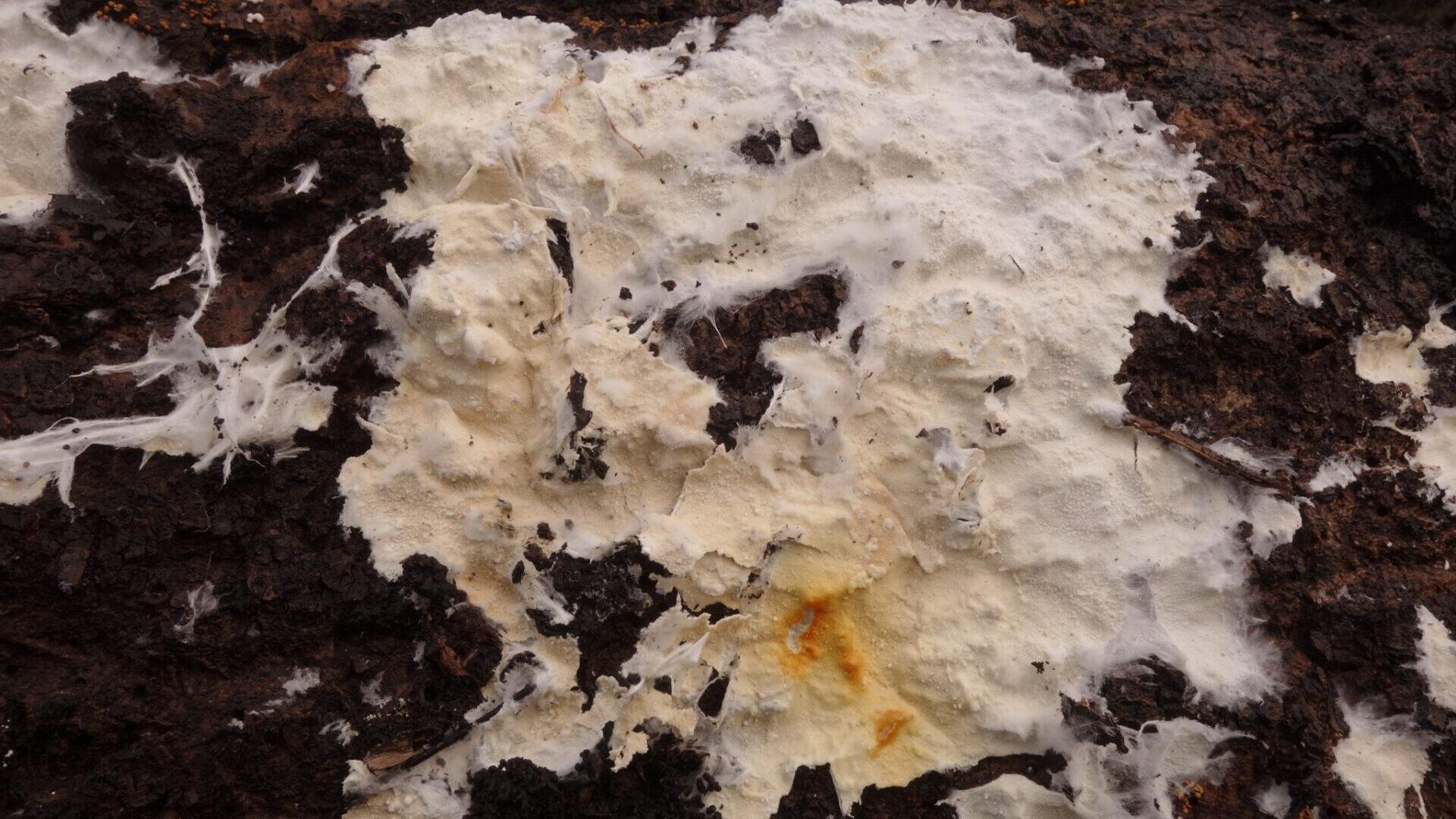
Trechispora cohaerens presents itself as a thin, delicate crust that clings tenaciously to its wooden substrate. The fruiting body forms a resupinate structure—entirely flat against the wood surface—creating thin layers that measure less than 0.3 millimeters thick yet can spread across 200 millimeters or more.
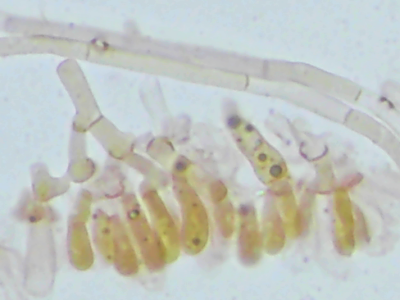
The surface begins smooth and white to cream-colored, gradually becoming granular or slightly bumpy as it matures. Under a hand lens, the hymenial surface (the spore-bearing layer) displays a distinctive smooth to slightly warty texture that becomes cracked and fissured as the fungus dries. The basidiospores are thick-walled, a key identifying feature that separates this species from its relatives.
Identification tip: Look for the characteristic loose attachment to wood—the fungal layer can be carefully peeled away from the substrate, a trait that distinguishes it from more firmly adhered species. The whitish to ochre coloration and granular surface provide visual clues in the field.
The journey of Trechispora cohaerens begins with microscopic spores drifting through forest air, landing on freshly fallen wood or exposed branches. Once a spore finds suitable substrate, it germinates and sends forth threadlike hyphae that penetrate the wood, establishing an invisible network of mycelium throughout the timber.
This fungus is an annual fruiter, meaning its visible fruiting bodies appear seasonally rather than persisting year-round. The fruiting bodies emerge when conditions align—typically following autumn and winter rains when moisture levels remain high and temperatures stay cool. The thin crust can produce millions of microscopic spores from even a small patch of fruiting surface, each one a potential pioneer ready to colonize new wood.
The mycelium works steadily within the wood, breaking down the complex polymers that give timber its structure. This decomposition process is gradual but relentless, transforming solid wood into soft, crumbly material over months and years.
Trechispora cohaerens displays a truly cosmopolitan distribution across the temperate world. GBIF records show its presence across 18 countries spanning Europe, North America, and even New Zealand—a testament to its adaptability and the universal nature of wood decomposition. The species thrives in the cool, moist climates of Scandinavia, Central Europe, and the British Isles, where over 1,700 documented occurrences paint a picture of widespread but localized abundance.
This fungus is an obligate wood-inhabiter, requiring dead timber as both habitat and food source. It colonizes fallen branches, decaying logs, and exposed wood in forests and woodlands. The species shows no preference for particular tree species, appearing equally on beech, birch, oak, and countless other hardwoods. Moist conditions are essential—the fungus requires sustained humidity to fruit, making autumn and winter optimal seasons when rain saturates the forest floor.
Trechispora cohaerens stands as a key player in forest nutrient cycling and ecosystem renewal. Trechispora are an important genus of wood-inhabiting fungi that have the ability to decompose rotten wood in the forest ecosystem. By breaking down dead wood, this fungus recycles locked-away nutrients—nitrogen, phosphorus, potassium, and countless trace elements—returning them to the soil where new generations of plants can access them.
The decomposed wood created by this fungus creates habitat for countless other organisms. Insects, mites, and bacteria colonize the softened wood, feeding on both the fungal tissue and the partially decomposed timber. Deadwood is an important habitat and dietary source for a variety of organisms, and differences in wood physicochemical properties related to decay types have strong impacts on the community composition, diversity, and interactions of these organisms. In this way, a single fruiting body of Trechispora cohaerens can support entire miniature ecosystems within the forest.
Edibility warning: Trechispora cohaerens is inedible and holds no culinary value. Its diminutive size and thin, papery texture would make it impossible to harvest in any meaningful quantity, and it offers no nutritional benefit to humans.
However, this fungus has significant value to mycologists and forest ecologists. It serves as an indicator species for forest health and the presence of healthy deadwood habitat. Researchers use its presence to assess whether forests contain sufficient standing and fallen dead wood to support saproxylic (wood-dependent) communities. The species is also of interest to systematic mycologists studying fungal evolution and the Sistotremataceae family.
In traditional European forestry, the presence of wood-decay fungi like Trechispora cohaerens was sometimes viewed as a sign of timber loss. Modern ecological understanding has reversed this perspective—these fungi are now recognized as essential for forest health and biodiversity, and their presence is actively encouraged in conservation areas.
Microscopic spore factory: A single fruiting body of Trechispora cohaerens, despite being barely visible to the naked eye, can release millions of spores into the forest air, making it an invisible but prolific seed-spreader.
Ancient lineage: Trechispora cohaerens belongs to the order Trechisporales, a group of fungi that has been decomposing wood for over 100 million years, predating the evolution of most modern tree species.
Thick-walled spores: The distinctive thick-walled basidiospores of this species are an adaptation to harsh environmental conditions, allowing them to survive desiccation and UV exposure during dispersal through the air.
Global nomad: Despite being described from North America in the 1830s, Trechispora cohaerens has since colonized forests across Europe, Asia, and even the remote forests of New Zealand—likely transported on timber products and through natural dispersal over centuries.
Forest architect: By softening and fragmenting dead wood, Trechispora cohaerens makes it accessible to insects, bacteria, and other decomposers, essentially “opening doors” for the entire decomposer community.
Hydnoid hunter: The genus Trechispora is characterized by spore-bearing surfaces that can be smooth, warty, or tooth-like (hydnoid), and T. cohaerens represents the smooth-surfaced specialists in wood decay.
Indicator of old-growth forests: In conservation biology, the presence of wood-decay fungi like Trechispora cohaerens indicates forests with sufficient structural complexity and dead wood—hallmarks of ecologically mature woodland.