
Insecta · Coleoptera
Common Goliath Beetle
Goliathus goliatus
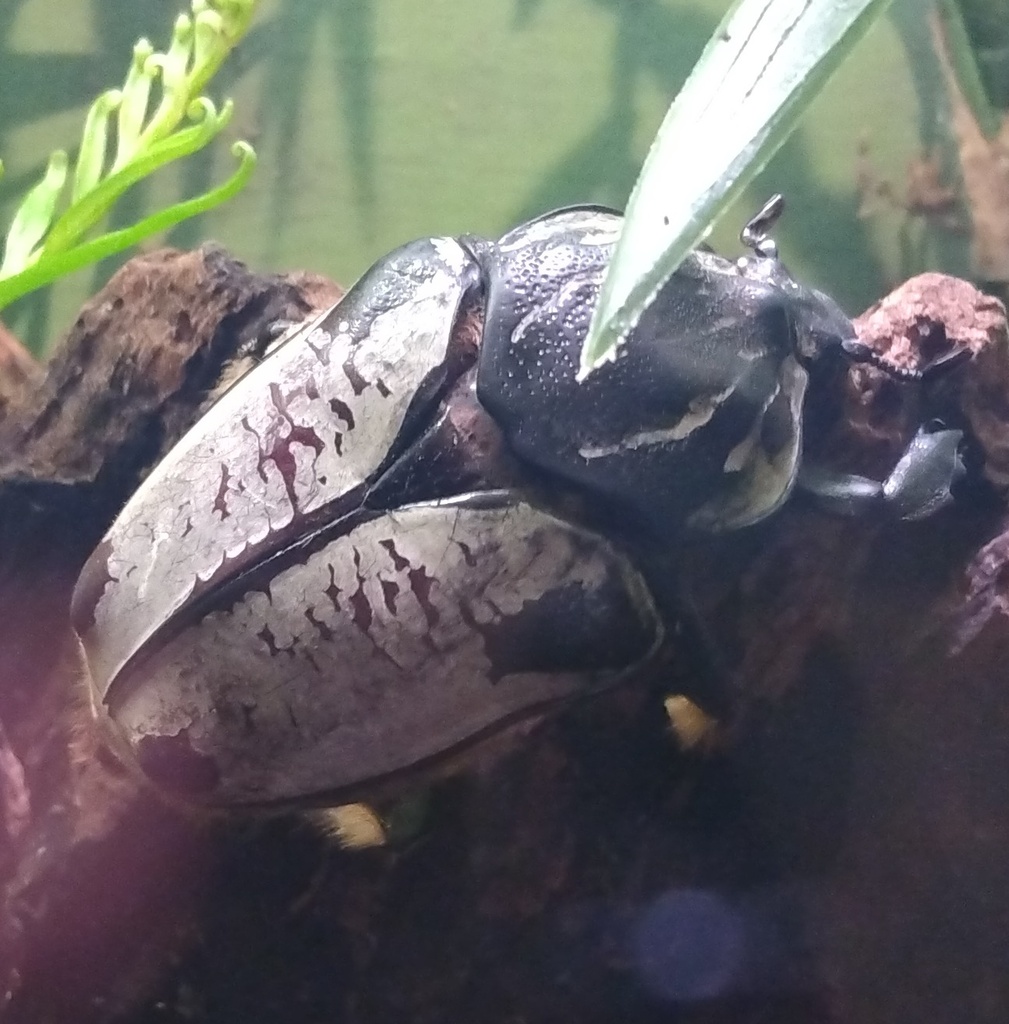
© Rob Schnautz · iNaturalist
Classification scientifique et faits rapides
Classification
Known For
Full profile in progress — check back soon.
Le scarabée Goliath commun, Goliathus goliatus, est l’un des insectes les plus massifs de la planète. Ses larves et ses adultes incarnent une puissance brute exceptionnelle dans le monde des coléoptères, capables de se développer jusqu’à des proportions remarquables et de supporter des poids considérables. Ce membre de la famille des Scarabaeidae règne dans les forêts d’Afrique subsaharienne, où il remplit un rôle écologique vital en tant que décomposeur et consommateur de matière organique.
Présent dans dix pays à travers le continent africain, Goliathus goliatus bénéficie d’un statut de conservation actuellement inconnu, ce qui reflète les lacunes dans le suivi systématique de cette espèce. Malgré son abondance relative dans certaines régions, peu d’études approfondies documentent les tendances de ses populations ou les menaces qui pèsent sur lui. Ce qui rend cette espèce particulièrement fascinante, c’est le contraste frappant entre sa taille impressionnante, sa force prodigieuse, et la rareté relative des connaissances complètes sur son cycle de vie, son écologie et son avenir face aux changements environnementaux.
Identification et Apparence
Goliathus goliatus est l’une des plus grandes espèces du genre Goliathus et l’un des plus grands insectes connus. Cette espèce se distingue par ses dimensions impressionnantes et sa morphologie robuste, caractéristiques des coléoptères scarabéides les plus spectaculaires.
Taille et dimorphisme sexuel
Les mâles mesurent entre 50 et 110 mm de longueur corporelle, tandis que les femelles sont légèrement plus petites, avec une longueur variant de 54 à 80 mm. Malgré cette apparente variation, les mâles atteignent généralement les dimensions maximales les plus impressionnantes. Le corps massif et robuste confère à cette espèce un poids notable, bien que les dimensions restent le caractère distinctif majeur.
Coloration et motifs distinctifs
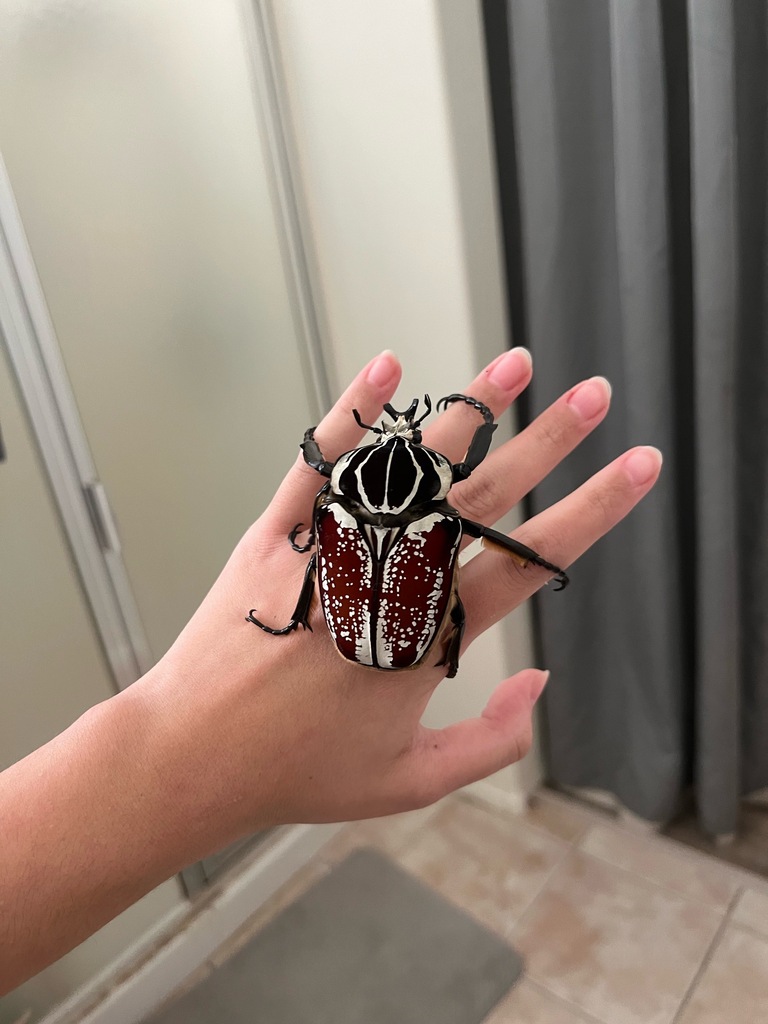
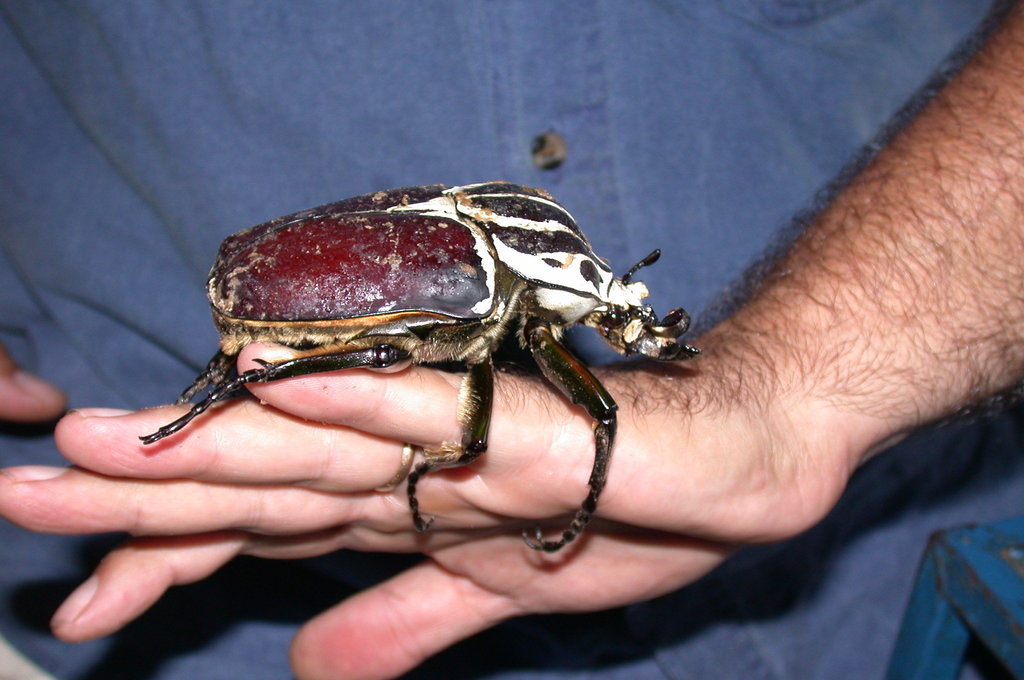
Le pronotum (bouclier thoracique) est principalement noir avec des rayures longitudinales blanchâtres bien marquées. Les élytres (ailes antérieures durcies) présentent une coloration très variable selon les formes géographiques. La forme typique affiche des élytres d’un brun foncé dominant, mais plusieurs variantes nommées coexistent dans les mêmes régions géographiques.
Certaines formes morphologiques, notamment celle désignée « quadrimaculatus », présentent des élytres majoritairement blancs. D’autres formes intermédiaires, nommées « albatus », « apicalis », « conspersus », « hieroglyphicus » et « undulatus », exhibent des motifs et proportions variables combinant le blanc, le noir et le brun. Cette polymorphie chromatique reflète une grande plasticité phénotypique au sein de l’espèce, avec des transitions graduelles entre les morphes dans les zones de chevauchement.
Distribution et Habitat
Goliathus goliatus est distribué dans les régions d’Afrique centrale et occidentale, avec une présence confirmée dans dix pays. Le Bénin abrite la majorité des observations enregistrées, avec 29 localités documentées, suivi du Cameroun qui en compte 11. La République démocratique du Congo, la Guinée équatoriale et l’Ouganda représentent également des strongholds importants, avec respectivement 5, 5 et 4 observations. Des occurrences isolées ont été signalées en République centrafricaine, au Congo, au Nigeria, au Gabon et au Kenya, témoignant d’une distribution fragmentée mais bien établie dans la zone tropicale africaine.
Altitude et habitat
L’espèce occupe une gamme altitudinale comprise entre 322 et 1 219 mètres, avec une altitude moyenne de 920 mètres. Cette amplitude verticale suggère une adaptation aux écosystèmes forestiers de plaine et de moyenne montagne, typiques des régions équatoriales et péri-équatoriales d’Afrique. Les observations concentrées à ces altitudes intermédiaires indiquent une préférence pour les environnements forestiers mésiques plutôt que pour les zones les plus basses ou les sommets les plus élevés.
Phénologie saisonnière
Les données d’occurrence montrent une saisonnalité marquée, avec un pic d’observations en avril, où 16 enregistrements ont été documentés. Cette concentration printanière suggère une émergence ou une activité maximale des adultes pendant la saison des pluies, période favorable au développement larvaire et à l’alimentation. Les observations restent présentes tout au long de l’année, bien que moins fréquentes, avec un creux notable en novembre.
Biologie
Comportement
Le Scarabée Goliath commun est un insecte largement nocturne qui passe la majeure partie de la journée enfoui dans la litière forestière ou sous l’écorce des arbres. À la nuit tombée, ces coléoptères émergent pour se nourrir et chercher des partenaires d’accouplement. Malgré leur taille imposante, ils sont des volants capables, bien que leurs mouvements soient relativement lourds et bruyants — le battement de leurs ailes produit un bourdonnement distinctif audible de loin.
Ces scarabées sont généralement solitaires et territoriaux. Les mâles, reconnaissables à leur corne frontale proéminente, engagent des combats ritualisés avec d’autres mâles pour établir la dominance et l’accès aux femelles. Ces affrontements impliquent des tentatives de retournement et de projection, utilisant la corne comme arme. Les femelles manquent de cette corne et présentent un corps plus ovale. Les individus des deux sexes émettent des sons de stridulation lorsqu’ils sont menacés, un mécanisme de défense acoustique.
Régime alimentaire
Le Scarabée Goliath commun est un herbivore opportuniste. Les adultes se nourrissent principalement de la sève et du nectar des arbres, en particulier des fruits fermentés et des écorces suintantes. Ils sont attirés par les odeurs de matière organique en décomposition et fréquentent les zones où la fermentation crée des sources alimentaires riches. Les larves, en revanche, sont saprophages — elles se développent dans le bois pourri, le compost et l’humus forestier riche, où elles consomment la matière organique en décomposition.
Reproduction
La reproduction du Scarabée Goliath commun suit un cycle saisonnier lié aux régimes de pluie des forêts tropicales africaines. Les mâles établissent des territoires et attirent les femelles par des signaux chimiques et acoustiques. L’accouplement se déroule généralement pendant la saison des pluies, lorsque la nourriture abonde et que l’humidité du sol facilite la ponte.
Après l’accouplement, la femelle pond ses œufs dans un environnement humide et riche en matière organique — typiquement dans le compost, le bois pourri ou la terre noire des forêts. Une femelle peut pondre plusieurs dizaines d’œufs au cours de sa vie. Les larves passent par trois stades de développement larvaire avant de former une chrysalide et d’émerger en tant que coléoptères adultes. Le cycle complet de développement, de l’œuf à l’adulte, dure généralement plusieurs mois, selon la température et l’humidité de l’environnement. Les adultes vivent plusieurs années, ce qui en fait l’un des scarabées les plus longévifs parmi les espèces de grande taille.
Conservation et Menaces
Le Goliath Commun (Goliathus goliatus) n’a pas été formellement évalué par l’Union Internationale pour la Conservation de la Nature (UICN), ce qui signifie que son statut de conservation exact demeure inconnu. En l’absence de données officielles sur la tendance des populations, la taille globale des effectifs et les menaces spécifiques documentées, il est difficile de déterminer avec certitude si l’espèce fait face à un déclin significatif ou si elle maintient une population stable.
Les coléoptères Goliath comme Goliathus goliatus dépendent des forêts tropicales et des zones boisées d’Afrique centrale pour leur survie. Bien que les menaces précises n’aient pas été systématiquement compilées dans les bases de données scientifiques majeures, la perte et la dégradation des habitats forestiers constituent une préoccupation générale pour les espèces d’insectes qui occupent ces écosystèmes. Le commerce international et la capture pour la collection d’insectes pourraient également peser sur les populations naturelles dans certaines régions.
Efforts de conservation
À ce jour, aucun programme de conservation spécifique dédié à Goliathus goliatus n’a été largement documenté dans la littérature disponible. Le manque d’évaluation officielle de l’UICN suggère que davantage de recherches et de surveillance des populations sont nécessaires pour élaborer des stratégies de protection adaptées. La préservation des forêts tropicales primaires et secondaires en Afrique centrale demeure essentielle pour maintenir les habitats vitaux de cette espèce et de nombreux autres organismes.
Signification Culturelle
Le nom scientifique Goliathus goliatus trouve son origine dans la figure biblique de Goliath, le guerrier philistin légendaire du Livre de Samuel. Ce géant de stature impressionnante, connu pour son combat singulier contre David qui deviendrait plus tard roi d’Israël, incarne la force et la puissance brute. Le coléoptère porte ce nom en raison de sa taille exceptionnelle et de son apparence imposante, établissant une connexion directe entre l’insecte et ce mythe antique d’affrontement entre le géant et le jeune guerrier.
Dans certaines cultures d’Afrique de l’Ouest, le Scarabée Goliath commun figure dans le folklore local comme symbole de force et d’endurance. Son exosquelette impressionnant et distinctif, particulièrement remarquable chez Goliathus goliatus avec son dos rouge caractéristique, en fait un objet de fascination et de collection. Les spécimens sont exposés dans les musées et les collections privées du monde entier, témoignant de l’intérêt que suscite cet insecte auprès des amateurs de biodiversité tropicale.
Bien que le scarabée soit associé au nom d’un géant légendaire, son rôle dans la mythologie reste limité comparé à celui d’autres coléoptères dans diverses traditions culturelles. Sa présence principale dans la culture humaine contemporaine relève plutôt de son statut de curiosité naturelle et de pièce de collection prisée, reflétant davantage l’admiration moderne pour les phénomènes biologiques exceptionnels que des croyances mythologiques établies.
Le saviez-vous ?
Faits fascinants
- Le scarabée Goliath commun est l’un des plus lourds insectes volants du monde, avec des mâles pouvant peser jusqu’à 100 grammes et atteindre 11 centimètres de longueur. Malgré cette masse considérable, il possède des ailes assez puissantes pour voler activement dans la canopée tropicale.
- Les larves de Goliathus goliatus se nourrissent exclusivement du bois pourri et des débris végétaux en décomposition, où elles passent plusieurs années à grandir avant leur métamorphose. Une seule larve peut atteindre une taille de 15 centimètres et peser plus que l’adulte final.
- Le scarabée adulte émet un bruit de sifflement distinctif quand on le menace, produit par le frottement de ses ailes sur son abdomen. Ce son sert de mécanisme de défense pour éloigner les prédateurs potentiels.
- Ces scarabées sont principalement nocturnes et se nourrissent de fruits fermentés et de sève d’arbres durant les heures sombres. Ils sont attirés par les fermentations alcooliques, où ils se rassemblent parfois en petit nombre.
- Le scarabée Goliath possède une armure chitineuse épaisse et des cornes prononcées chez les mâles, structures qu’il utilise pour combattre d’autres mâles lors de la compétition pour l’accès aux femelles. Ces combats sont violents et peuvent durer plusieurs minutes.
- La couleur spectaculaire du scarabée—allant du vert émeraude au bleu-noir avec des taches blanches distinctives—n’est pas produite par des pigments, mais par la structure physique de l’exosquelette qui diffracte la lumière.
- Dans son habitat naturel des forêts pluviales africaines, le scarabée Goliath remplit un rôle écologique important en tant que contributeur à la décomposition du bois mort et à la circulation des nutriments dans l’écosystème forestier.
Galerie photos
Rob Schnautz ·
Espèces apparentées

Ce profil vous a-t-il été utile ?