Fungi
| Kingdom | Fungi |
|---|---|
| Phylum | Basidiomycota |
| Class | Pucciniomycetes |
| Order | Pucciniales |
| Family | Pucciniaceae |
| Genus | Uromyces |
| Species | Uromyces pyriformis |
Uromyces pyriformis stands as one of nature’s most intricate plant parasites, a microscopic fungal master that has evolved an astonishing arsenal of biochemical weapons to penetrate, colonize, and exploit its host plants. This remarkable member of the rust fungi family represents a pinnacle of parasitic specialization, wielding strategies so sophisticated that mycologists continue to uncover new secrets hidden within its cellular machinery.
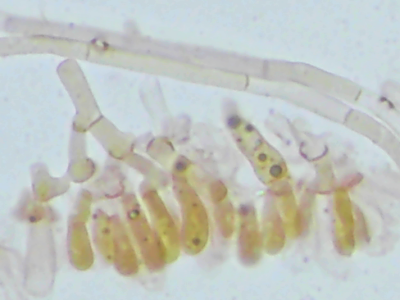
Uromyces is a genus of rust fungi in the family Pucciniaceae, and U. pyriformis exemplifies the defining characteristics of this genus. The genus is generally characterized by its unicellular teliospores that help to characterize it and distinguish it from another important rust genus, Puccinia. Unlike the bicellular teliospores of its larger cousin Puccinia, U. pyriformis produces distinctive single-celled resting spores—a microscopic signature that separates it from hundreds of other rust species.
The fungus manifests on infected plant tissues as numerous small, rust-like orange/yellow or brown pustules formed on infected plant tissues. These pustule formations are the visible windows into an invisible world of fungal conquest. Dark brown to black-brown telia are usually formed by the rust fungi during infection, creating the characteristic darkened lesions that mark the fungus’s overwintering stage.
What makes U. pyriformis truly fascinating is its extraordinarily complex life cycle. The rust diseases caused by Uromyces are generally autoecious (one plant host) and macrocyclic (produce five spore stages in the life cycle) in nature. This means the fungus completes its entire reproductive drama on a single host plant, cycling through five distinct spore types—a biological feat of stunning complexity.
The general life cycle process of Uromyces spp. involves the germination of diploid teliospores in the spring with a metabasidium after overwintering on plant debris. The metabasidium produces four haploid basidiospores after meiosis. These basidiospores with two different mating types germinate and start infection by producing different infection structures on the surface of the host plant. Picture this: overwintering teliospores awaken in spring like soldiers rising from trenches, immediately dividing to produce basidiospores that float on the wind searching for susceptible plants.
Once infection is established, the fungus orchestrates a cascade of spore production stages. With the repeated infection of the host plant, these urediospores are produced in large quantities during the summer. Surprisingly, urediospores can disseminate thousands of kilometers with the help of the wind. When suitable hosts are found, these spores differentiate into telia, which ultimately produce unicellular diploid teliospores in the winter. The fungus essentially hijacks the host plant’s physiology, converting living tissue into a spore factory that releases billions of infectious particles into the atmosphere.
They have a worldwide distribution but large occurrences happen in North America and Europe. Uromyces pyriformis records cluster heavily across North America, with particularly dense observations in the Great Lakes region, the upper Midwest, and scattered across the northeastern United States. The fungus has also been documented in Asia, including China, Japan, Indonesia, and Papua New Guinea, demonstrating its capacity to thrive across diverse climatic zones.
The Uromyces fungal species have been recorded on various host plants belonging to a wide range of the families, including Asteraceae, Euphorbiaceae, Fabaceae, Liliaceae, Loranthaceae, and Poaceae. The specific host preferences of U. pyriformis determine where it flourishes. These diversified fungi are obligate biotrophic parasites distributed in all geographical areas on a wide range of wild and cultivated plants. The fungus is an obligate biotroph, meaning it cannot survive without a living host—it is utterly dependent on the metabolic machinery of its plant victim, unable to exist as a free-living saprophyte.
As a plant pathogen, U. pyriformis plays a complex ecological role that extends far beyond simple parasitism. The severity of the disease causes a loss of photosynthetic area in infected plants, resulting in a reduction in overall plant performance. By consuming the photosynthetic tissues of its host, the fungus fundamentally alters plant energy metabolism, weakening growth and reproduction.
The ecological consequences ripple outward through entire ecosystems. The leaf beetle Gastrophysa viridula fed and oviposited less on dock plants (Rumex obtusifolius) infected by the rust fungus Uromyces rumicis than on healthy plants in laboratory experiments. These results were partly confirmed in manipulative field experiments. Herbivores actively avoid rust-infected plants, demonstrating how this fungal pathogen fundamentally alters herbivore-plant interactions and food web dynamics. The infected plant becomes less desirable to its natural consumers, creating a paradoxical survival advantage amid disease.
Edibility warning: Uromyces pyriformis is not edible and has no culinary applications. As a microscopic fungal pathogen, it is neither harvested nor consumed by humans. The fungus is known exclusively as a plant disease agent, and any contact with infected plant material should be treated with caution.
The significance of U. pyriformis lies entirely in its role as an agricultural and horticultural concern. Uromyces is the causal agent of rust disease on numerous agricultural, horticultural, and forest plantations. Rust fungi of this genus are considered a major economic threat due to possible yield losses from reduced production. Farmers and gardeners regard this fungus not as a delicacy but as an adversary to be managed through crop rotation, resistant varieties, and fungicide applications.
Historically, rust fungi like U. pyriformis have shaped agricultural practices for centuries. The emergence of rust diseases prompted farmers to develop sophisticated understanding of disease cycles, leading to foundational principles of plant pathology. Today, understanding U. pyriformis and related rusts remains critical for food security and crop production worldwide.
Microscopic sophistication: U. pyriformis produces specialized structures called haustoria—finger-like penetrations that invade plant cells without rupturing them, creating an intimate parasitic interface that allows nutrient theft while keeping the host cell alive as long as possible.
Ancient lineage: Rust fungi are among the oldest plant parasites on Earth, with fossil evidence suggesting they have been infecting plants for over 100 million years, coevolving with flowering plants since their emergence.
Wind-powered pandemic: A single infected plant can release billions of urediospores into the atmosphere. These microscopic spores can travel thousands of kilometers on wind currents, potentially reaching new continents and establishing epidemics in previously uninfected regions.
Chemical warfare: Uromyces species produce sophisticated molecular weapons to suppress plant immune responses, including effector proteins that hijack host metabolism and release compounds like mannitol that neutralize the plant’s defensive reactive oxygen species.
Sensory genius: U. pyriformis spores possess remarkable sensory abilities—when they land on a leaf, their germ tubes can detect the microscopic ridges and topography of the leaf surface, using this tactile information to locate stomata (breathing pores) for infection entry with uncanny precision.
Reproductive flexibility: While typically autoecious (completing its life cycle on one host), some Uromyces species can shift to heteroecious lifestyles, requiring two different hosts—a evolutionary flexibility that allows the fungus to adapt to changing environmental conditions.
Five-stage symphony: The five spore types produced during the macrocyclic life cycle represent one of the most complex reproductive strategies in the fungal kingdom, with each spore type specialized for different ecological roles—survival, dispersal, infection, and sexual reproduction.