Fungi
| Kingdom | Fungi |
|---|---|
| Phylum | Basidiomycota |
| Class | Pucciniomycetes |
| Order | Pucciniales |
| Family | Cronartiaceae |
| Genus | Cronartium |
| Species | Cronartium ribicola |
Cronartium ribicola stands as one of the most consequential fungal pathogens in North American forest history—a microscopic invader that has reshaped entire ecosystems and sparked some of the largest ecological management campaigns ever undertaken. This rust fungus causes the disease white pine blister rust, and its story is one of global trade, unintended consequences, and the profound power of a single organism to transform landscapes.
The life cycle of Cronartium ribicola includes two host species and goes through five spore stages, a pattern termed heteroecious. This complexity makes the fungus difficult to identify as a single entity—instead, you must recognize its telltale signatures on two entirely different plants.
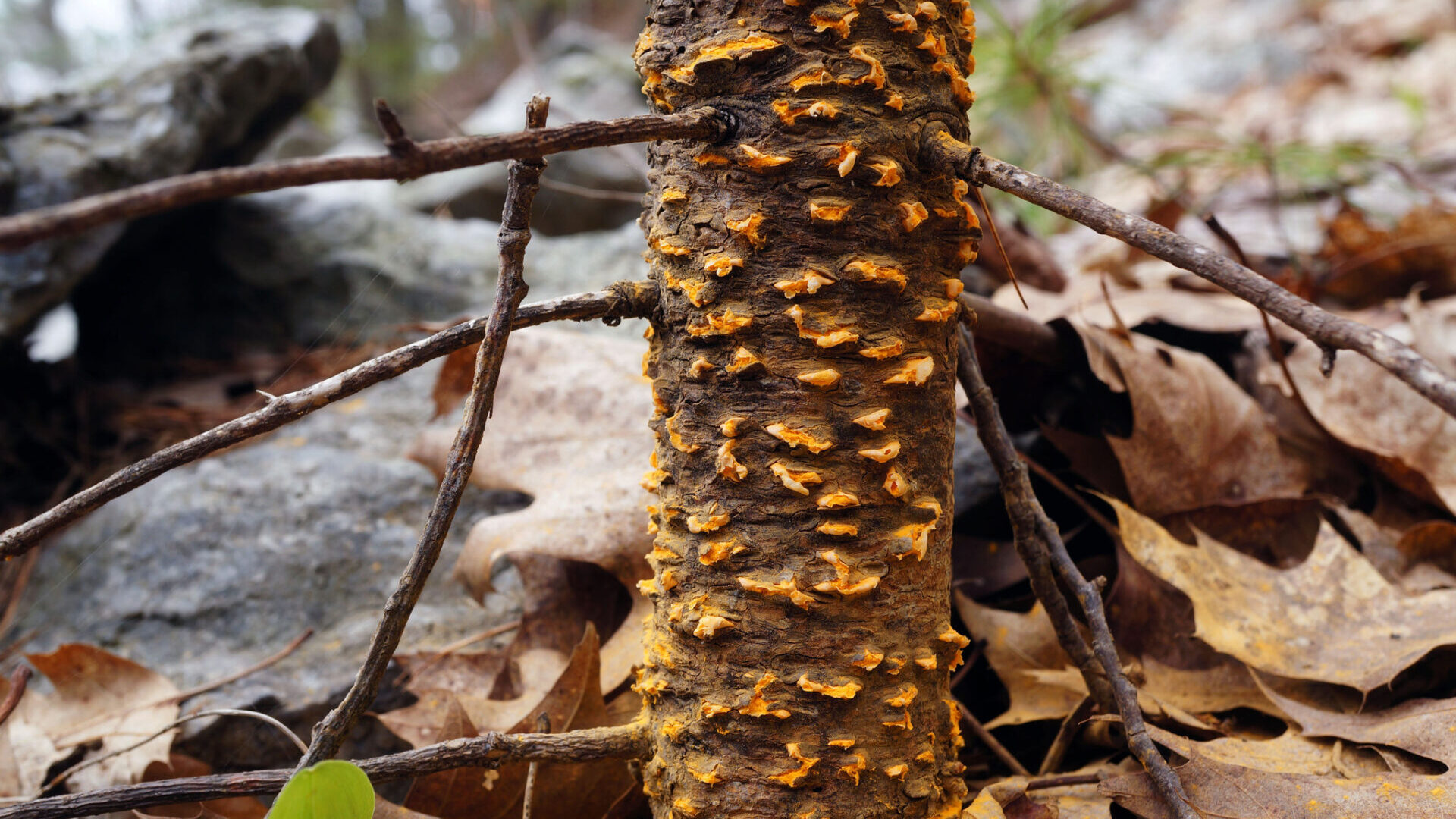
On white pine hosts, the fungus creates some of the most visually striking symptoms in forest pathology. Infection of needles results in development of yellow to brown spots and bands, and the fungus slowly grows through pine needles and bark to eventually form cankers on twigs, branches, and trunks of trees. A typical white pine blister rust canker has resinous margins, and may appear “blistered” before rupturing to expose fruiting bodies with yellow to bright orange spores.
The fungus produces distinctly different structures depending on which host it occupies:
The life cycle of Cronartium ribicola is nothing short of extraordinary—a biological marvel that unfolds over years and across two completely unrelated plant species. The life cycle is very complex, involving five different stages (with associated spore forms) and a required phase of development on an alternate host, and it takes 4 to 5 years to complete.
The journey begins in autumn. Five-needle pines are infected in the fall by basidiospores that have spread under cool, moist conditions from the alternate host, currants and gooseberries, and germinated on needles to enter with germ tubes through open stomata. Once inside the needle, the fungus embarks on its slow march toward the tree’s vital tissues. A mycelial network then spreads through the needle and into intercellular space in the inner bark, resulting in the formation of a blister rust canker.
The following spring, the fungus enters its sexual phase. Spermagonia are produced at the margins on the canker and give rise to spermatia in the following spring. Once spermatia have fertilized receptive hyphae in the Pinus host, aecia are formed within a year, appearing as white blisters before rupture reveals the orange or yellow aeciospores within. These spores then drift on the wind to find their alternate host.
The wind-blown aeciospores infect Ribes species and the fungus quickly develops uredia in less than a few weeks. Telia are developed on the abaxial (lower) surface of leaves, where teliospores germinate to give rise to basidiospores that will complete the disease cycle by infecting Pinus hosts. The cycle closes, and a single infected tree can produce spores that travel miles to infect new hosts.
Cronartium ribicola is native to China, and was introduced to North America. The fungus arrived not through natural means but through the global trade in nursery stock—a sobering reminder of how human commerce can inadvertently reshape entire continents. The rust was first discovered on currants in Geneva, New York in 1906. It was first seen on imported white pine seedlings from European nurseries in 1909.
From these initial introductions, the fungus spread with remarkable speed. It was accidentally introduced into North America in approximately 1900, where it is an invasive species causing serious damage to the American white pines, which have little genetic resistance. GBIF records indicate the fungus now occurs across a vast geographic range spanning North America and Europe, with over 8,400 documented occurrences. The fungus thrives in cool, moist forest environments where its two required hosts coexist.
Mortality is particularly heavy in western white pine, sugar pine, limber pine and whitebark pine. Ribes shrubs (currant and gooseberry) grow along streams, in moist open forests, in drier forest woodlands, and on subalpine woodlands. Almost all forest types that are open and contain deciduous shrubs contain Ribes and the possibility of pinekilling blister rust. The two species most commonly acting as alternate host for the rust are Ribes lacustre and Ribes viscosissimum.
The ecological impact of Cronartium ribicola cannot be overstated. In North America, white pine blister rust has caused more damage and costs more to control than any other conifer disease. Since the 1920’s, millions of dollars have been spent on the eradication of the alternate host, Ribes, and thousands of white pine stands have been severely damaged.
The disease has triggered cascading ecological consequences. White pine blister rust creates all sizes of snags by killing five-needle pines. Mountain pine beetles frequently are attracted to older trees infected with Cronartium ribicola, providing good foraging habitat for woodpeckers. Young trees are particularly vulnerable. Young pines are most susceptible and will die at faster rates following infection. The loss of whitebark pine, a keystone species that produces nutritious seeds critical for grizzly bears and other wildlife, represents a profound ecological loss in high-elevation ecosystems.
Interestingly, European and Asian white pines (e.g. Macedonian pine, Swiss pine and blue pine) are mostly resistant to the disease, having co-evolved with the pathogen. This evolutionary arms race suggests that given time, North American pines may develop similar resistance. In the early 1900s, large outbreaks of C. ribicola infestation resulted in the observation of apparently resistant trees, asymptomatic in heavily infected areas. By 1950, breeding programs were in place to use these remaining trees as parents to cross and backcross with progeny to develop rust-resistant varieties. There are now resistant western white pine trees available.
Edibility warning: Cronartium ribicola is not edible and has no culinary value. This fungus is a pathogen, not a food source. Its significance lies entirely in its ecological and economic impacts on forest ecosystems.
However, the fungus has profound implications for human management and conservation efforts. The disease prompted one of the most ambitious ecological control campaigns in history. The notion that eradication of the alternate host Ribes species would be an effective means of controlling the causal agent was largely responsible for the federal ban restricting cultivation of Ribes in the 1920s. Until 1966, when the ban was lifted, US breeding efforts in Ribes were essentially halted. Today, although some state and local bans remain in place, Ribes cultivars are slowly gaining popularity and many resistant varieties are commercially available.
The fungus has also become a focal point for conservation biology and forest genetics. Understanding Cronartium ribicola‘s biology has driven advances in disease resistance breeding and adaptive forest management, making it an organism of considerable scientific importance despite its destructive nature.
Scientists once thought that the alternate (telial) hosts were always Ribes species, but Cronartium ribicola knows how to have its way with some completely unrelated plants. Pedicularis and Castilleja species seem to be the most common alternate, alternate hosts—a discovery that surprised mycologists and forced them to reconsider decades of management assumptions.
The infection progresses through the branch towards the main trunk travelling about 3 inches a year, a steady, relentless advance that dooms infected trees over years.
C. ribicola cannot survive in wood after its host dies, meaning the fungus must complete its complex cycle or face extinction—a biological gamble played out millions of times across the forest floor.
Large-scale weather events that bring moist conditions to a region increase opportunities for infection and spore travel distance. Infection is also influenced by topographic features combined with microclimate, such as in saddles or on mountaintops frequented by late summer fog.
The fungus produces five distinct spore types during its life cycle, each with different functions and dispersal mechanisms—a reproductive strategy of stunning biological complexity.
The two species most commonly acting as alternate host for the rust are Ribes lacustre and Ribes viscosissimum. They are found on the best growing sites for western white pine, meaning the fungus’s preferred hosts occupy the same prime real estate as its primary victims.
Removal of currants is rarely successful in practice, as they readily re-grow from small pieces of root left in the soil, and the seeds are very widely spread in birds’ droppings—nature’s way of ensuring the alternate host persists despite human eradication efforts.
Geils, B. W., Hummer, K. E., & Hunt, R. S. (2010). White pines, Ribes, and blister rust: a review and synthesis. Forest Pathology, 40(3-4), 147-185.
Maloy, O. C. (1997). White pine blister rust control in North America: A case history. Annual Review of Phytopathology, 35, 87-109.
McDonald, G. I., Richardson, B. A., Zambino, P. J., Klopfenstein, N. B., & Kim, M.-S. (2006). Pedicularis and Castilleja are natural hosts of Cronartium ribicola in North America: a first report. Forest Pathology, 36(2), 73-82.
USDA Forest Service. (2019). White Pine Blister Rust. Northern Research Station and Forest Health Protection.
Wikipedia Contributors. (2024). Cronartium ribicola. In Wikipedia, The Free Encyclopedia.