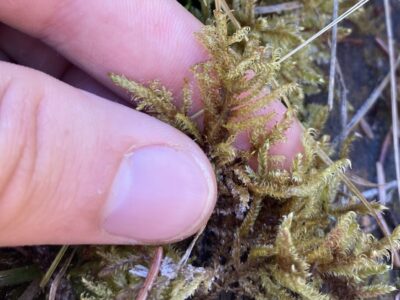
Plants
| Kingdom | Plantae |
|---|---|
| Phylum | Charophyta |
| Class | Zygnematophyceae |
| Genus | Spirotaenia |
| Species | Spirotaenia condensata |
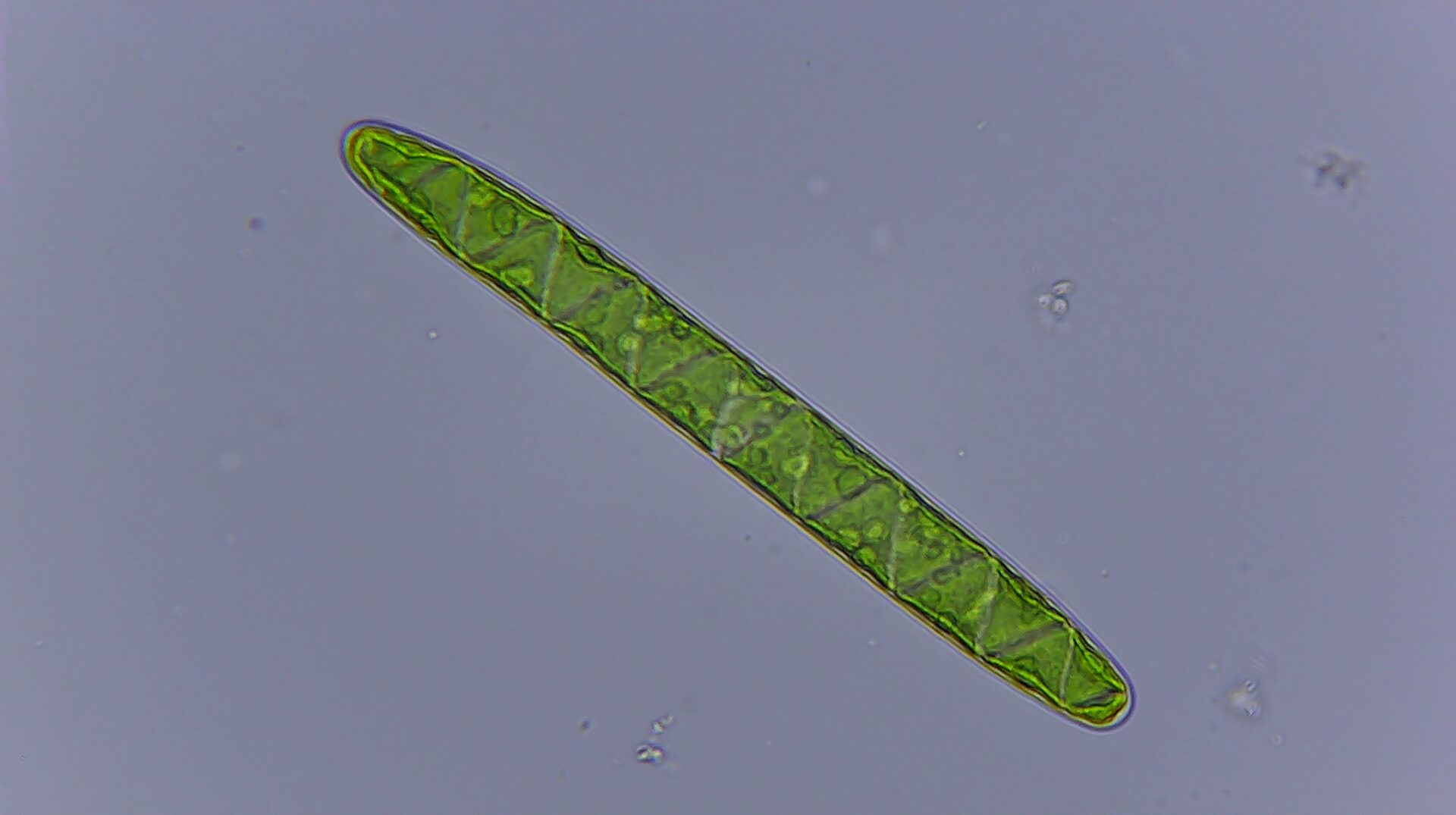
Spirotaenia condensata is a basal unicellular green alga that inhabits the hidden aquatic world beneath our feet—a living jewel visible only through the microscope’s lens. This unassuming organism represents one of nature’s most elegant designs, with a body wrapped in a spiral embrace of chlorophyll that catches light in mesmerizing patterns. From Nordic bogs to Australian wetlands, from Brazilian rainforests to North American marshes, this cosmopolitan species weaves through freshwater ecosystems with quiet persistence, playing roles we are only beginning to understand.
The most familiar species of this genus is S. condensata, marked by large, cylindric cells. Cells are minute to medium sized (7-270 µm long, length 2-12 times width), elliptic, cylindric or fusiform, with broadly rounded to acutely pointed ends. At the larger end of this size spectrum, S. condensata becomes visible to the naked eye—a rarity among algae that elevates it from microscopic curiosity to observable marvel.
Usually, the helical chloroplast is twisted tightly but cells with loosely twisted chloroplast tapes may be encountered as well. The chloroplast is parietal, spiral band, or axial mass with spiralling lateral ridges, containing 2-many pyrenoids. This species, like most others in the genus, is usually found enclosed in a mucilaginous sheath and has a parietal spiral chloroplast. This gelatinous coating serves as both armor and anchor, protecting the delicate cell while securing it to aquatic substrates.
The name condensata comes from a Latin adjective meaning “crowded together.” This nomenclature hints at the organism’s tendency to gather in dense populations, transforming water bodies into living tapestries of microscopic cells.
Asexual reproduction occurs by transverse cell division only. During this process, the cell divides across its middle, each daughter cell inheriting half of the original cell wall and generating a new half. This elegant biological economy ensures continuity while maintaining the species’ distinctive morphology.
The life cycle of S. condensata reveals a fascinating duality. Desmids most commonly reproduce by asexual fission, during which the two halves of a cell separate, and each half develops into a new cell. Yet in adverse conditions, desmids may reproduce sexually through a process of conjugation. Zygospores form as paired structures between gametangia, with coarse areolae in the zygospore wall; karyogamy possibly occurs soon after plasmogamy, with meiosis at germination producing four gones.
This is a freshwater species. It is common and cosmopolitan, found in acidic aquatic habitats or Sphagnum bogs, and occasionally in subaerial habitats. The organism thrives in conditions that would challenge many other algae—acidic waters, nutrient-poor environments, and the oxygen-depleted depths of peat bogs.
Spirotaenia condensata and S. obscura are the only common and cosmopolitan Spirotaenia species. This widespread distribution spans from the Arctic to the tropics. iNaturalist data indicates observations across Europe (Denmark, France, Austria, Norway, Sweden, Poland, Portugal, Germany, Finland, Czechia, Italy), North America (United States), South America (Brazil), Africa (Nigeria), Asia (South Korea), and Australia.
Desmids are found in freshwater habitats all over the world, but strongly prefer bogs, mires, and other nutrient-poor wetlands, with most species preferring waters with low amounts of dissolved calcium and magnesium, low salinity levels, and somewhat acidic pH. Desmids are predominantly freshwater inhabitants with their presence particularly pronounced in pristine aquatic ecosystems, and they are renowned for their utility as bioindicators of water quality, serving as sensitive indicators of environmental pollution and responding rapidly to changing ecological conditions.
While S. condensata lacks flowers in any traditional sense, its reproductive strategies are no less sophisticated. It is sexually conjugating, a mode of reproduction that was previously only known in the Zygnemataceae/Mesotaeniaceae, the sister groups to the land plants, which is surprising as Spirotaenia is much more basal, and the conjugating process is substantially aberrant. Spirotaenia condensata and some other species of the genus studied so far differ from all the conjugating green algae in producing no conjugation tube or vesicle.
Observations on the sexual cycle of the saccoderm desmid Spirotaenia condensata reveal a reproductive process unlike any other green alga. Rather than forming connecting tubes through which genetic material flows, cells appear to merge directly, achieving genetic recombination through means still not entirely understood. This aberrant conjugation—unique among conjugating algae—marks S. condensata as a living fossil of sorts, preserving ancient reproductive mechanisms in its cellular architecture.
While Spirotaenia condensata lacks direct economic importance, its scientific value is immense. The UTEX Culture Collection of Algae maintains living strains collected from Crescent Lake, Arizona, making this species available for research and education. Laboratory cultures thrive in soilwater-peat medium, revealing the organism’s preference for acidic, nutrient-poor conditions that mirror its natural bog habitats.
As a bioindicator organism, S. condensata serves environmental monitoring efforts worldwide. Its presence or absence, density, and health status reveal the chemical and biological status of freshwater ecosystems. Scientists and citizen naturalists monitoring water quality often use desmid communities—including this species—to assess pollution levels and ecosystem integrity. In educational settings, S. condensata offers an accessible window into algal diversity and the hidden complexity of microscopic life.
Ancient lineage: Spirotaenia is a genus of basal unicellular green algae that may be sister to the Chlorokybophyceae, placing it among the most ancient green algae lineages and making it a living connection to early plant evolution.
Reproductive puzzle: Spirotaenia condensata differs from all the conjugating green algae in producing no conjugation tube or vesicle—a unique reproductive strategy that challenges our understanding of sexual reproduction in algae.
Global citizen: S. condensata is common and cosmopolitan, found on every continent except Antarctica, making it one of the most widely distributed desmid species.
Spiral secrets: The helical chloroplast is usually twisted tightly but cells with loosely twisted chloroplast tapes may be encountered, suggesting environmental or genetic variation in how this organism captures light.
Type species honor: This is the type species (lectotype) of the genus Spirotaenia, meaning all other Spirotaenia species are compared to this one—it is the reference standard for the entire genus.
Bog sentinel: Found in acidic aquatic habitats or Sphagnum bogs, and occasionally in subaerial habitats, it thrives in some of Earth’s most delicate and threatened ecosystems.
Visible giant: At up to 270 micrometers long, S. condensata is among the largest desmids, occasionally visible to the naked eye as a tiny speck in a water droplet—a rare achievement among single-celled algae.
Guiry, M.D. & Guiry, G.M. (2024). AlgaeBase. World-wide electronic publication, National University of Ireland, Galway. https://www.algaebase.org
Hoshaw, R.W. & Hilton, R.L. (1966). “Observations on the sexual cycle of the saccoderm desmid Spirotaenia condensata.” Phycologia, 5(1): 12-23.
Coesel, P.F.M. & Meesters, J. (2007). Desmids of the Lowlands. KNNV Publishing, Zeist, 351 pp.
Gontcharov, A.A. & Melkonian, M. (2004). “Unusual position of the genus Spirotaenia (Zygnematophyceae) among streptophytes revealed by SSU rDNA and rbcL sequence comparisons.” Phycologia, 43: 105-113.