Animals
| Kingdom | Animalia |
|---|---|
| Phylum | Arthropoda |
| Class | Diplopoda |
| Order | Polydesmida |
| Family | Gomphodesmidae |
| Genus | Ulodesmus |
| Species | Ulodesmus robustus |
From South Africa’s hidden leaf litter emerges a creature of quiet determination—Ulodesmus robustus, a soil millipede belonging to the ancient lineage of Diplopoda. Though small and easily overlooked, this arthropod represents millions of years of evolutionary refinement, a living testament to nature’s patient engineering of life in the soil.
Ulodesmus robustus is a member of the family Gomphodesmidae, which contains around 55 genera and 150 species. Like all millipedes, this species possesses two pairs of jointed legs on most body segments, a characteristic that defines the class Diplopoda. The flat-backed body plan typical of Gomphodesmidae allows this millipede to navigate through tight spaces in soil and leaf litter with remarkable efficiency.
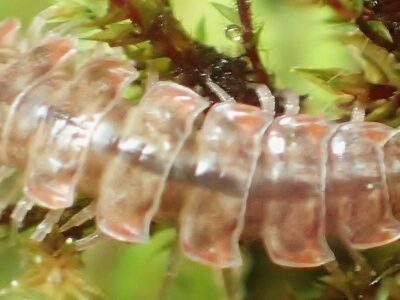
The body segments of U. robustus are arranged with precision, each one bearing its complement of legs in a rhythmic pattern that extends the full length of the creature. Polydesmids grow and develop through a series of molts, adding segments until they reach a fixed number in the adult stage, a mode of development known as teloanamorphosis. This careful, measured growth distinguishes soil millipedes from their relatives and allows them to reach their mature form with predictable precision.
In the darkness of the soil ecosystem, Ulodesmus robustus moves with the slow, deliberate pace characteristic of its kind. Polydesmids are very common in leaf litter, where they burrow by levering with the anterior end of the body, feeding on decaying vegetation. This humble existence belies the creature’s crucial ecological role—as a detritivore, it participates in one of nature’s most essential processes.
The millipede’s defensive strategy is equally fascinating. Gomphodesmidae are cyanogenic millipedes (the ones that produce cyanide-containing toxins), equipped with 11 pairs of glands opening along the sides of the body. When threatened, the millipede secretes these chemical deterrents, rendering itself unpalatable to potential predators. This chemical arsenal, though potent, serves as a last resort—the millipede’s primary defense is simply to remain hidden in the soil where few creatures venture.
Ulodesmus robustus inhabits South Africa, where it has been recorded from specific localities in the country’s diverse ecosystems. The family Gomphodesmidae is native to Africa, and occurs primarily in savanna habitat (open-canopy grasslands) from South Africa north to Senegal and Ethiopia. This wide continental distribution speaks to the adaptability of the family, though individual species like U. robustus maintain more restricted ranges.
The species’ limited dispersal capacity shapes its distribution pattern. Few species of millipede are at all widespread; they have very poor dispersal abilities, depending as they do on terrestrial locomotion and humid habitats, factors that have favoured genetic isolation and rapid speciation, producing many lineages with restricted ranges. This makes each local population of U. robustus a unique evolutionary lineage, shaped by the specific conditions of its South African homeland.
The diet of Ulodesmus robustus centers on the slow decomposition of dead organic matter. Most millipedes are slow-moving detritivores, eating decaying leaves and other dead plant matter. As the millipede consumes this material, it extracts nutrients that would otherwise remain locked away in decomposing wood and leaves.
This feeding behavior transforms the millipede into an ecological engineer of profound importance. By processing dead plant matter, U. robustus and its relatives break down complex organic compounds and return essential nutrients to the soil. All species of Sphaerotheriida are detritivores, feeding on dead organic matter such as leaves and wood on the forest floor, and like earthworms, they play an important role in decomposition; by breaking down decaying organic matter they release locked up nutrients back into the soil, such recycling is essential for plant nutrition and accordingly for the entire ecology. The same principle applies to U. robustus and other Gomphodesmidae—they are nature’s recyclers, quietly maintaining the fertility of African soils.
Like all millipedes, Ulodesmus robustus reproduces through a specialized system involving modified male legs. Reproduction in most species is carried out by modified male legs called gonopods, which transfer packets of sperm to females. The specifics of courtship and mating in this particular species remain largely undocumented in scientific literature, a reminder of how much we still have to learn about soil-dwelling invertebrates.
The development of young millipedes follows a remarkably consistent pattern. Millipedes in this order typically develop through a series of eight stages, hatching with only 7 segments (including the telson) and 3 pairs of legs, then molting seven times, these eight stages featuring 7, 9, 12, 15, 17, 18, 19, then finally 20 segments, and the adults then reproduce and die without another molt. Each molt represents a threshold crossed, a step toward maturity and the ability to reproduce.
The conservation status of Ulodesmus robustus remains undocumented in major conservation databases, reflecting the general lack of attention paid to soil invertebrates. This absence of data itself tells an important story—millipedes, for all their ecological importance, have historically been overlooked in conservation planning. With only five recorded occurrences in scientific databases, U. robustus represents a species about which we know remarkably little.
However, the broader threat landscape facing millipedes is becoming increasingly clear. Climate changes and other environmental factors resulting from human activities such as land use changes and forest fragmentation have already affected and will increasingly affect animal species, especially poikilotherms which are in contact with soil litter, such as millipedes, the reduction of number of species is the most evident, this important taxa has received very little attention in terms of conservation study on animal biodiversity in Africa and particularly in Cameroon, and to date, no conservation mesure and status are defined for these species in Cameroon, this despite the alarming rate of conversion of forest into cultivated land. These pressures likely extend to South Africa and threaten species like U. robustus as well.
Conservation note: The true ecological importance of soil millipedes demands greater attention from conservation biologists. As climate change and habitat fragmentation accelerate, these humble detritivores may face mounting pressures that go largely unnoticed until populations collapse.
First appearing in the Silurian period, millipedes are some of the oldest known land animals—U. robustus belongs to a lineage that has survived over 400 million years of planetary change.
Despite their name, millipedes do not have a thousand feet. Although the name “millipede” derives from Latin for “thousand feet”, no species was known to have 1,000 or more until the discovery in 2020 of Eumillipes persephone, which can have over 1,300 legs.
Gomphodesmidae are cyanogenic millipedes, making them one of nature’s chemical factories—they produce cyanide-based toxins as a defense mechanism against predators.
There are approximately 12,000 named species classified into 16 orders and around 140 families, making Diplopoda the largest class of myriapods, an arthropod subphylum that also includes centipedes.
Millipedes are crucial to soil health and ecosystem function. They have been used for bio-indication of environmental changes, their propriety for environmental studies is based on their limited dispersal capacities; they are wingless and they move relatively slowly.
Millipedes are generally harmless to humans, although some can become household or garden pests—a far cry from their fearsome reputation in popular culture.
The Gomphodesmidae family has cultural significance in parts of Africa, where certain species are consumed as food, highlighting the diverse ways humans interact with these arthropods across the continent.
Enghoff, H., Manno, N., Tchibozo, S., et al. (2014). “Millipedes as Food for Humans: Their Nutritional and Possible Antimalarial Value—A First Report.” Evidence-Based Complementary and Alternative Medicine, 2014, article ID 651768.
Hoffman, R.L. (2005). “Monograph of the Gomphodesmidae: A Family of African Polydesmoid Millipeds.” Museum of Natural History, Vienna.
Olsen, S.A., Rosenmejer, T., & Enghoff, H. (2020). “A Mountain of Millipedes IX: Species of the Family Gomphodesmidae from the Udzungwa Mountains, Tanzania.” European Journal of Taxonomy, 675, 1-35.
Armstrong, A.J., & Hamer, M.L. (2015). “English Names of the Millipedes (Diplopoda) of KwaZulu-Natal.” African Invertebrates, 56(1), 147-159.
Wikipedia contributors. (2025). “Millipede.” Wikipedia, The Free Encyclopedia.