Animals
| Kingdom | Animalia |
|---|---|
| Phylum | Chordata |
| Class | Mammalia |
| Order | Diprotodontia |
| Family | Petauridae |
| Genus | Petaurus |
| Species | Petaurus breviceps |
In the moonlit canopies of Australia’s eucalyptus forests, a tiny acrobat performs death-defying leaps through the darkness, its silky membrane stretched wide like a living parachute. The Sugar Glider, one of nature’s most endearing marsupials, has captured hearts worldwide with its enormous eyes, gentle demeanor, and remarkable ability to sail effortlessly between trees. These pocket-sized gliders represent millions of years of evolutionary perfection, transforming the night sky into their personal highway.
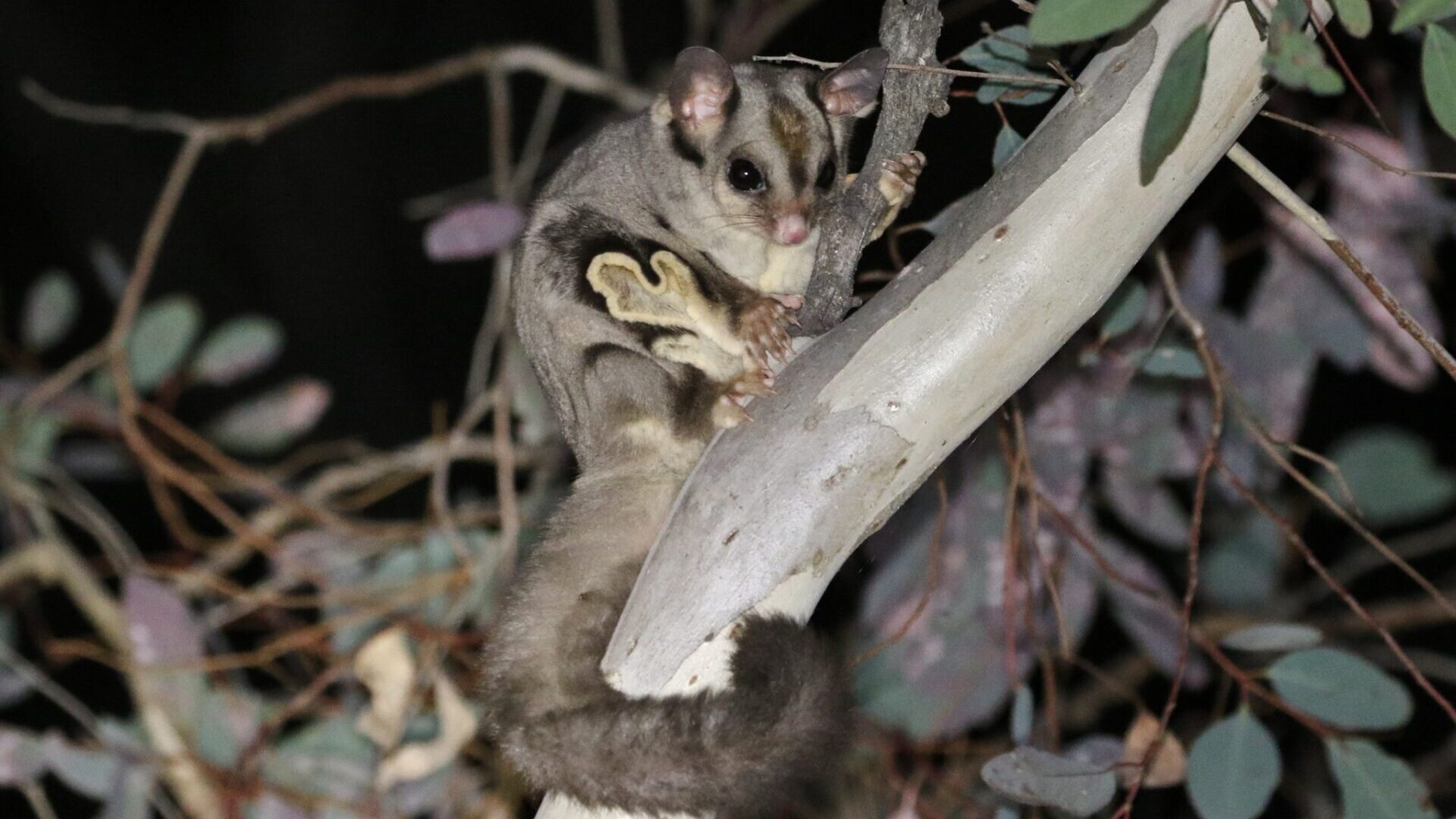
The Sugar Glider is a diminutive marvel, measuring just 12-17 centimeters in body length with an equally long, feathery tail that serves as both rudder and blanket. Weighing a mere 90-150 grams—roughly equivalent to a small apple—these creatures pack incredible charm into their petite frames. Their most striking feature is undoubtedly their enormous, bulging eyes, perfectly adapted for nocturnal vision and giving them an almost cartoon-like appearance that melts even the coldest hearts.
Their soft, dense fur ranges from pearl grey to brownish-grey on the back, with a distinctive dark stripe running from nose to tail, while their bellies shine cream to pale yellow. The gliding membrane, called a patagium, stretches from wrist to ankle on each side, creating wing-like flaps that remain hidden until the moment of flight. Notable feature: Their hands are remarkably human-like, with opposable thumbs and long, delicate fingers tipped with sharp claws perfect for gripping bark.
Key identification characteristics include:
As the sun sets across the Australian landscape, Sugar Gliders emerge from their cozy tree hollows to begin their nightly adventures. These highly social creatures live in family groups of 6-10 individuals, sharing communal nests and engaging in elaborate grooming rituals that strengthen their bonds. Their nights are filled with acrobatic displays as they glide up to 50 meters between trees, using their tail as a rudder to execute precise landings on target branches.
Social behavior: Sugar Gliders communicate through a complex vocabulary of chirps, clicks, and barking calls that echo through the forest canopy. They mark their territory and family members with scent glands, creating a chemical map of their world. During cold weather, entire families huddle together in tree hollows, their body heat creating a warm microclimate that helps them survive chilly nights.
Their gliding ability is nothing short of spectacular—launching themselves from heights of 30 meters or more, they can cover horizontal distances that would be impossible for ground-dwelling animals of their size. Key behavioral traits include:
• Strictly nocturnal activity patterns
• Highly social family group living
• Territorial scent marking
• Communal nesting and grooming
• Seasonal torpor during cold periods
• Complex vocal communication system
Sugar Gliders inhabit the eastern and northern coastal regions of Australia, from Queensland down through New South Wales and into Victoria, with populations also found in Tasmania and parts of South Australia. Their range extends from sea level to elevations of 1,200 meters, wherever suitable eucalyptus forests provide the tree hollows and food sources they require for survival.
These adaptable marsupials thrive in a variety of forest types, from coastal woodlands to mountain ash forests, but they show a strong preference for areas with:
• Dense canopy cover for gliding corridors
• Abundant tree hollows for nesting
• Diverse plant species for food variety
• Minimal habitat fragmentation
• Presence of wattle trees for gum harvesting
Conservation note: While still relatively common across much of their range, Sugar Glider populations face increasing pressure from habitat clearing, urban development, and climate change, making forest conservation critical for their long-term survival.
Sugar Gliders are opportunistic omnivores with a particular sweet tooth that earned them their delightful name. Their diet revolves around the sugary sap and gum that oozes from wattle trees and eucalyptus, which they harvest by making small incisions in the bark with their sharp teeth. This high-energy food source fuels their active nighttime lifestyle and provides essential nutrients during lean periods.
Beyond their namesake sweets, these versatile foragers consume a diverse menu that changes with the seasons. During spring and summer, they feast on nectar from flowering trees, supplemented by protein-rich insects, spiders, and small vertebrates. Their diet includes:
• Tree sap and gum (primary energy source)
• Nectar from eucalyptus and banksia flowers
• Insects, beetles, and moths
• Bird eggs and small nestlings
• Pollen and honeydew
• Seasonal fruits and seeds
Feeding strategy: Sugar Gliders are methodical foragers, often returning to the same productive trees night after night. They use their keen sense of smell to locate the sweetest sap flows and their nimble fingers to extract insects from bark crevices, making them efficient harvesters of the forest’s bounty.
The Sugar Glider’s breeding season coincides with Australia’s warmer months, typically from June through January, when food resources are most abundant. Males become increasingly territorial during this period, using scent marking and vocalizations to establish dominance and attract females. Courtship involves elaborate gliding displays and gentle grooming sessions that strengthen pair bonds within the family group.
After a remarkably brief gestation period of just 15-17 days, females give birth to 1-2 tiny, underdeveloped joeys no larger than rice grains. These helpless newborns crawl into their mother’s pouch, where they attach to a nipple and continue developing for the next 60-70 days. Remarkable adaptation: The mother’s pouch opens backward, preventing the joeys from falling out during her acrobatic gliding sessions.
Once they emerge from the pouch, young Sugar Gliders remain in the family nest for another 6-8 weeks, gradually learning to glide under their parents’ watchful guidance. The entire family participates in raising the young, with older siblings often helping to groom and protect the newest members. Breeding characteristics include:
• Seasonal breeding from June to January
• Gestation period of 15-17 days
• Litter size of 1-2 joeys
• Pouch development for 60-70 days
• Family group cooperation in child-rearing
• Sexual maturity reached at 8-12 months
1. Jackson, S. M. (2000). “Glide angle in the genus Petaurus and a review of gliding in mammals.” Mammal Review, 30(1), 9-30.
2. Russell, E. M. (1984). “Social behaviour and social organization of marsupials.” Mammal Review, 14(3), 101-154.
3. Smith, A. P. (1982). “Diet and feeding strategies of the marsupial sugar glider in temperate Australia.” Journal of Animal Ecology, 51(1), 149-166.
4. Suckling, G. C. (1984). “Population ecology of the sugar glider, Petaurus breviceps, in a system of fragmented habitats.” Australian Wildlife Research, 11(1), 49-75.
5. Australian Museum. (2021). “Sugar Glider – Petaurus breviceps.” Australian Museum Online. https://australian.museum/learn/animals/mammals/sugar-glider/