Animals
| Kingdom | Animalia |
|---|---|
| Phylum | Arthropoda |
| Class | Diplopoda |
| Order | Julida |
| Family | Parajulidae |
| Genus | Ptyoiulus |
| Species | Ptyoiulus impressus |
Meet the flocculent tailed millipede, Ptyoiulus impressus, a North American arthropod that is most commonly spotted during the fall months. This quiet, unassuming creature spends its days methodically working through the leaf litter and decaying plant material of eastern forests, a tiny but essential decomposer that few people ever notice. Yet for those patient enough to observe, Ptyoiulus impressus reveals an intricate world of adaptation and survival hidden beneath our feet.
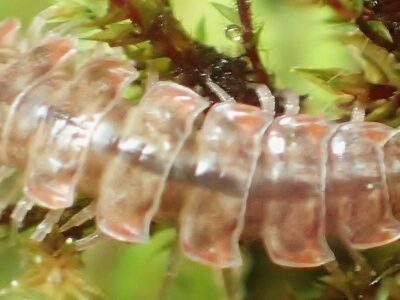
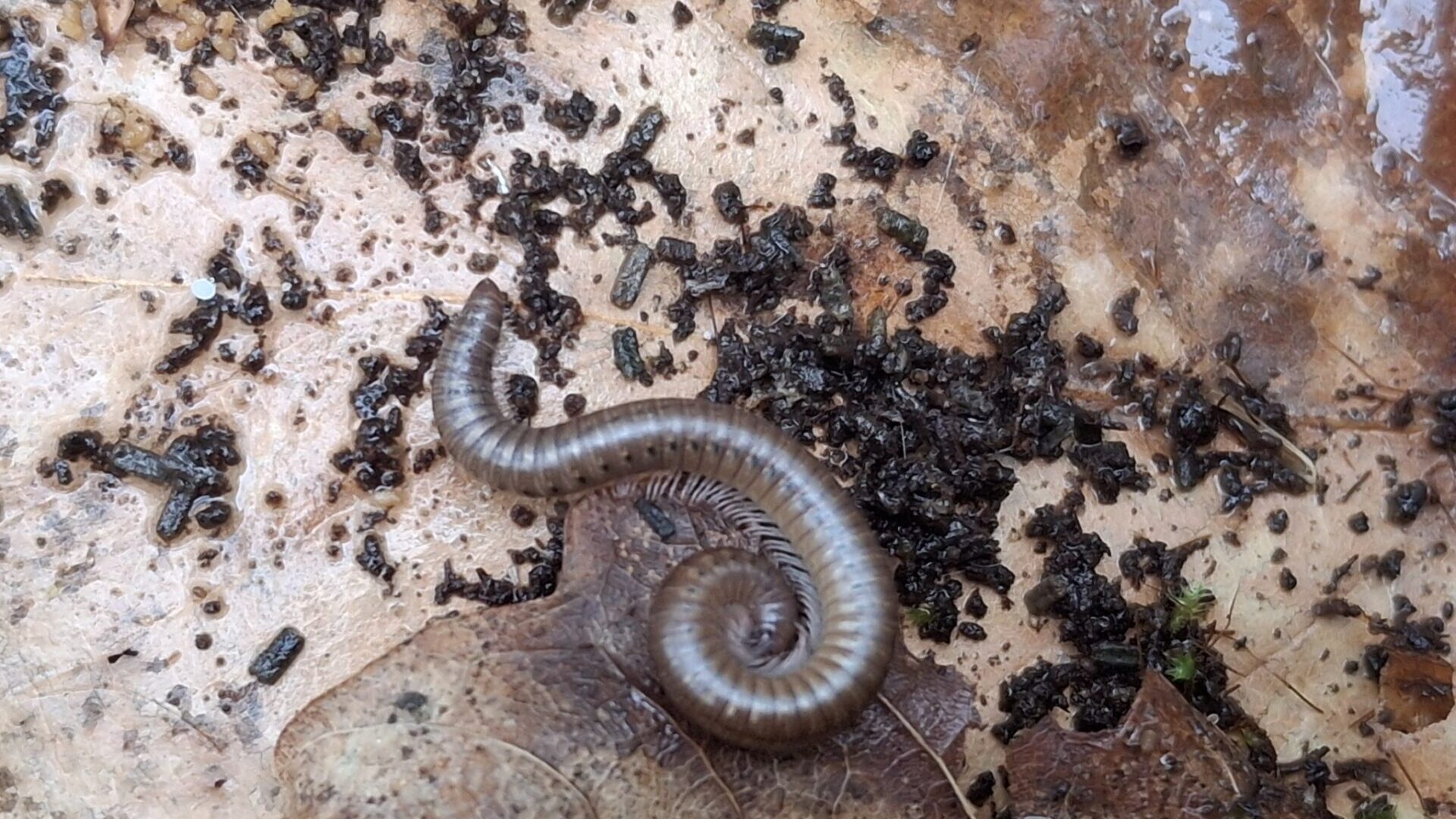
The body is usually a mottled, subuniform dark brown, gray, or black, providing excellent camouflage against the forest floor where it lives. This millipede belongs to the family Parajulidae, a group characterized by their cylindrical bodies and numerous paired legs—one pair per body segment. The creature’s most distinctive feature lies in its reproductive anatomy: males possess a gonopod with a laminate, serrate calyx at the tip of the anterior coxal process, a specialized structure used during mating that sets P. impressus apart from its closest relative, P. montanus.
While specific measurements are limited in the available literature, like most parajulid millipedes, P. impressus is relatively modest in size—small enough to navigate through soil pores and leaf debris with ease. The species prefers wooded areas and moist environments, where humidity levels support its permeable exoskeleton and prevent dehydration.
The life cycle includes larval and adult stages, with mature adults more commonly observed in the fall. This seasonality is a key characteristic of the species—autumn is when populations become most visible to observers, likely due to increased activity as the creatures prepare for winter dormancy. The millipede’s daily existence revolves around a simple but essential mission: locating and consuming decaying organic matter.
These arthropods are primarily nocturnal foragers, emerging under cover of darkness to navigate through the complex three-dimensional world of the forest floor. Habitat characterizations from scientific samples include “bottomland hardwoods,” “under decaying pine tree bark,” “woods, pitfall traps,” “wooded hillside,” “in ravine,” and “oak-maple litter”—all environments where decomposing plant material accumulates. The millipede’s slow, deliberate movement through these microhabitats allows it to efficiently process large quantities of dead organic matter.
The range spans from Quebec to Florida and includes western states like Wisconsin and Arkansas. Ptyoiulus impressus occupies every state except perhaps Louisiana and is the only species in areas that were inundated during the Cretaceous and glaciated during the Pleistocene. This expansive distribution makes it one of the most widespread millipede species in eastern North America.
The genus occupies a broad area between the Mississippi River and Atlantic Ocean extending from southern New England, Ontario, and Michigan to the Florida Panhandle, with four small disjunct populations—from Montreal, Québec, to northern Vermont; along southwestern Lake Michigan in Wisconsin and Illinois; northeastern/eastcentral Arkansas; and a point locality in northeastern Louisiana. Distribution patterns suggest an old species, montanus, being actively displaced by the younger and more successful impressus. Recent observations confirm the species’ continued presence across its range, with iNaturalist data showing 357 documented occurrences spanning from Maine to Georgia and from New York to the Midwest.
The species is herbivorous, feeding primarily on decaying plant material. This dietary specialization makes P. impressus a critical component of forest ecosystems, breaking down dead leaves, wood, and other organic debris that would otherwise accumulate. Millipedes like this species play a vital role in nutrient cycling, fragmenting large pieces of dead matter into smaller particles that soil microorganisms can further decompose.
The feeding process is continuous throughout the active season. As the millipede crawls through leaf litter and soil, it consumes whatever decomposing plant material it encounters, processing it through its digestive system and returning nutrients to the soil. Mature adults are more commonly observed in the fall, suggesting peak activity and feeding during this period. This seasonal feeding pattern likely reflects the abundance of freshly fallen leaves in autumn, providing an abundant food source.
Details on reproduction are limited, but typical for many millipedes, it likely involves the laying of eggs after mating. The male’s specialized gonopod structure—with its serrate calyx—plays a crucial role in transferring sperm packets to females during mating. This reproductive anatomy is so distinctive that it serves as the primary characteristic used to distinguish P. impressus from P. montanus in scientific identification.
The breeding season likely corresponds with the fall activity peak, when mature adults become most abundant. Like other millipedes, P. impressus females probably deposit eggs in protected microhabitats within the soil or leaf litter, where developing young can feed on decomposing matter in safety. The complete developmental timeline from egg to adult remains poorly documented in the scientific literature, though it likely spans multiple seasons given the creature’s small size and modest metabolic rate.
With over 1,200 observations recorded on iNaturalist and widespread distribution across eastern North America, P. impressus appears to maintain healthy populations throughout its range. The species has successfully colonized diverse habitats from urban parks to pristine forests, demonstrating remarkable adaptability. Recent sightings from 2025 and early 2026 confirm ongoing presence across multiple states, including Pennsylvania, New York, Ohio, Virginia, North Carolina, Georgia, and Alabama.
No formal conservation assessment has been published for this species, and it is not listed as threatened or endangered. The primary ecological concern involves habitat loss through deforestation and urban development, which reduces the availability of suitable wooded areas with adequate moisture and organic matter. However, the species’ broad geographic range and ability to persist in fragmented habitats suggest it is not currently facing significant population-level threats. Maintaining healthy forest ecosystems with adequate leaf litter and deadwood remains the best conservation approach for this and countless other decomposer species.
The species is notably recognized for its male gonopod characteristics and is most commonly spotted during the fall, making autumn the prime season for millipede hunters seeking to observe this species.
While the distribution of P. montanus covers only four latitudinal degrees, P. impressus spans around 15 degrees of latitude, making it far more successful at colonizing diverse regions.
The millipede’s scientific name has a complex taxonomic history, having been originally described as Julus impressus by Thomas Say in 1821 and later reclassified multiple times before settling on its current designation.
When the Cretaceous Western Interior Seaway receded, P. impressus spread southward into the formerly inundated area, demonstrating the species’ ability to colonize new habitats over geological timescales.
These millipedes serve as a crucial food source for numerous predators including centipedes, spiders, ground beetles, and small vertebrates, playing a vital role in forest food webs despite their small size.
Male first legs are greatly enlarged and strongly forcipulate, clearly more so than in other eastern family-group taxa, giving males a distinctly different appearance from females.
The species’ ability to thrive in both pristine forests and disturbed habitats, including urban gardens and park leaf litter, demonstrates remarkable ecological flexibility for such a small creature.
Shelley, R. M., & Smith, J. M. (2016). “Parajulid milliped studies XII: Initial assessment of Ptyoiulus Cook 1895 and neotype designations for Julus impressus Say 1821 and J. montanus Cope 1869.” Insecta Mundi, 522, 1-21.
Say, T. (1821). “Description of the Myriapoda of the United States.” Journal of the Academy of Natural Sciences of Philadelphia, 3, 102.
iNaturalist Community. “Ptyoiulus impressus (Flocculent Tailed Millipede).” Retrieved from iNaturalist.org, 2025.
BugGuide.Net. “Ptyoiulus impressus – Millipede in North America.” Retrieved from BugGuide.Net, 2025.