Fungi
| Kingdom | Fungi |
|---|---|
| Phylum | Basidiomycota |
| Class | Pucciniomycetes |
| Order | Pucciniales |
| Family | Milesinaceae |
| Genus | Milesina |
| Species | Milesina whitei |
Milesina whitei stands as one of nature’s most intricate parasites, a rust fungus that orchestrates an elaborate dance between two entirely different plant kingdoms. Found across the temperate forests of Europe and North America, this microscopic master of deception alternates its life between the needles of fir trees and the delicate fronds of ferns, completing a biological cycle so complex it rivals the most sophisticated strategies in nature.
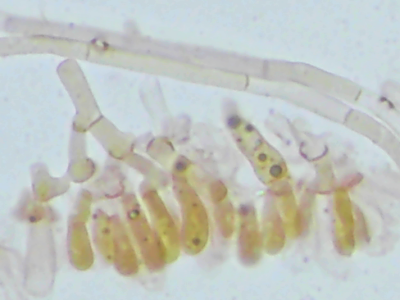
The urediniospores of Milesina whitei are hyaline (transparent), ellipsoidal to oval in shape, measuring 27.5–40.0 × 16.5–25.0 micrometers, with a wall thickness of 0.5–1.0 micrometers. These microscopic spores appear remarkably consistent in their form, making them useful for identification under the microscope.
Milesina species are distinguished based on host taxonomy and urediniospore morphology, with characteristics including the size, shape and ornamentation of urediniospores. The spores possess distinctive germ pores—tiny openings through which the fungus penetrates its host—that vary in number and position between species. Under scanning electron microscopy, the surface texture reveals fine details crucial for separating Milesina whitei from its congeners.
Identification tip: Look for the characteristic hyaline, smooth to faintly ornamented urediniospores on the undersides of infected fern fronds. The fungus produces visible pustules (sori) that form yellow to orange masses on the host tissue.
Milesina whitei host-alternates between needles of fir (Abies spp.) and fronds of ferns (species of Polypodiales). This heteroecious lifestyle—requiring two unrelated host plants to complete its reproductive cycle—represents one of the most sophisticated survival strategies in the fungal kingdom.
The fungus begins its season on fir needles, where it produces aecia (cup-like fruiting structures). Aeciospores are released and windborne to fern fronds, where they germinate and establish infection. On ferns, the fungus produces uredinia, which generate urediniospores capable of reinfecting fern fronds repeatedly throughout the growing season. Later in the season, as conditions change, the fungus produces telia, which form overwintering structures. When spring arrives, basidiospores from these telia are carried back to fir needles, completing the circle.
Species of Milesina may cause symptoms on fern fronds including pale green to yellow spots, which later become necrotic and are typically confined by veins. The fungus remains entirely dependent on moisture for spore germination and host penetration, making humidity a critical factor in its survival.
Species of rust fungi of the genus Milesina are distributed mainly in northern temperate regions. Milesina whitei occurs across a wide range spanning from the British Isles and continental Europe to North America, with documented records from Switzerland, Austria, the Netherlands, France, Germany, Croatia, Montenegro, Jersey, Ireland, Canada, and the United States.
The fungus thrives in cool, moist forest environments where both its alternate hosts grow in proximity. It shows particular preference for ravines, gorges, and other humid microhabitats where ferns flourish beneath conifer canopies. The geographic distribution reveals a preference for mountainous and coastal regions with adequate moisture, conditions essential for spore dispersal and host infection.
Milesina species are important in forest ecosystems as they regulate host populations and contribute to biodiversity through complex host interactions. By infecting fern fronds, Milesina whitei affects the photosynthetic capacity of its hosts, influencing energy flow through forest understory communities. The fungus also serves as food for various microscopic organisms and may influence nutrient cycling through its effects on host plant physiology.
Milesina species are not known to cause major economic damage, distinguishing them from destructive agricultural rusts. Their ecological impact remains subtle, operating within the complex web of forest interactions rather than causing catastrophic plant death. The fungus demonstrates the delicate balance maintained in natural ecosystems, where parasites and hosts coexist in evolutionary equilibrium.
Milesina whitei is not consumed and has no culinary applications. As an obligate plant pathogen—an organism that can only survive by parasitizing living plant tissue—it offers no nutritional value and would be inedible in any practical sense.
The scientific interest in Milesina whitei lies primarily in mycological research and forest ecology. Specimens of Milesina species have been examined by light and scanning electron microscopy for urediniospore morphology with a focus on visualising germ pores and echinulation. The fungus serves as a subject for understanding rust biology, host-pathogen interactions, and the evolution of heteroecious parasitism.
Edibility warning: This is not an edible fungus. Its value is entirely scientific and ecological.
The rust life cycle can involve up to five spore stages, both sexual and asexual, and may be completed on a single host (autoecious rust) or require two, unrelated host plants (heteroecious rust) for completion—Milesina whitei represents the more complex heteroecious strategy.
The North American Milesina polystichi is considered conspecific with M. whitei by several authors, though they possess striking differences in germ pore numbers on urediniospores, highlighting ongoing taxonomic refinement in the genus.
Teliospores are either not formed regularly or at all in Milesina species, making identification dependent on the more commonly encountered urediniospore stage—a remarkable adaptation to forest life.
The fungus has been documented since at least 1914, when type specimens were collected in Croatia, yet it remains poorly known to the general public despite its widespread distribution across temperate forests.
The fern hosts of Milesina species include various members of Polypodiales, meaning the fungus may parasitize dozens of different fern species across its range, each representing a potential host.
Urediniospore morphology features are sufficient to distinguish Milesina whitei from most congeners, whereas ITS sequences separate only some Milesina species, demonstrating that microscopic examination remains essential for accurate identification.
The fungus represents an ancient evolutionary lineage; fern rusts are among the earliest diverging members of Melampsorineae, the second major radiation of the rust fungi, and belong to the two earliest families in this suborder (Milesinaceae and Pucciniastraceae).
Bubner, B., Buchheit, R., Friedrich, F., Kummer, V., & Scholler, M. (2019). Species identification of European forest pathogens of the genus Milesina (Pucciniales) using urediniospore morphology and molecular barcoding including M. woodwardiana sp. nov. MycoKeys, 48, 1–40.
Aime, M.C., & McTaggart, A.R. (2021). A higher-rank classification for rust fungi, with notes on genera. Fungal Systematics and Evolution, 7, 21–47.
Sinclair, W.A., & Lyon, H.H. (2005). Diseases of trees and shrubs (2nd ed.). Cornell University Press.
Faull, J.H. (1934). The biology of milesian rusts. Journal of the Arnold Arboretum, 15, 50–85.
Hiratsuka, N. (1936). A monograph of the Pucciniastreae. Memoirs of the Tottori Agricultural College, 4, 1–374.