The asterisk lichen owes its name to the striking star-shaped, or stellate, black apothecia that stud its pale crust like tiny bursts of ink on bark. Arthonia radiata is a common and widespread crustose lichen in the family Arthoniaceae, living tightly pressed into the smooth bark of trees and shrubs rather than growing upright like a leafy or shrubby lichen.
Its thallus is immersed directly into the bark surface, so the lichen reads almost as a stain rather than a separate organism at first glance. That subtlety, paired with the eye-catching black apothecia scattered across its surface, makes it a rewarding species for anyone learning to look closely at tree trunks.
Fruiting Body and Identification
The most reliable clue to Arthonia radiata is its combination of an immersed, pale thallus and black, variably shaped apothecia. The thallus itself is thin and sunk into the bark, colored white to pale grey, sometimes with a brownish or olive tinge, and it often forms a mosaic-like patchwork across the substrate. A thin brown line frequently marks the boundary between the lichen and the surrounding bark.
The apothecia are the most conspicuous feature: black, non-pruinose (never frosted-looking), and ranging from rounded to star-like (stellate) to elongated in outline. They measure between 0.15 and 2.2 mm across and sit flat or only slightly convex on the thallus surface.
Under the microscope, the apothecia show a thin brown to olive-brown epithecium that turns pale green with certain chemical reagents, sitting above a clear hymenium and a colorless to pale olive-brown hypothecium. The paraphysoids, slender sterile filaments within the hymenium, are 1–2 μm wide (occasionally widening to 3 μm) and often capped with darker brown tips. The ascospores are cylindric-obovoid to cylindrical, divided by three septa into four cells, measuring 15–20 μm long and 4.5–6 μm wide, with the uppermost cell not enlarged. Asexual pycnidia are rare, immersed and black, releasing small rod-shaped conidia around 4–5 μm long.
Distribution and Habitat
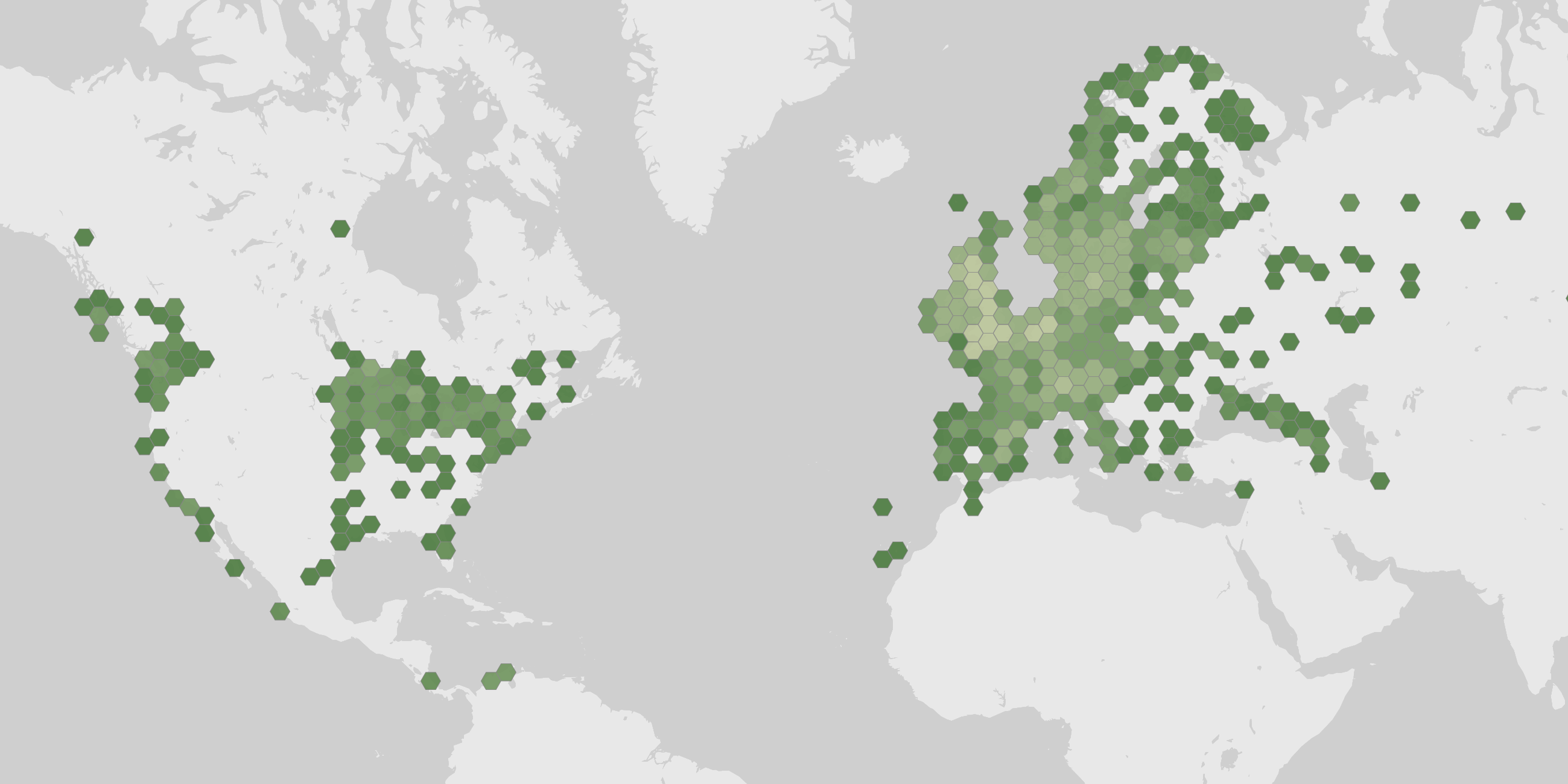
Arthonia radiata is a widespread and common lichen, growing on the smooth bark of a wide range of trees and shrubs. Its corticolous habit ties it closely to bark texture rather than to any single tree species, which helps explain its broad distribution.
Monthly observation counts show a seasonal pattern, with reports peaking in March (2,956) and staying relatively high through the early months of the year before declining toward a low point in November (1,597). This pattern likely reflects when the lichen is most noticed or recorded rather than a true change in abundance, since GBIF occurrence data reflect presence observations, not population size or a complete range.
Ecology and Relationships
Arthonia radiata lives on the bark of trees and shrubs, occupying the smooth outer surface without penetrating deeper tissue in the way a parasite would. Its presence on such a wide range of woody hosts underscores its role as a common, low-profile part of bark-surface communities.
The species itself hosts other fungi: lichenicolous species recorded growing on Arthonia radiata include Muellerella polyspora, Stigmidium arthoniae, and an undescribed species of Opegrapha. These fungi live on or within the lichen's tissues, forming another layer of biological relationships built on top of an already specialized bark-dwelling organism.
Fun Facts
- Arthonia radiata is the type species of the entire genus Arthonia, making it the reference point against which other species in the genus are compared.
- It was first described in 1794 by Christiaan Hendrik Persoon, who originally placed it in the genus Opegrapha under the name Opegrapha radiata.
- Erik Acharius later transferred it to the genus Arthonia in 1808, giving it the scientific name it carries today.