
Animals
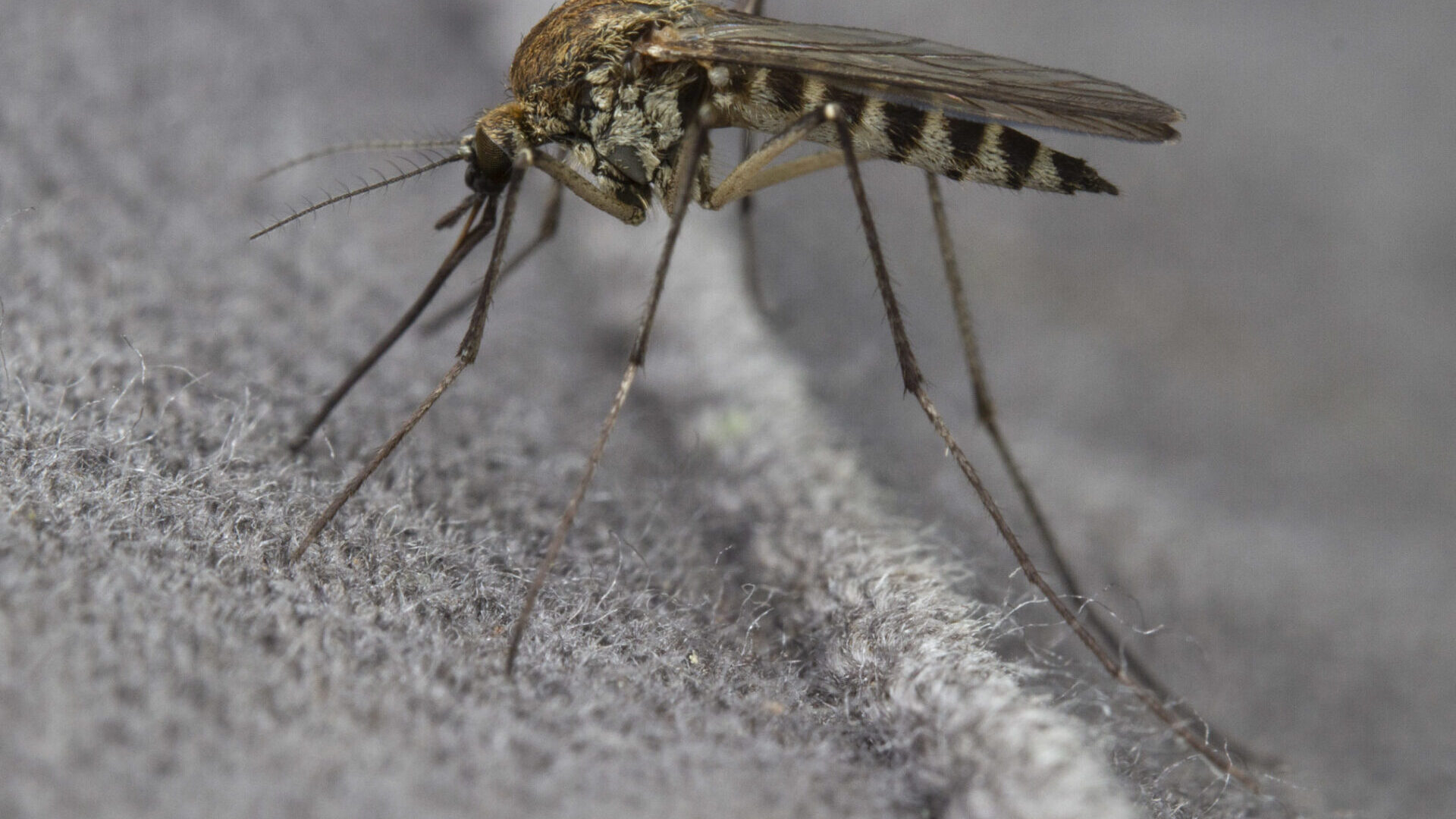
Aedes hexodontus, known by the common name six-toothed mosquito, is a specialized snow pool mosquito found across boreal and alpine regions of the Northern Hemisphere. Emerging from eggs in early April with most adults developed by late June, this species inhabits a wide altitudinal range between 2,300 and 3,400 meters in Colorado. This cold-adapted mosquito represents a fascinating example of how insects thrive in the harsh, ephemeral habitats created by seasonal snowmelt.
Aedes mosquitoes are visually distinctive because they have noticeable black and white banding and/or patches on their bodies and legs. Aedes hexodontus can be distinguished from closely related species through careful morphological examination. Adult females are distinguished by extensive scaling of the probasisternum, a diagnostic feature that sets this species apart from its congeners Aedes punctor and Aedes abserratus.
Six larval characters differ between Ae. hexodontus and Ae. punctor, though the ranges of each character overlap and none are diagnostic. The larvae are small and delicate, adapted for rapid development in temporary pools. Adult males possess the characteristic feathery antennae typical of male mosquitoes, while females have sparse, short antennal hairs.
Larvae of Aedes hexodontus are distributed continuously in grassy pools along the banks of rivers, making them inhabitants of a unique ecological niche. Boreal or snow pool Aedes mosquitoes possess a larval stage that hatches and matures in temporary ponds produced by melting snow during the spring. This adaptation to ephemeral water bodies requires rapid larval development and synchronized emergence.
Unlike most other mosquitoes, Aedes species are active and bite only during the daytime, with peak biting periods early in the morning and in the evening before dusk. Adult females of all three snow pool species survive well into late summer, with biting Ae. hexodontus recorded in late August in northern Utah. As summer progresses and pools dry, females face dwindling opportunities for both oviposition sites and blood meals.
Although oviposition behavior in snow pool Aedes is not well known, humidity seems to be the determining factor in site selection, and most larval habitats are temporary pools that are dry by mid-summer, making oviposition sites harder for females to recognize after the sites become dry.
GBIF records show Aedes hexodontus has been documented across a broad geographic range spanning North America and Europe. The species occurs in Norway, Sweden, and the United States, with particularly dense occurrence records from the western mountains of the continental U.S. and northern Scandinavian regions. Thirteen Aedes hexodontus populations from throughout the western United States exhibit a pattern of genetic variation that forms a north-south cline across Washington, Oregon, and California.
The species shows a marked preference for high-elevation habitats. In Colorado, Aedes hexodontus occurs in a wide altitudinal range between 2,300 and 3,400 meters. This elevation range reflects the species’ adaptation to cool climates and temporary snowmelt pools. The species thrives in boreal forests and alpine meadows where seasonal snowmelt creates suitable breeding habitat.
Aedes mosquitoes are active and bite only during the daytime, and like other mosquitoes in the genus, Aedes hexodontus females require blood meals for egg production. The species feeds on vertebrate hosts available in its alpine and boreal environments, including mammals and birds. Males, by contrast, feed on nectar and plant sugars rather than blood.
Larval Aedes hexodontus are filter feeders, consuming organic detritus, algae, and microorganisms suspended in their temporary pool habitats. The quality of larval nutrition directly influences adult size and reproductive capacity. Snow pools attract vertebrate hosts that serve as sources of blood meals, though hosts become less abundant as pools dry in mid-late summer.
Aedes hexodontus exhibits synchronized emergence patterns typical of snow pool mosquitoes. Adults emerge from eggs in early April with most individuals having emerged by the end of June. This coordinated timing ensures that males and females encounter each other during the brief window of favorable conditions in alpine and boreal regions.
Mating occurs shortly after adult emergence, with males detecting females through sensory receptors on their feathery antennae. After mating, females seek blood meals to develop their eggs. The female takes a blood meal to provide nutrients for egg production, with each female producing 100-200 eggs per batch depending on the size of the blood meal taken.
Females lay their eggs in damp substrates near the edges of snow pools. The eggs enter diapause, a dormant state that allows them to survive the harsh winter months and cold temperatures. This reproductive strategy ensures that eggs remain viable until the following spring’s snowmelt triggers hatching.
Little is documented about the specific conservation status of Aedes hexodontus. The species appears to be stable across its range, though its dependence on ephemeral snow pool habitats makes it potentially vulnerable to climate change and altered precipitation patterns. Genetic drift probably occurs through random larval mortality when snow pools are washed out during spring run-off.
Mountains do not appear to act as major barriers to gene flow in snow pool Aedes species, and instead seasonal differences in adult emergence may serve as barriers to migration among populations. The species’ wide altitudinal range and geographic distribution across multiple continents suggest it possesses considerable ecological flexibility. However, the timing and volume of snowmelt—factors increasingly affected by climate change—will likely influence future population dynamics.
No specific disease transmission role has been documented for Aedes hexodontus, distinguishing it from the medically important Aedes aegypti and Aedes albopictus. The species remains primarily of ecological and entomological interest rather than public health concern.
Six-toothed identifier: The common name “six-toothed mosquito” refers to specific morphological features used by entomologists to distinguish this species from congeners, particularly visible structures on the female genitalia.
Alpine specialist: Aedes hexodontus thrives at elevations exceeding 3,400 meters in some locations, making it one of the highest-altitude mosquito species in North America.
Rapid development: Larvae must complete their entire development cycle in the brief window between spring snowmelt and mid-summer pool desiccation—a race against time that has shaped their biology.
Synchronized emergence: Populations exhibit remarkable temporal coordination, with most adults emerging within a narrow timeframe to maximize mating opportunities in harsh alpine conditions.
Genetic diversity: Genetic variation forms a north-south cline across Washington, Oregon, and California, suggesting populations have adapted to regional climatic conditions over time.
Temporary habitat specialist: Unlike mosquitoes that breed in permanent water bodies, Aedes hexodontus has evolved to depend entirely on ephemeral snow pools, a strategy that requires precise physiological timing.
Circum-boreal distribution: The species’ presence across both North America and northern Europe reflects its ancient evolutionary history and adaptation to post-glacial boreal environments.
Harbach, R.E. (2018). Culicipedia: Species-group, genus-group and family-group names in Culicidae (Diptera). International Journal of Mosquito Research.
Carpenter, S.J. & LaCasse, W.J. (1955). Mosquitoes of North America (North of Mexico). University of California Press, Berkeley.
Wilkerson, R.C., Linton, Y-M., & Strickman, D. (2021). Mosquitoes of the World. Johns Hopkins University Press.
Darsie, R.F. & Ward, R.A. (1981). Identification and geographical distribution of the mosquitoes of North America, north of Mexico. University Press of Florida.