Plants
| Kingdom | Plantae |
|---|---|
| Phylum | Tracheophyta |
| Class | Magnoliopsida |
| Order | Solanales |
| Family | Solanaceae |
| Genus | Solanum |
| Species | Solanum pumilum |
In the sun-drenched glades and limestone outcrops of the southeastern United States, a diminutive member of the nightshade family quietly commands attention with its delicate beauty and remarkable resilience. Solanum pumilum, known as Carolina horsenettle, represents one of nature’s most charming contradictions—a plant that combines the gentle appearance of a wildflower with the hardy constitution of a survivor. This enchanting species has carved out its own ecological niche in some of the region’s most challenging habitats, where few other plants dare to flourish.
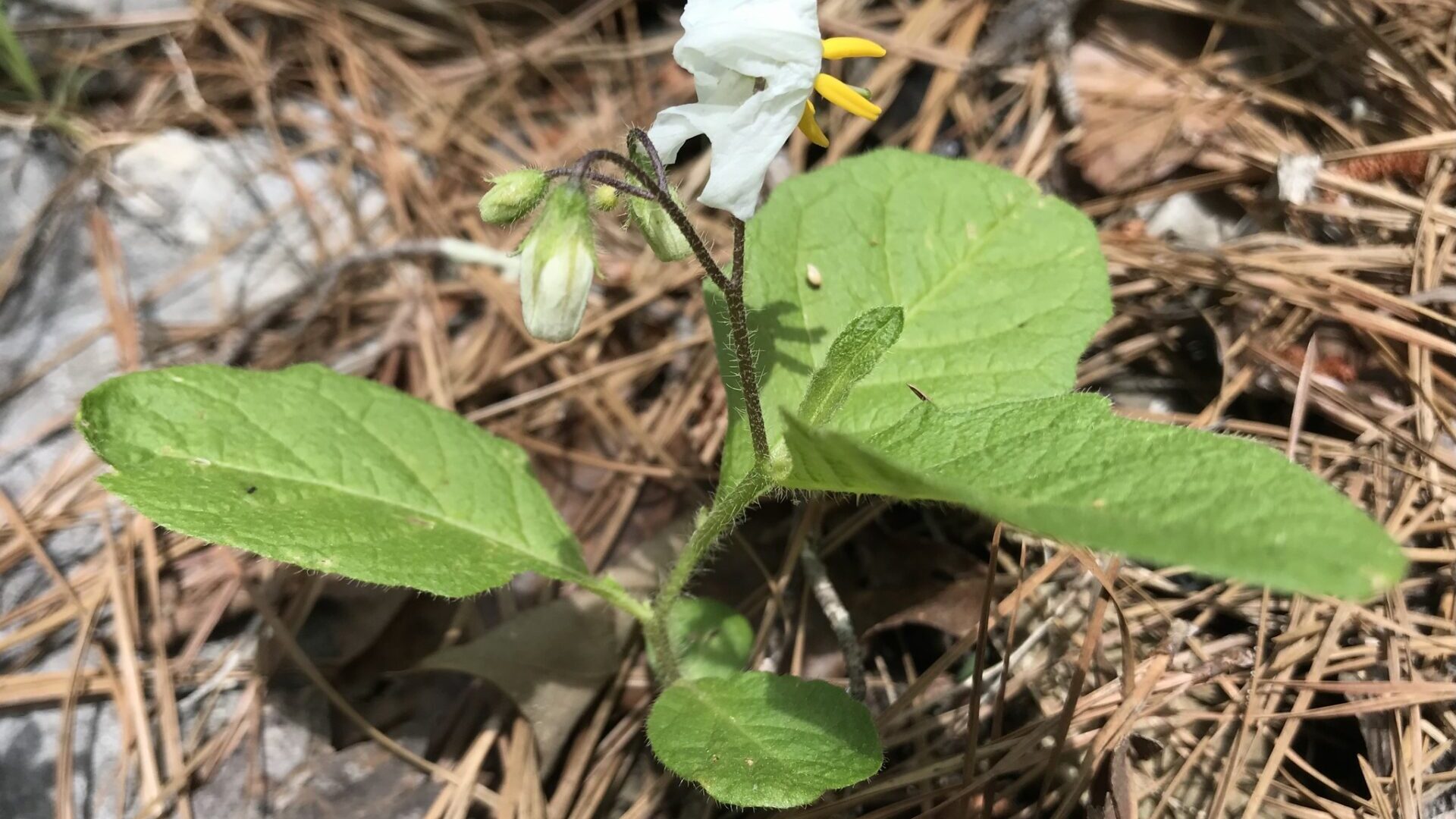
Carolina horsenettle presents itself as a low-growing perennial herb that rarely exceeds 30-60 centimeters in height, earning its “pumilum” designation, which literally means “dwarf” in Latin. The plant’s compact stature belies its robust character, with multiple branching stems that spread horizontally before ascending, creating a bushy, somewhat sprawling appearance that hugs the ground like a botanical embrace.
The leaves tell a story of adaptation and beauty, displaying an elliptical to ovate shape with gently undulating margins that catch and play with filtered sunlight. These deep green leaves, measuring 3-8 centimeters in length, possess a subtle texture that feels almost velvety to the touch, thanks to a fine covering of stellate hairs that shimmer silver in the right light.
Most distinctive feature: The flowers are where Carolina horsenettle truly shines, producing delicate five-petaled blooms that range from pristine white to the softest lavender-blue. Each flower, measuring about 2-3 centimeters across, features prominent yellow anthers that create a striking contrast against the pale petals, forming perfect stars that seem to glow against the plant’s modest foliage.
Carolina horsenettle follows the patient rhythm of a true perennial, investing its first year in developing an extensive underground root system that serves as both anchor and lifeline in harsh conditions. This subterranean network, often more impressive than the visible plant above, allows the species to survive periods of drought and disturbance that would devastate less prepared plants.
The plant’s reflects millions of years of evolutionary wisdom. Rather than racing skyward like many of its relatives, Carolina horsenettle spreads laterally, creating colonies through underground rhizomes that emerge as new shoots when conditions are favorable. This approach ensures survival even when individual stems are damaged by grazing, fire, or harsh weather.
Seasonal rhythm: Spring brings a burst of fresh growth as temperatures warm and daylight hours lengthen. The plant emerges from winter dormancy with remarkable vigor, quickly producing new stems and leaves that will support the upcoming flowering season. By late spring and early summer, the plant reaches its full glory, covered in a constellation of star-shaped blooms that attract pollinators from across the landscape.
The geographic story of Carolina horsenettle unfolds primarily across the southeastern United States, with significant populations documented throughout Alabama, extending into neighboring states and reaching as far south as the Yucatan Peninsula of Mexico and Guatemala. This distribution pattern reveals a plant perfectly adapted to the warm, humid subtropical climate that characterizes much of the American South.
Habitat preferences include:
The species shows a particular affinity for calcareous soils, thriving in areas where limestone bedrock influences soil chemistry. These challenging growing conditions, often too alkaline or nutrient-poor for many plants, provide Carolina horsenettle with a competitive advantage, allowing it to flourish where others struggle to survive.
The flowering season of Carolina horsenettle represents one of nature’s most delightful spectacles, typically beginning in late spring and extending through early summer when conditions are optimal. Each flower opens with the precision of a tiny clockwork mechanism, unfurling its five petals to reveal the golden treasure of pollen-laden anthers within.
Pollination occurs through a fascinating partnership with native bees, particularly small solitary species that have co-evolved with the plant over millennia. These industrious insects perform “buzz pollination,” vibrating their flight muscles at just the right frequency to release clouds of pollen from the flower’s poricidal anthers—a sophisticated mechanism that ensures efficient reproduction.
Reproductive strategy: Following successful pollination, the plant produces small, berry-like fruits that ripen to a deep purple-black color. These fruits, while toxic to humans, serve as an important food source for various bird species, which disperse the seeds across the landscape, ensuring the continuation of this remarkable species in new locations where conditions permit establishment.
While Carolina horsenettle lacks the extensive ethnobotanical history of some of its more famous nightshade relatives, indigenous peoples of the Southeast likely recognized and utilized various parts of the plant for traditional purposes, though specific historical records remain limited. Modern botanical interest in the species focuses primarily on its ecological value and potential for native plant gardening.
Cultivation considerations:
For gardeners interested in supporting native ecosystems, Carolina horsenettle offers an opportunity to cultivate a truly regional species that provides nectar for native pollinators while requiring minimal water or care once established in appropriate conditions.
• Ancient survivor: Carolina horsenettle belongs to the Solanaceae family, sharing ancestry with tomatoes, potatoes, and tobacco, yet has remained virtually unchanged for thousands of years
• Buzz pollination specialist: The plant’s flowers can only release their pollen when vibrated at specific frequencies, making native bees essential partners in reproduction
• Underground empire: A single plant can develop an extensive rhizome system spanning several meters, creating what appears to be multiple plants but is actually one interconnected organism
• Limestone lover: The species shows such a strong preference for calcareous soils that its presence often indicates underlying limestone geology
• Seasonal transformer: During winter dormancy, the entire above-ground portion dies back, leaving no trace of the vibrant colony that will emerge the following spring
• Pollinator magnet: Despite its small flowers, a single plant in full bloom can attract over a dozen different species of native bees and other beneficial insects
• Living fossil: Fossil evidence suggests that plants very similar to Carolina horsenettle existed in North America over 10 million years ago