Plants
| Kingdom | Plantae |
|---|---|
| Phylum | Rhodophyta |
| Class | Florideophyceae |
| Order | Gigartinales |
| Family | Caulacanthaceae |
| Genus | Caulacanthus |
| Species | Caulacanthus okamurae |
Caulacanthus okamurae is a red alga of remarkable subtlety, dwelling in the cool coastal waters where temperate oceans meet rocky shores. Named by Japanese phycologist Yamada in 1933, this crimson-hued organism represents one of nature’s most elegant solutions to life in the intertidal zone. Few plants capture the resilience and beauty of the marine realm quite like this delicate yet tenacious seaweed, thriving across an impressive range of Atlantic and Pacific coastlines.
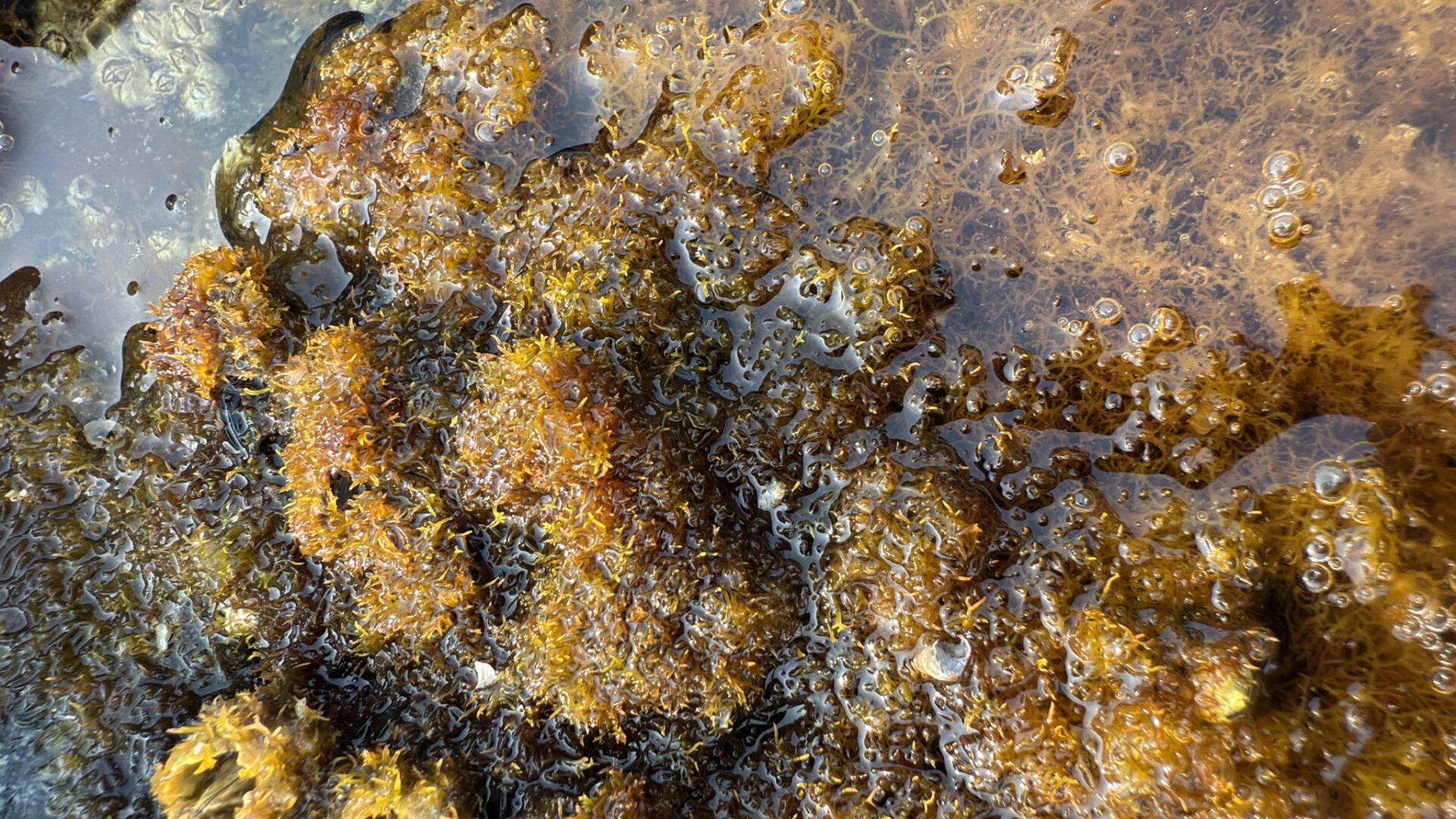
Caulacanthus okamurae is a small to medium-sized red alga displaying a distinctive branching structure that sets it apart from its relatives. The thallus typically reaches heights of 5-15 centimeters, though specimens can occasionally exceed this range. Its coloration ranges from deep crimson to burgundy, shifting toward purple-brown as the plant matures or experiences stress from environmental conditions.
The fronds display a delicate, feathery appearance with numerous fine branches radiating from a central axis. Each branch bears characteristic spiny projections—the “caudate” structures that give the genus its name—creating a texture that feels almost bristly to the touch. The overall morphology is compact and bushy rather than elongated, allowing the plant to withstand wave action and tidal currents.
Notable feature: The distinctive spiny branchlets serve both protective and reproductive functions, housing reproductive structures within their modified tissues. This adaptation demonstrates how marine algae have evolved intricate architectural solutions to simultaneous challenges of exposure and reproduction.
Caulacanthus okamurae follows the complex life cycles characteristic of red algae, alternating between diploid and haploid generations. This organism is perennial, persisting year-round in suitable habitats, though growth rates and biomass fluctuate with seasonal temperature and light availability. Peak growth typically occurs during spring and early summer when water temperatures warm and daylight hours extend.
The alga exhibits remarkable resilience in variable conditions. It tolerates salinity fluctuations common in coastal estuaries and adapts to the dramatic light changes of intertidal zones, where it may experience complete submersion during high tide and partial exposure during low tide. This capacity for physiological flexibility allows populations to thrive across diverse microhabitats within the same rocky shore ecosystem.
Reproduction occurs through multiple pathways:
These overlapping reproductive strategies ensure genetic diversity while maintaining population stability even when environmental stress limits sexual reproduction.
Caulacanthus okamurae displays a fascinating bipolar distribution pattern, occurring in temperate waters on both sides of the Atlantic and Pacific Oceans. iNaturalist data indicates the species has been documented across an impressive range spanning Belgium, the Netherlands, the United Kingdom, France, Spain, Morocco, Canada, the United States, and South Korea. This wide distribution reflects both natural dispersal mechanisms and human-mediated transport through shipping and aquaculture activities.
The species inhabits rocky intertidal and shallow subtidal zones, typically found at depths of 0-10 meters. It thrives in areas with strong wave action and good water circulation, preferring hard substrates—bedrock, boulders, and cobbles—where it attaches via a small holdfast. Preferred habitats include exposed rocky shores and wave-swept reefs where competing macroalgae are limited by physical disturbance. The plant tolerates cool to temperate waters ranging from approximately 8-18°C, explaining its abundance in northern Atlantic and Pacific regions while remaining absent from tropical seas.
Key habitat characteristics:
As a red alga, Caulacanthus okamurae does not produce flowers in the traditional sense, but rather develops specialized reproductive structures invisible to the naked eye. The species exhibits a triphasic life cycle involving gametophyte and sporophyte generations, each producing distinct reproductive organs. Female gametophytes develop carpogonia (female reproductive structures), while male gametophytes produce spermatangia that release motile spermatia into the water column.
Reproductive activity peaks during cooler months when water temperatures drop, typically from autumn through early spring in temperate regions. Fertilization occurs when spermatia contact carpogonia, initiating a complex developmental sequence that produces carpospores. These spores are released into the water and settle on suitable substrates, germinating into tetrasporophyte plants that subsequently produce tetraspores. This intricate reproductive choreography ensures genetic recombination while the asexual tetraspore stage maintains populations during periods when sexual reproduction is limited by environmental stress or low population density.
While Caulacanthus okamurae lacks the economic importance of larger kelps or the culinary applications of sea lettuce, this species holds significant value in marine ecology and scientific research. Phycologists study this alga as a model organism for understanding red algal reproduction, development, and environmental responses. In some regions, the species contributes to coastal ecosystem health by providing microhabitat for small invertebrates and juvenile fish, functioning as a keystone species within rocky shore communities.
Cultivation of Caulacanthus okamurae remains limited to research settings. Scientists maintain laboratory cultures to investigate its physiology, reproduction, and responses to environmental variables including temperature, light, and nutrient availability. The species shows promise for phycological education, allowing students to observe complete algal life cycles within controlled conditions. Its hardiness and moderate growth rate make it suitable for experimental studies on climate change impacts, as researchers use it to model how coastal algal communities may respond to warming oceans and changing light regimes.
Ancient evolutionary lineage: Red algae like Caulacanthus okamurae diverged from green plants over 1.5 billion years ago, making them among Earth’s most ancient photosynthetic organisms. Their unique pigment complement—including phycobilins—represents a completely different light-harvesting strategy than land plants.
Color-changing chameleon: This alga shifts its pigmentation based on light quality and intensity, appearing more purple-red in dim conditions and brighter crimson in strong light. This dynamic color adjustment allows optimal photosynthetic efficiency across varying underwater light spectra.
Microscopic sperm: Male red algae produce spermatia so small they lack flagella and cannot swim, instead drifting passively on ocean currents until chance encounters bring them to female reproductive structures. This bizarre reproductive strategy works remarkably well in the turbulent intertidal zone.
Bipolar wanderer: The species’ presence on both Atlantic and Pacific coasts suggests either ancient vicariance events or modern human-mediated dispersal through ballast water and shipping activities, making it a potential bioindicator of global marine transport patterns.
Tidal acrobat: Caulacanthus okamurae experiences dramatic daily cycles of submersion and exposure, enduring desiccation stress, osmotic shock, and extreme light fluctuations that would kill most other algae. Its cell walls contain specialized mucopolysaccharides that prevent water loss during low tide exposure.
Reproductive flexibility: This species can reproduce sexually or asexually, and can even switch reproductive modes mid-season depending on environmental conditions—a flexibility that ensures population persistence even when conditions limit sexual reproduction.
Living fossil: Molecular evidence suggests Caulacanthus represents an ancient red algal lineage with roots extending back millions of years, making each specimen a living connection to prehistoric ocean ecosystems.
Guiry, M.D. & Guiry, G.M. (2024). “AlgaeBase: World-wide electronic publication.” National University of Ireland, Galway. AlgaeBase.
Freshwater, D.W., Fredericq, S., Butler, B.S., Hemsley, M.M., & Hommersand, M.H. (1994). “The phylogenetic systematics of red algae (Rhodophyta).” Journal of Phycology, 30(3), 318-335.
Global Biodiversity Information Facility (GBIF). Caulacanthus okamurae occurrence records. Accessed via iNaturalist and GBIF databases.
Pereira, R. & Yarish, C. (2008). “Mass production of marine macroalgae for bioethanol: Cultivation of Saccharina latissima.” Journal of Applied Phycology, 20(5), 555-569.
Krayesky, D.M., Schmidt, W.E., & Fredericq, S. (2009). “Phylogeny and species diversity of Rhodophyta from the Gulf of Mexico.” Journal of Phycology, 45(5), 1138-1150.