Fungi
| Kingdom | Fungi |
|---|---|
| Phylum | Basidiomycota |
| Class | Agaricomycetes |
| Order | Polyporales |
| Family | Irpicaceae |
| Genus | Ceriporia |
| Species | Ceriporia reticulata |
Ceriporia reticulata is a wood-decay fungus that transforms dead timber into vital nutrients, quietly orchestrating one of nature’s most essential recycling processes. Found across the temperate regions of Europe and North America, this modest but industrious decomposer plays a silent yet crucial role in forest ecosystems. Despite its ecological importance, this species remains relatively obscure to casual naturalists—a hidden gem waiting to be discovered by those who venture into woodland shadows.
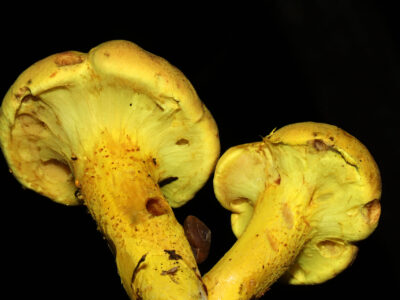
Identifying Ceriporia reticulata requires patience and a keen eye for subtle details. The fruiting body appears as a thin, shelf-like bracket or resupinate crust that spreads across decaying wood surfaces. The undersurface displays the most distinctive feature: a delicate pore surface with angular, often irregular pores that form a reticulate (net-like) pattern—the very characteristic that gives this species its scientific name.
The color palette is understated but elegant. Fruiting bodies typically display pale cream to pale brown tones, sometimes with a faint ochre or yellowish hue that deepens with age or moisture exposure. The pore surface, where spores are released, maintains a similar pale coloration, occasionally becoming slightly darker toward the margin. The texture is thin and brittle when dry, yet flexible when moist, adapting to the contours of its woody substrate like a second skin.
Identification cues to look for:
The life story of Ceriporia reticulata begins as invisible threadlike mycelium colonizing freshly fallen logs and branches. These delicate hyphae penetrate the wood with enzymatic precision, breaking down the complex polymers that give timber its strength. This decomposition process unfolds slowly over months or years, depending on wood moisture and temperature conditions.
When conditions align—adequate moisture, appropriate temperature, and sufficient nutrient availability—the mycelium commits to reproduction. Fruiting bodies emerge as thin crusts or brackets spreading across the wood surface, their pore surface facing downward to release countless microscopic spores into the air. Ceriporia reticulata is a perennial species, meaning individual fruiting bodies can persist and produce spores across multiple seasons. The fungus fruits most prolifically during autumn and winter months when moisture levels remain high and temperatures cool, though it may fruit sporadically throughout the year if conditions permit.
The species demonstrates remarkable efficiency in its decomposition strategy. Rather than competing aggressively with other wood-decay fungi, Ceriporia reticulata specializes in breaking down specific wood components, allowing it to coexist with other decomposers in a carefully balanced ecological partnership.
Ceriporia reticulata enjoys a wide distribution across temperate regions, with documented records from across Europe—from Scandinavia to the Mediterranean—and North America. iNaturalist data indicates over 4,100 documented occurrences, reflecting both the species’ widespread presence and the growing number of naturalists documenting fungi in their local areas.
This species shows a strong preference for decaying hardwood substrates. Dead logs, fallen branches, and standing deadwood of broadleaf trees provide the ideal habitat. The fungus thrives in moist environments where wood remains partially saturated, conditions commonly found in old-growth forests, woodland margins, and areas with high humidity. While Ceriporia reticulata appears adaptable to various forest types, it shows particular abundance in mixed deciduous and coniferous woodlands where fallen timber accumulates.
Preferred habitat characteristics:
Within forest ecosystems, Ceriporia reticulata functions as a master decomposer, participating in the grand cycle of nutrient recycling that sustains woodland health. As wood-decay fungi, species like this break down lignin and cellulose—the tough structural polymers that would otherwise accumulate indefinitely on the forest floor. Through this decomposition, nutrients locked within dead wood become available to living plants, completing cycles that have persisted for millions of years.
The presence of Ceriporia reticulata on decaying wood creates microhabitats for countless other organisms. Insects, mites, and other invertebrates shelter within the fungal fruiting bodies and the wood they colonize. These creatures, in turn, become food for birds and small mammals, weaving the fungus into complex food webs. Additionally, the mycelium’s enzymatic activity softens wood, making it accessible to woodpeckers and other cavity-nesting birds seeking nesting sites. This humble fungus thus contributes to forest structure, biodiversity, and the intricate relationships that define woodland communities.
Ceriporia reticulata is not recognized as edible and holds no culinary value. The thin, brittle fruiting bodies lack the substance and palatability that characterize choice edible fungi. More importantly, the species has not been studied for toxicity, and consuming unknown wood-decay fungi carries inherent risks.
Edibility warning: This species should not be consumed. Always verify the edibility of any fungus before considering it for culinary use, and never consume fungi identified only to genus level.
While not useful as food, Ceriporia reticulata holds scientific and ecological value. Mycologists study wood-decay fungi to understand decomposition processes, enzyme production, and forest nutrient cycling. The enzymatic systems these fungi employ may have biotechnological applications, from biofuel production to industrial enzyme development. For naturalists and woodland observers, Ceriporia reticulata represents a window into the hidden decomposition processes that sustain forest ecosystems—a reminder that not all fungi need to be eaten to be appreciated.
Invisible architects: The mycelium of Ceriporia reticulata can extend through wood for years before producing visible fruiting bodies, silently transforming timber into soil nutrients.
Net-like precision: The reticulate pore pattern that gives this fungus its name isn’t random—it represents an optimized structure for spore dispersal and water management.
Perennial persistence: Individual fruiting bodies can remain active across multiple seasons, continuously producing spores and adapting to changing environmental conditions.
Enzyme powerhouse: This fungus produces specialized enzymes called ligninases that break down one of nature’s toughest polymers, making it invaluable to forest recycling systems.
Forest medicine cabinet: The decomposition activity of species like Ceriporia reticulata creates nutrient-rich soil that feeds the next generation of forest plants and trees.
Woodpecker’s friend: By softening deadwood, this fungus indirectly creates nesting cavities used by woodpeckers, flickers, and other cavity-nesting birds.
Ancient partnership: Fungi like this have been decomposing wood for over 300 million years, playing the same ecological role since the first trees evolved.