Animals
Home »
| Kingdom | Animalia |
|---|---|
| Phylum | Chordata |
| Order | Cypriniformes |
| Family | Cyprinidae |
| Genus | Luxilus |
| Species | Luxilus cornutus |
Meet the common shiner, a small but spirited minnow that dances through North American rivers with a silvery flash that catches the eye. This freshwater fish is found in North America, where it plays a vital role in aquatic ecosystems while displaying remarkable behaviors and striking spawning colors that few observers ever witness.
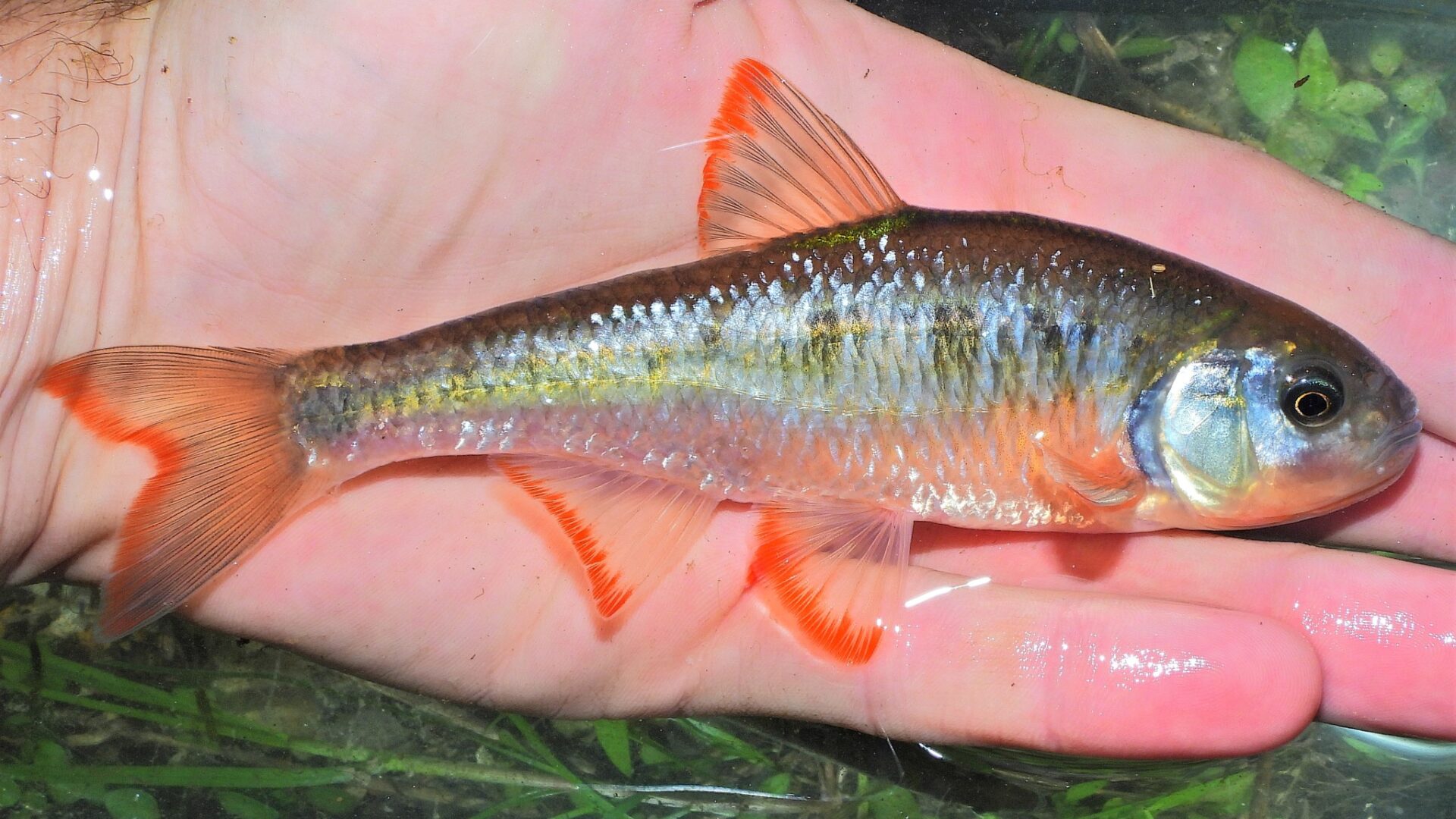
The common shiner ranges in length between 4 and 6 inches (10 and 15 cm), although they can reach lengths of up to 8 inches (20 cm). This modest size makes them easily overlooked, yet their appearance rewards closer inspection. The common shiner is silvery colored (sometimes bronze) and has an “olive back with a dark dorsal stripe”.
Their body structure reveals specialized adaptations for their habitat. The common shiner is a relatively deep-bodied minnow with a combination of 9 anal rays (rarely 8 or 10); deeper-than-wide anterior lateral scales; and more than five scales above the lateral line. It has horizontal stripes that sometimes can be seen in three bands: a pale mid-dorsal band, a darker stripe below it, and a second pale stripe below that. In comparison with Notropis, the common shiner’s head, eyes, and mouth are large, giving them an advantage in spotting and capturing prey.
The most dramatic transformation occurs during breeding season. In breeding males, the stripes become golden and the body bronze; dark crescent-shaped marks appear on the body; the head darkens to blue-gray; and the fins darken with a pink to red distal edge. Breeding males have a pinkish tint over most of their body and small bumps or tubercles on their head—physical weapons and displays that signal dominance during the intense competition for spawning sites.
Common shiners are deeply social creatures, their behavior shaped by the constant threat of predation. A distinct difference exists in daytime and nighttime behavior in the shiners. During the day they school, congregating in the lower half of one end or the other of the tank. Once the overhead lighting goes off they stop schooling and swim independently throughout the entire tank, including the middle and upper portions. This shift reflects their vulnerability to visual predators like bass and herons during daylight hours.
Adults inhabit rocky pools in small to medium rivers, where they position themselves to intercept drifting food. Common shiners are considered habitat generalists, but are said to prefer cool, clear streams with gravel substrates, little vegetation, and flowing water. They reside near pool–riffle complexes and become more dependent on pools as water levels decrease. The constant current keeps oxygen levels high and brings a steady supply of food.
They can live to be approximately 6 years old. They are considered sexually mature by 7.4 centimetres (2.9 in). This relatively short lifespan means each breeding season carries enormous importance for the species’ survival.
North America: Atlantic, Great Lakes, Hudson Bay, and Mississippi River basins from Nova Scotia to southeastern Saskatchewan, Canada and south to James River drainage in Virginia, northern Ohio, central Missouri and Colorado, USA. Their presence spans a vast geographic range, from the eastern seaboard to the continental interior. iNaturalist data indicates over 22,000 documented occurrences across their range, with recent observations continuing to confirm their widespread distribution throughout suitable stream habitats.
Common shiners are opportunistic feeders that hunt with surprising sophistication. The common shiner eats “terrestrial and aquatic insects, vegetation, and other fishes”. The common shiner feeds mainly at the surface or in midwater, but it is an opportunistic feeder.
Their feeding strategy shifts with the season and available prey. Aquatic insects, including both adults and larvae, are the primary food source, but small fishes and some plant materials are also eaten occasionally. Young shiners, barely visible to the naked eye, consume even tinier organisms like copepods and diatoms before graduating to larger prey as they grow.
Spawning transforms the common shiner into a fierce competitor. The common shiner reaches sexual maturity by 1–2 years of age, and produces between 400 and 4000 eggs per year. Common shiners spawn in spring between May and June, at temperatures of 16–26 °C (61–79 °F).
The spawning ritual is a complex dance of cooperation and conflict. Common shiners often spawn over the nest of a creek chub, river chub, or fallfish, although some males will make their own small nests. Gravel in riffles is also possible. Sometimes up to 100 common shiners will gather at one nest to compete for position. Spawning males are territorial and will often engage in fights with other males. Once the eggs are ready the male guards the nesting site. This parental investment ensures the eggs receive adequate oxygen and protection from silt, giving the next generation a fighting chance.
Common shiners are known to hybridize with other shiner species, particularly where their ranges overlap with related species. This genetic mixing creates populations of hybrid vigor, though it also complicates species identification in nature.
The common shiner maintains a status of Least Concern, reflecting its continued abundance across much of its range. However, this seemingly secure status masks troubling regional declines. It appears that the common shiner has declined in relative occurrence in the central and eastern portions of the state during the past century. The threats include pollution, dams, stream channel alteration, and altered stream flow.
Habitat degradation poses the greatest threat to their future. Although populations have not been quantitatively assessed, the species may be impacted by habitat impairments such as dams, pollution, and warming stream temperatures. Dams fragment populations, preventing migrations to spawning grounds. Siltation from erosion smothers the gravel beds essential for egg survival. Warming waters stress their preference for cool conditions.
Protecting cool river and stream habitat would likely benefit common shiners. Conservation efforts focusing on stream restoration, dam removal, and riparian protection offer hope for maintaining healthy populations. These small fish serve as environmental indicators—their presence signals a stream’s ecological health, while their absence warns of degradation.
The preferred water temperature is 21.9 °C (71.4 °F), making them sensitive thermometers of stream health as climate change warms freshwater ecosystems.
The lateral line has 34-38 scales; scales are large and easily seen, allowing these fish to detect the slightest vibrations in water—essential for hunting in murky conditions and avoiding predators.
Predators of the common shiner include fish (such as the smallmouth bass and chain pickerel) and birds, placing them at the center of aquatic food webs that sustain larger game fish prized by anglers.
Young common shiners reach maturity remarkably quickly—young common shiners reach maturity in their third summer, allowing multiple generations to spawn within a single human lifetime.
Male common shiners move stones with their snouts to excavate spawning pits, demonstrating surprising engineering ability in these tiny creatures.
The common shiner’s range spans over 2,000 miles from Nova Scotia to the Rocky Mountains, making them one of North America’s most widespread minnows despite their small size.
Page, L.M. and B.M. Burr. 2011. A field guide to freshwater fishes of North America north of Mexico. Houghton Mifflin Harcourt.
Weitzel, D.L. 2002. Conservation and Status Assessment for the Common Shiner (Luxilus cornutus) and other native minnows of the Platte and Niobrara River drainages, Wyoming. Wyoming Game and Fish Department.
Massachusetts Division of Fisheries and Wildlife. Common Shiner species profile and conservation assessment.
FishBase. Luxilus cornutus species summary and life history data.
U.S. Fish & Wildlife Service. Common Shiner species information and distribution data.