Animals
| Kingdom | Animalia |
|---|---|
| Phylum | Arthropoda |
| Class | Diplopoda |
| Order | Polydesmida |
| Family | Trichopolydesmidae |
| Genus | Cottodesmus |
| Species | Cottodesmus crissolensis |
Found in the rolling hills of northern Italy, Cottodesmus crissolensis is a small but significant member of the millipede world—a creature that exemplifies the hidden diversity of European arthropods. This species, first described by the legendary diplopodologist Verhoeff in 1936, belongs to the family Trichopolydesmidae, a Northern Hemisphere group of millipedes whose members remain poorly understood despite their ecological importance.
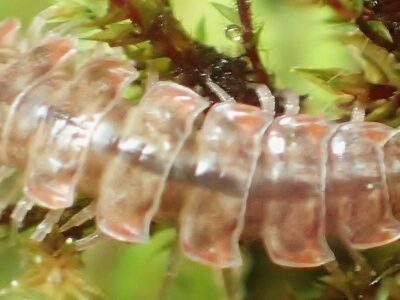
Cottodesmus crissolensis is a diminutive millipede typical of its family. Members of the order Polydesmida vary in length from 1.4 to 134 mm, and this species occupies the smaller end of that spectrum. Like all members of its order, this millipede is a flat-backed form.
Members of the order Polydesmida are known as flat-backed millipedes, because on most species, each body segment has wide lateral keels known as paranota, which are produced by the posterior half (metazonite) of each body ring behind the collum. Polydesmids have no eyes, and adults usually have 20 segments, counting the collum as the first ring and the telson as the last ring. The body color and specific morphological details that distinguish C. crissolensis from its congeners remain incompletely documented in the scientific literature, reflecting the challenges of studying such small, geographically restricted invertebrates.
As a member of the order Polydesmida, Cottodesmus crissolensis shares the ecological role of its relatives as a detritivore—a creature dedicated to breaking down the forest floor’s accumulated organic matter. Most millipedes are slow-moving detritivores, eating decaying leaves and other dead plant matter. This humble lifestyle masks an essential ecological function: these millipedes process nutrient-rich dead material and return it to the soil ecosystem.
The primary defence mechanism is to curl into a tight coil, thereby protecting its legs and other vital delicate areas on the body behind a hard exoskeleton. Additionally, many of the larger species show bright coloration patterns which warn predators of their toxic secretions. Whether C. crissolensis employs chemical defenses is not well documented, though such adaptations are characteristic of many polydesmids.
The daily rhythms of this millipede remain largely unstudied. Like most millipedes, it likely favors humid microhabitats within the leaf litter and soil, emerging during periods of high moisture to forage and move through its miniature world.
Cottodesmus crissolensis is known from a restricted area in northern Italy, specifically from the region around coordinates 44.6939°N, 7.1251°E—a locality in the Piedmont region near the Alps. With only 21 recorded occurrences clustered at this single location, this species exemplifies the narrow endemism characteristic of many millipedes. Few species of millipede are at all widespread; they have very poor dispersal abilities, depending as they do on terrestrial locomotion and humid habitats, factors that have favoured genetic isolation and rapid speciation, producing many lineages with restricted ranges.
The species likely inhabits mixed deciduous and coniferous forests typical of the Alpine foothills, where cool temperatures and persistent moisture create ideal conditions for these moisture-dependent arthropods. The restricted distribution suggests this millipede may be endemic to this specific region, making it a unique component of Italian biodiversity.
Cottodesmus crissolensis follows the dietary pattern of its relatives, subsisting on decaying organic matter found in forest soils. This millipede plays a vital role in nutrient cycling, consuming dead leaves, decomposing plant material, and fungi that colonize the forest floor. The slow, methodical feeding behavior allows it to extract maximum nutrition from material that other organisms might overlook.
As a detritivore, this millipede contributes significantly to soil health and nutrient availability. Its feces, enriched with processed organic matter, help structure soil and make nutrients accessible to plants. This recycling function, performed by countless millipedes across forest ecosystems, is essential for maintaining healthy, productive soils.
Reproduction in most species is carried out by modified male legs called gonopods, which transfer packets of sperm to females. The specific breeding season and courtship behaviors of C. crissolensis remain undocumented. Like other polydesmids, males likely use their specialized gonopods to transfer sperm packets directly to females.
Polydesmids grow and develop through a series of molts, adding segments until they reach a fixed number in the adult stage, which is usually the same for a given sex in a given species, at which point the molting stops, a mode of development known as teloanamorphosis. Young millipedes hatch with fewer segments and gradually acquire the full adult complement through successive molts, a process that may take several months to a year depending on environmental conditions.
The true conservation status of Cottodesmus crissolensis remains unknown, as it has never been formally assessed by conservation organizations. Its restricted distribution and the limited number of known occurrences raise legitimate concerns about its vulnerability. The species appears to be a short-range endemic, confined to a small area where habitat loss or degradation could pose significant threats.
Like many European millipedes, C. crissolensis likely faces pressures from forest management practices, land-use changes, and potentially climate change. Millipedes’ lack of wings, absence of phoresy, and low dispersal capability fosters narrow endemism, and many individual species are known as short-range endemics (SRE), distributed in areas less than 10,000 km², with their narrowly restricted distributions exemplifying that they are irreplaceable biodiversity which is ultra-susceptible to global extinction due to habitat loss. Future research and monitoring efforts are essential to determine whether this species’ population is stable or declining.
First appearing in the Silurian period, millipedes are some of the oldest known land animals, making Cottodesmus crissolensis a modern representative of an ancient arthropod lineage that has survived for over 400 million years.
The scientific name honors the Crissolensis region of Italy, preserving the geographic origin of this species within its nomenclature.
Millipedes are characterized by having two pairs of jointed legs on most body segments, with each double-legged segment being a result of two single segments fused together—a unique body plan that distinguishes them from all other arthropods.
This species was formally described in 1936 by the renowned Austrian diplopodologist Carl Verhoeff, one of the most prolific scientists in millipede taxonomy, who described over 1,000 millipede species during his lifetime.
Polydesmida is the largest order of millipedes, with more than 5,000 species, including all the millipedes reported to produce hydrogen cyanide (HCN), though the defensive chemistry of C. crissolensis specifically remains unknown.
The entire known range of this species covers less than a few square kilometers, making it an irreplaceable component of local biodiversity and a living example of how evolution has produced countless species adapted to specific microhabitats.
Golovatch, S.I. (2011). “Millipede (Diplopoda) distribution patterns and their evolution.” ZooKeys, 156, 1-24.
Shelley, R.M. (2003). “A synopsis of the North American millipedes of the family Trichopolydesmidae (Polydesmida, Diplopoda).” Arthropoda Selecta, 12(2), 87-103.
Verhoeff, K.W. (1936). “Neue Diplopoden aus Europa und Asien.” Archiv für Naturgeschichte, 5, 1-156.
Wikipedia Contributors. (2024). “Millipede.” In Wikipedia, The Free Encyclopedia. Retrieved from https://en.wikipedia.org/wiki/Millipede
Wikipedia Contributors. (2024). “Polydesmida.” In Wikipedia, The Free Encyclopedia. Retrieved from https://en.wikipedia.org/wiki/Polydesmida