Fungi
| Kingdom | Fungi |
|---|---|
| Phylum | Basidiomycota |
| Class | Pucciniomycetes |
| Order | Pucciniales |
| Family | Cronartiaceae |
| Genus | Cronartium |
| Species | Cronartium pini |
Cronartium pini stands as one of the most ecologically fascinating—and economically devastating—rust fungi in the Northern Hemisphere. This microscopic pathogen has shaped European and Asian forests for centuries, weaving an intricate tale of two-host parasitism that rivals the complexity of any organism on Earth. Born from an ancient evolutionary dance, Cronartium pini represents a masterclass in fungal ingenuity: a pathogen that cannot survive without abandoning its host, alternating between pine trees and wildflowers in a cycle that spans years and demands precise environmental conditions to succeed.
Cronartium pini is a rust fungus in the order Pucciniales, and like all rusts, it is an obligate biotroph—meaning it cannot survive without living plant tissue. The fungus exists in two distinct life-cycle forms that are genetically separate but morphologically indistinguishable, a cryptic duality that has long puzzled mycologists. The heteroecious form requires alternating hosts, while the autoecious form spreads directly from pine to pine in a clonal fashion.
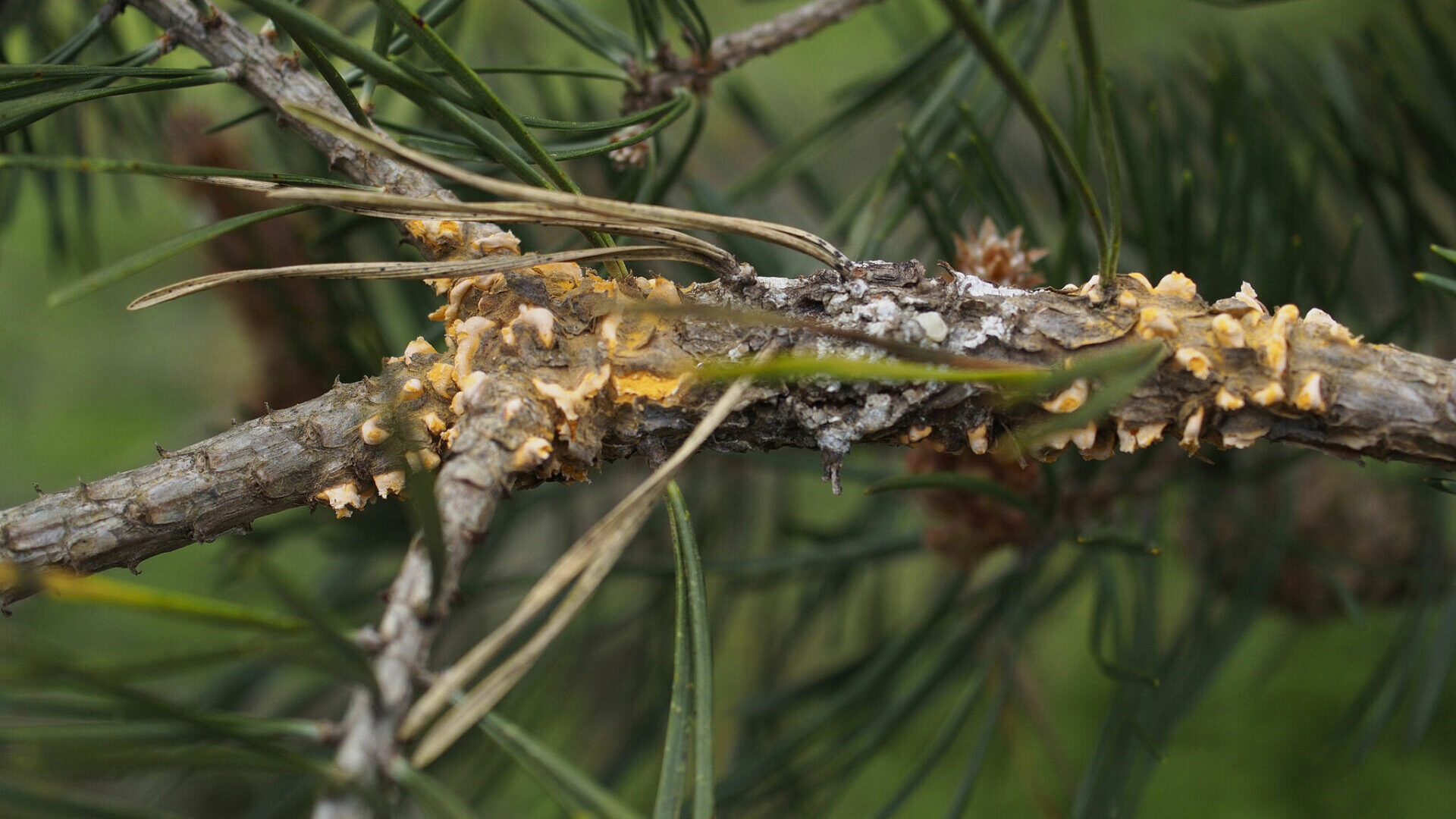
When Cronartium pini infects Scots pine (Pinus sylvestris) and related two-needle pines, it produces the disease commonly called Scots pine blister rust or resin-top disease. The hallmark symptoms are unmistakable once established: stem swelling, perennial cankers on branches and trunks, and the characteristic “resin-top” appearance—dead branch tips with excessive pitch flow that gives the disease its colloquial name. GBIF records show the fungus is widely distributed across Northern Europe, from Scotland to Russia, with particularly severe outbreaks in Fennoscandia.
The life cycle of Cronartium pini is a marvel of evolutionary complexity. Recent studies indicate the heteroecious form produces five distinct spore stages—spermatia, aeciospores, urediniospores, teliospores, and basidiospores—each with its own role in the fungus’s survival strategy. This macrocyclic lifecycle unfolds across two unrelated plant families, a requirement that seems almost impossibly restrictive yet has persisted for millennia.
Infection begins in late summer or early fall when basidiospores from alternate hosts (wildflowers such as peonies, gentians, poppies, and many others) drift on cool, moist air currents to pine needles. The spores germinate slowly, invading the needle tissue and eventually working their way into the bark, where they establish perennial cankers. For one to two years, the fungus grows silently within the pine’s tissues. Then, in late summer, it produces spermagonia—tiny flask-shaped structures that release spermatia. These must undergo plasmogamy (fusion) with receptive hyphae, a sexual process that triggers the formation of aecia the following spring.
Recent studies indicate that optimal conditions for infection require specific combinations of temperature and moisture. High humidity is essential for spore germination and infection, while temperatures above 25°C inhibit the process. The cyclic nature of outbreaks—with years of high infection alternating with quiet years—reflects the fungus’s dependence on these precise environmental windows. Once aeciospores are released from pine cankers, they travel on the wind to infect the alternate hosts, where the cycle accelerates dramatically: uredinia develop within weeks, producing urediniospores that spread the infection rapidly among wildflower populations. By late summer, telia form on the undersides of leaves, and the cycle turns back toward the pines.
Cronartium pini is a creature of cool, moist climates across Eurasia. GBIF records show it occurs throughout much of Northern Europe—from the United Kingdom and Scandinavia south to the Alps and east across Russia. The fungus has been documented in at least 18 European countries, with particularly severe outbreaks in Finland, Sweden, and Norway. The distribution data reveals a clear preference for northern latitudes and higher elevations, where cool, wet conditions persist longer into the growing season.
The ecological context is crucial to understanding this fungus. Recent studies indicate that severe outbreaks have become increasingly common in Northern Fennoscandia over the past two to three decades, possibly driven by climate change, shifts in forestry practices, or the introduction of new genetic stocks. The fungus’s fate is inextricably linked to the presence of its alternate hosts—a diverse array of herbaceous plants spanning multiple angiosperm families. When peonies were recently planted in large commercial fields adjacent to young pine plantations in southwestern France, disease incidence in nearby pines skyrocketed to 80% in some stands, a dramatic illustration of how the presence of the right alternate host can trigger explosive epidemics.
Cronartium pini is a pathogen, not a decomposer, and its ecological role is fundamentally one of damage and mortality. The fungus is biotrophic, meaning it feeds on living cells without killing them immediately, maintaining the host in a weakened, infected state for years. Cankers that girdle branches or stems eventually cut off water and nutrient flow, leading to branch flagging—the death of branch tips that remain attached with discolored, often reddish needles.
Ecologically, Cronartium pini influences forest structure and composition. Young Scots pine stands are particularly vulnerable, and severe infections can cause top-kill, reducing tree height and timber value. In some European forests, the disease has become so prevalent that foresters must adjust management strategies, favoring more resistant tree species or implementing costly pruning programs to remove infected branches before cankers reach the main trunk. The fungus also creates a complex ecological network: its presence in pine stands depends on the abundance of alternate hosts in the surrounding landscape, creating an intricate web of plant-pathogen interactions that spans multiple ecosystems.
Edibility warning: Cronartium pini is not edible. As an obligate plant pathogen, it has no culinary or nutritional value. However, its significance extends far beyond the kitchen into forest management, conservation, and economic forestry. The disease causes substantial economic losses in timber production, particularly in Scandinavia where Scots pine plantations are widespread.
The fungus has become a focal point for forest pathology research and disease management innovation. Scientists have investigated biological control using hyperparasitic fungi such as Cladosporium tenuissimum, which attacks rust spores and reduces disease development. Genetic resistance breeding programs are underway to develop pine varieties less susceptible to infection. In some regions, foresters practice “pathological pruning,” removing branches with cankers before they reach the trunk—a labor-intensive but effective management strategy that can prevent main-stem infection if caught early.
The presence of Cronartium pini has also shaped cultural and economic attitudes toward alternate hosts. In some European countries, the fruit value of currants and gooseberries (alternate hosts of related rust species like Cronartium ribicola) has historically outweighed the timber value of pines, leading to different management decisions than those made in North America. This fungus reminds us that pathogens are not simply destructive forces—they are evolutionary drivers that shape how humans manage forests and landscapes.
Cronartium pini can exist as two genetically distinct forms that cannot be told apart by appearance alone: one alternates between two hosts (heteroecious), while the other spreads clonally on pines (autoecious). Recent genetic studies in Fennoscandia revealed these forms occupy separate populations and may have different ecological roles in disease outbreaks.
The fungus produces five different spore types, each with its own dispersal mechanism and environmental requirements. This complexity means that a single infection event can trigger a cascade of infections across multiple plant species over several years—a biological relay race of staggering intricacy.
Wind-borne basidiospores from alternate hosts can travel several hundred meters to infect pine needles, but only under specific conditions of cool, moist air. The fungus is so dependent on these environmental windows that entire years may pass with no new infections if weather conditions are unfavorable.
The fungus can remain dormant in infected pine tissue for years, producing spores only when environmental conditions align. This cryptic persistence means that early infections are extremely difficult to detect, and asymptomatic infected trees can unknowingly harbor the pathogen.
In recent decades, Cronartium pini has become a more severe problem in Northern Europe, possibly due to climate change making conditions more favorable for the fungus or to changes in forestry practices that have altered the genetic composition of planted pine stands.
The heteroecious form of the fungus requires specific alternate hosts to complete its sexual cycle. When peonies were commercially cultivated near pine plantations in France, the disease incidence exploded, demonstrating how human agricultural decisions can inadvertently create perfect conditions for fungal epidemics.
Cronartium pini is listed as a harmful organism in several countries outside Europe, including Colombia, New Zealand, and Taiwan, reflecting its global significance as a forest pathogen and the international concern about its potential spread.
Wulff, S., Holdenrieder, O., & Kaitera, J. (2022). A review of biology, epidemiology and management of Cronartium pini with emphasis on Northern Europe. Scandinavian Journal of Forest Research, 37(3), 1-30.
Kaitera, J., Nuorteva, H., & Kasanen, R. (2008). Inoculations of eight Pinus species with Cronartium and Peridermium stem rusts. Forest Ecology and Management, 255(3-4), 973-981.
Ioos, R., Fourrier, C., & Husson, C. (2025). Population genetics suggests that the resurgence of pine blister rust caused by Cronartium pini in the Landes forest of France was triggered by the recent cultivation of alternate hosts. Forest Pathology, 55(2), e70028.
Plant Health Progress. (2022). Recovery plan for Scots pine blister rust caused by Cronartium pini. Plant Health Progress, 23(1), 1-10.