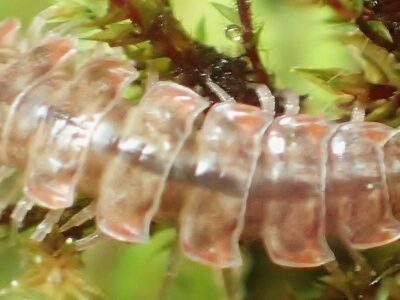
Animals
| Kingdom | Animalia |
|---|---|
| Phylum | Bryozoa |
| Class | Gymnolaemata |
| Order | Cheilostomatida |
| Family | Fenestrulinidae |
| Genus | Fenestrulina |
| Species | Fenestrulina mutabilis |
What if you could witness an entire civilization of animals, each one barely visible to the naked eye, working together in perfect synchrony to filter the ocean’s bounty? Fenestrulina mutabilis is precisely such a creature—a colonial bryozoan that represents millions of years of evolutionary refinement in one of the ocean’s most overlooked phyla.
Bryozoans are simple, aquatic invertebrate animals that live in sedentary colonies, typically about 0.5 millimetres long, with a special feeding structure called a lophophore, a “crown” of tentacles used for filter feeding. This remarkable species dwells in the waters of the western Pacific, creating intricate colonies that capture food and reproduce with remarkable efficiency.
The family Fenestrulinidae, which includes Fenestrulina mutabilis, is defined by comparable frontal shield and ooecial morphologies. Like all bryozoans, this species exists as a colony of interconnected individuals called zooids. The colonies are composed of individual modules, or zooids, with each zooid effectively being a complete animal, yet the zooids remain interconnected and may exchange nutrients and other substances through interconnecting cables or minute pores in their body walls.
Zooids capable of feeding have a ring of slender tentacles at one end of the body, with cilia (hairlike projections) that propel tiny particles of food toward the zooid mouth found on this ring, and the whole feeding organ is called a lophophore. The encrusting colonies of Fenestrulina mutabilis form delicate, sheet-like structures that spread across hard substrates. Each individual zooid is a marvel of miniature engineering, yet the true wonder lies in how thousands of these microscopic animals function as a unified organism, sharing resources and coordinating their feeding activities across the entire colony.
Bryozoans are aquatic animals, and most are marine; in aquatic habitats, bryozoans may be found on all types of hard substrates: sand grains, rocks, shells, wood, and blades of kelps and other algae may be heavily encrusted with bryozoans. Fenestrulina mutabilis occupies similar niches throughout its range, establishing permanent colonies on rocky surfaces and shells in shallow to moderate depths.
Most bryozoans are sessile and immobile, but a few colonies are able to creep about. Fenestrulina mutabilis colonies remain fixed in place, their energy devoted entirely to feeding and reproduction rather than movement. In some bryozoans, groups of zooids work together to create increased currents for feeding and waste removal, suggesting at least some form of primitive, inter-zooid communication. This coordinated behavior allows the entire colony to optimize its feeding efficiency, with zooids adjusting their tentacle movements in response to food availability.
GBIF records show Fenestrulina mutabilis occurs across a wide geographical range spanning the western Pacific. The species has been documented in South Korea, where it is particularly abundant along the southern and eastern coasts. Its distribution extends southward through the waters around New Caledonia and into Australian waters, with records from multiple locations along the Australian coast including Queensland and New South Wales. This broad distribution suggests the species thrives in temperate to subtropical marine environments, likely occupying similar ecological niches wherever suitable hard substrates and adequate food sources are available.
The most common type of zooid is the feeding autozooid, in which the polypide bears a “crown” of hollow tentacles called a lophophore, which captures food particles from the water. Bryozoans feed on small microorganisms, including diatoms and other unicellular algae. Each zooid in a Fenestrulina mutabilis colony operates as a miniature filter-feeding engine, continuously drawing water through its tentacles and extracting microscopic nourishment.
As filter feeders, bryozoans control planktonic populations in their environments; it has been reported that a single zooid may filter as much as 8.8 mL of water a day. When multiplied across thousands of zooids in a colony, the collective feeding capacity becomes impressive—an entire colony can process vast quantities of seawater, extracting diatoms and other microscopic organisms that form the foundation of marine food webs. The efficiency of this feeding strategy explains why bryozoan colonies can thrive even in waters with modest food availability.
Although many marine species function first as males and then as females, their colonies always contain a combination of zooids that are in their male and female stages; all species emit sperm into the water, and some also release ova into the water, while others capture sperm via their tentacles to fertilize their ova internally. In Fenestrulina mutabilis, sexual reproduction generates genetic diversity essential for the species to adapt to environmental changes.
In some species the larvae have large yolks and quickly settle on a surface, while others produce larvae that have little yolk but swim and feed for a few days before settling; after settling, all larvae undergo a radical metamorphosis that destroys and rebuilds almost all the internal tissues. Asexual reproduction occurs by budding off new zooids as the colony grows, and is the main way by which a colony expands in size. This dual reproductive strategy—combining sexual reproduction for genetic variation with asexual budding for rapid colony expansion—represents an evolutionary solution to the challenges of life as a sessile marine organism.
Current population trends for Fenestrulina mutabilis remain unknown, and the species has not been formally evaluated for conservation status. Like many bryozoan species, it likely faces mounting pressures from ocean warming and acidification. Bryozoans are especially impacted by ocean acidification because, just like corals, they build their honeycomb-shaped skeletons from calcium carbonate. As ocean pH continues to decline, the ability of Fenestrulina mutabilis and its relatives to construct and maintain their protective skeletons may become increasingly compromised.
Ocean warming and acidification are happening more rapidly in some regions; warming waters plus ocean acidification are making the skeletons of bryozoans more likely to dissolve, as when the ocean warms, the bryozoans build more magnesium into their skeletons, making them vulnerable to acidification. The future outlook for this species depends heavily on how effectively marine ecosystems adapt to these changing conditions. Protecting the rocky substrates and kelp forests where Fenestrulina mutabilis establishes its colonies remains crucial for its long-term survival.
5,869 living species of bryozoa are known, yet bryozoans remain among the least studied of all marine phyla, with new species regularly discovered in both tropical and polar waters.
If a piece of a bryozoan colony breaks off, the piece can continue to grow and will form a new colony, making bryozoans remarkably resilient to physical damage and capable of colonizing new substrates through fragmentation.
Scientists discovered that a common marine bryozoan produces compounds with potent and broad anti-tumor activity, particularly high concentrations present in the larvae and juveniles where they provide protection against fish predators, and this compound has become the drug Bryostatin 1, used for treating some cancers.
Each zooid in Fenestrulina mutabilis is hermaphroditic and capable of both male and female reproduction, yet the colony maintains a balance of reproductive stages to maximize breeding success across the entire community.
The genus Fenestrulina has a world-wide distribution, making it one of the most geographically widespread bryozoan genera and a testament to the group’s remarkable adaptability to diverse marine environments.
Bryozoan colonies can be so abundant in certain ecosystems that in the Antarctic there are forests and patch reefs of bryozoans covering large areas providing habitat for many other species, with bryozoan diversity in the Southern Ocean estimated at more than 400 species.
Orr, R.J., Waeschenbach, A., Enevoldsen, E.L., et al. (2019). “Bryozoan genera Fenestrulina and Microporella no longer confamilial; multi-gene phylogeny supports separation.” Zoological Journal of the Linnean Society, 186(1), 190-199.
Rosso, A., Di Martino, E., Donato, G., et al. (2025). “Unlocking Mediterranean bryozoan diversity: seven new species unveiled after fixing a neotype for Fenestrulina malusii.” ZooKeys, 1254, 1-74.
Hayward, P.J. & Ryland, J.S. (1990). The marine fauna of the British Isles and North-West Europe: 1. Introduction and protozoans to arthropods. Clarendon Press: Oxford, UK.
Shape of Life. (2021). “Bryozoans.” Retrieved from https://www.shapeoflife.org/news/featured-creature/
Digital Atlas of Ancient Life. (2020). “Bryozoa.” Retrieved from https://www.digitalatlasofancientlife.org/learn/bryozoa/