Fungi
| Kingdom | Fungi |
|---|---|
| Phylum | Basidiomycota |
| Class | Agaricomycetes |
| Order | Agaricales |
| Family | Hymenogastraceae |
| Genus | Galerina |
| Species | Galerina praticola |
Galerina praticola stands as a quiet sentinel of the mossy grasslands and damp margins of the temperate world, a small but significant fungus that has captured the attention of mycologists across Europe, Greenland, and North America. This delicate mushroom belongs to a genus renowned for its ecological importance in decomposition, yet shrouded in the mystery that surrounds many of the world’s smallest fungi. To encounter Galerina praticola is to witness the intricate architecture of the fungal kingdom expressed in miniature form.
Galerina praticola follows the characteristic “little brown mushroom” morphology that defines its genus, displaying the modest but distinctive features that reveal its identity to those who know where to look. The fruiting bodies are remarkably small, with caps typically measuring only 1-2 centimeters in diameter, though occasionally reaching slightly larger dimensions under favorable conditions. Galerina fruiting bodies are typically small, undistinguished mushrooms with a typical “little brown mushroom” morphology and a yellow-brown, light brown to cinnamon-brown spore print. The pileus is typically glabrous and often hygrophanous, and a cortina-type veil is present in young specimens of roughly half of recognized species, though it sometimes disappears as the mushroom ages in many of these species.
The caps range in color from tan to rust-brown, with a surface that appears delicately smooth when young. Like many of its congeners, the species exhibits hygrophanous properties—the cap darkens noticeably when wet and fades as it dries, creating a dynamic appearance that shifts with moisture levels. The genus Galerina is defined as small mushrooms of mycenoid stature, that is, roughly similar in form to Mycena species: a small conical to bell-shaped cap, and gills attached to a long and slender cartilaginous stem. The gills are crowded and delicate, ranging from pale to rusty-brown as the spores mature. The slender stem reaches perhaps 3-5 centimeters in height, thin and brittle, often bearing a fragile, ephemeral ring that may disappear with age.
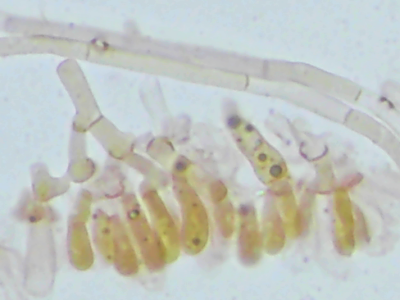
Identification tip: Most species have spores that are ornamented, lack a germ pore, and have a plage. Many species also have characteristic tibiiform cystidia. Microscopic examination reveals the characteristic plage—a distinctive patch on the spore surface that resembles delicate, wrinkled plastic—a feature that separates Galerina from many similar genera.
The mycelium of Galerina praticola colonizes its substrate with patient determination, spreading through mossy habitats and decomposing plant material where it initiates its slow work of nutrient cycling. Ecologically, all Galerina are saprobic, growing in habitats like rotting wood or in moss. This fungus is a decomposer at heart, breaking down the complex polymers of plant material and returning their nutrients to the living world.
The fruiting season for Galerina praticola extends across the warmer months, with observations recorded from spring through autumn in its northern European range. Galerina also seems to have a very long fruiting season and fruits multiple times each year from the same mycelium. I think I’ve found it in every month that we don’t have snow. The species fruits prolifically when conditions align—adequate moisture, moderate temperatures, and suitable substrate—producing small fruiting bodies in scattered groups or solitary emergence.
Galerina praticola occupies a distinctly Northern Hemisphere range, with documented occurrences spanning from the United States westward across the Atlantic to Scandinavia, the British Isles, continental Europe, and even the remote Faroe Islands and Greenland. GBIF records document over 200 occurrences across this broad geographic range, indicating a species well-adapted to cool, moist climates. The fungus thrives in habitats where moisture persists and organic matter accumulates—particularly in damp grasslands, mossy margins, and wetland edges where it finds the conditions necessary for growth.
Habitat highlights:
The species shows a marked preference for habitats where bryophytes (mosses) flourish, as Galerinas will be found associated with moss, and this can separate out the genus in nature fairly well. Unlike some of its wood-decomposing relatives, Galerina praticola favors soil-based habitats where moisture and organic richness create ideal conditions for its growth.
Though diminutive in stature, Galerina praticola plays a meaningful ecological role within its grassland and wetland communities. As a saprobic fungus, it participates in the essential process of decomposition, breaking down dead plant material and transforming it into forms accessible to other organisms. The mycelium secretes enzymes that dissolve the complex carbohydrates and lignins of plant cell walls, gradually reducing plant matter to simpler compounds that enrich the soil.
This decomposition process is fundamental to nutrient cycling in ecosystems. By fragmenting and mineralizing organic matter, Galerina praticola and its congeners liberate nitrogen, phosphorus, and other essential elements locked within dead plant tissues, making them available for uptake by living plants and other organisms. The fungal fruiting bodies themselves provide sustenance for small invertebrates and insects, creating another link in the food web. In this way, even the smallest mushroom contributes to the health and vitality of its ecosystem.
Edibility warning: The numerous different Galerina species are very difficult to distinguish from deadly galerinas, and toxin content of different species has yet to be investigated. While Galerina praticola itself has not been documented as containing the deadly amatoxins found in some of its congeners, the extreme difficulty in distinguishing between Galerina species makes consumption of any member of this genus inadvisable and potentially fatal. Deadly galerinas contain dangerous and potentially life-threatening toxins that damage or destroy the liver and kidneys.
The primary value of Galerina praticola lies not in the kitchen but in the field and laboratory. For mycologists and naturalists, this species represents an opportunity to understand the intricate diversity of fungal life and the ecological processes that sustain terrestrial ecosystems. Its small size and modest appearance belie the complexity of its biology and the importance of its ecological function. Amateur and professional mycologists study Galerina species to refine their identification skills and deepen their understanding of fungal taxonomy and ecology.
Galerina means helmet-like, a reference to the characteristic shape of the small, bell-shaped caps that characterize the genus.
Galerina is a genus of small brown-spore saprobic mushroom-bearing fungi, with over 300 species found throughout the world from the far north to remote Macquarie Island in the Southern Ocean.
The spore ornamentation of Galerina species features a unique structure called a plage—a clear patch on the spore surface that resembles wrinkled plastic shrink-wrap, visible only under the microscope.
The extreme toxicity of some Galerina species means that recognition of Galerina is of great importance to mushroom hunters who are seeking hallucinogenic Psilocybe mushrooms. Species like Galerina marginata may bear a superficial resemblance to Psilocybe cyanescens and other Psilocybe species, and has often been found growing amongst and around Psilocybe cyanescens and other Psilocybe species, making identification all the more confusing to the uninitiated.
Galerina praticola was originally described as Pholiota praticola by Danish mycologist F.H. Møller in 1945 before being reclassified into the genus Galerina by British mycologist P.D. Orton in 1960.
In Scandinavian regions, this species is known by the Swedish common name “gräshätting,” literally translating to “grass hat”—a poetic reference to its grassland habitat and helmet-like cap shape.
Galerina seems to colonize the wood only in the wake of other fungi that have already partially broken it down. At least I’ve only seen it fruiting on such decrepit looking wood.