Fungi
| Kingdom | Fungi |
|---|---|
| Phylum | Basidiomycota |
| Class | Agaricomycetes |
| Order | Russulales |
| Family | Stereaceae |
| Genus | Gloeocystidiellum |
| Species | Gloeocystidiellum luridum |
Across the cool forests of northern Europe, from the misty woodlands of Sweden to the alpine valleys of Switzerland, a humble fungal artist works in silence. Gloeocystidiellum luridum (Bres.) Boidin is a wood-decay fungus belonging to the family Stereaceae, a group of decomposers that transform the landscape of death into the foundation of new life. This inconspicuous crust fungus, with its thin, crust-like fruiting bodies, plays a vital role in one of nature’s most essential processes: the recycling of dead wood into fertile soil.
Gloeocystidiellum luridum is a species of Fungi in the family Stereaceae. Like its relatives in this family, this fungus manifests as a crust-like fruiting body that adheres closely to its wooden substrate. Fungi in this family are primarily characterized by their crust-like or flaky fruiting bodies, which adhere closely to the surface of wood or other substrates. The fruiting bodies of Stereaceae fungi are generally crust-like, thin, and often have a leathery or somewhat woody texture. They typically form a continuous layer or patch on the surface of decaying wood or other organic matter.
The fruiting surface—called the hymenium—where spores are produced, is typically smooth or pore-like rather than gilled, distinguishing it from the gill-bearing mushrooms many people know. The upper surface of the fruiting body can be smooth or slightly wrinkled, and the color ranges from white and cream to various shades of brown or gray. The name “luridum” hints at the fungus’s darker coloration, a characteristic that aids in distinguishing it from other corticioid (crust-like) species in the field.
Identification tip: Look for thin, tightly adhered crusts on decaying wood with a smooth or slightly pored spore-producing surface. The darker coloration and leathery texture help separate this species from lighter-colored relatives.
The life story of G. luridum begins with a network of thread-like hyphae—the mycelium—that colonizes dead wood. Gloeocystidiellum luridum is a family of fungi that are all saprophytic on dead wood or leaf litter. This means that they get sustenance by decomposing the wood. The mycelium spreads through the wood substrate, breaking down its complex polymers and extracting nutrients.
When environmental conditions align—adequate moisture, suitable temperature, and sufficient nutrient availability—the fungus produces its visible fruiting bodies. Different species can grow flat to the wood surface or rise from the surface in fan shapes. These fruiting structures release countless microscopic spores into the air, which drift on currents until they settle on new sources of dead wood, perpetuating the fungus’s cycle of growth and reproduction. The fruiting season typically spans autumn and winter, when moisture levels peak and the forest floor becomes a landscape of decay and renewal.
Ecological peculiarities: on decayed wood, preferably of deciduous trees but may also occur on coniferous wood. GBIF records show this species has been documented across much of temperate Europe, with occurrences spanning from the Nordic countries (Sweden, Norway, Denmark) through Central Europe (Germany, Austria, Switzerland) to Western Europe (France, Belgium, Netherlands, United Kingdom) and Spain. A notable record also exists from Korea and Canada, indicating this fungus has a broader geographic reach than once thought.
The fungus thrives in cool, moist forest environments where fallen logs and dead branches accumulate. These microhabitats—whether downed timber on the forest floor, standing snags, or freshly cut logs—provide the ideal stage for G. luridum‘s ecological performance. The fungus is indifferent to whether its substrate is hardwood or softwood, demonstrating the ecological flexibility that allows it to persist across diverse forest types.
The family is notable for its ecological contributions to the decomposition of lignocellulosic materials and its role in nutrient recycling within forest ecosystems. Gloeocystidiellum luridum is a key player in this grand recycling act. In nature, this process causes the breakdown of complex molecules and leads to the return of nutrients to the soil.
Without fungi like G. luridum, forests would become choked with accumulating dead wood, and essential nutrients locked within that wood would remain unavailable to living trees and plants. Wood decay fungi are considered key species in the forest ecosystems because the process of decomposing dead wood creates new habitats for other species, helps in the nutrient recycling, participate in the energy transportation and transformation and provides food to other species. As the fungus slowly consumes wood, it creates microhabitats for beetles, mites, bacteria, and other decomposers, transforming a log into a miniature ecosystem teeming with life.
Like most corticioid fungi in the Stereaceae family, G. luridum has no culinary or medicinal applications. The thin, leathery texture and inconspicuous growth habit make it unsuitable for harvesting or consumption. Edibility warning: This species should not be consumed. Its role is entirely ecological—to serve as nature’s recycler rather than as food for humans.
The true value of G. luridum lies not in any human use, but in its ecological services. Mycologists study this and related species to understand wood decay processes and forest nutrient cycling. By documenting its distribution and ecology, scientists gain insight into how forests regenerate and how dead wood—often viewed as waste—is actually a vital resource that sustains entire communities of organisms.
Gloeocystidiellum luridum was formally described and named by Jacques Boidin in 1951, though the species was originally classified under a different genus name, Corticium luridum, by Bresadola in the 1800s.
This fungus belongs to the order Russulales, a diverse group that includes everything from the delicate coral fungi to the robust polypores—a testament to the hidden diversity within the fungal kingdom.
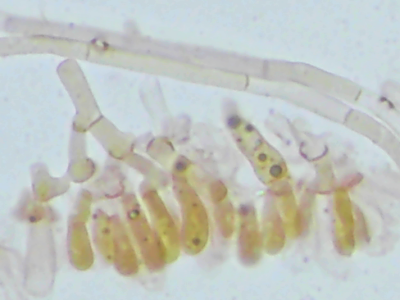
The genus Gloeocystidiellum is characterized by specialized cells called gloeocystidia, which are gelatinous structures that help the fungus maintain moisture in its fruiting bodies—an elegant adaptation to life on exposed wood surfaces.
The hyphal system is monomitic, with hyphae measuring 2.0-3.5 µm in diameter, making individual hyphae invisible to the naked eye but collectively forming the visible crust that covers decaying logs.
A single fruiting body of G. luridum can produce millions of spores, yet each spore must land on suitable dead wood to germinate—a reminder of nature’s prodigal approach to reproduction.
This fungus has been recorded from over 1,460 locations across its range, making it one of the more commonly documented wood-decay fungi in European mycological surveys.
The darker coloration of G. luridum (the species name “luridum” means “dark” or “gloomy”) may help the fungus absorb more solar radiation, allowing it to function efficiently even in the dim light of the forest floor.
Boidin, J. (1951). “Révision des Corticiés (Hyménomycètes) à hyménium lisse ou poreux.” Revue de Mycologie – A foundational work describing the genus and species.
Bernicchia, A. & Gorjón, S.P. (2010). Corticiaceae s.l. – Fungi Europaei 12. Alassio: Edizioni Candusso – A comprehensive European field guide to corticioid fungi.
Núñez, M. & Ryvarden, L. (1997). “East Asian Polypores. Vol. 1: Ganodermataceae and Hymenochaetaceae.” Synopsis Fungorum – Important taxonomic reference for wood-decay fungi distribution.
Global Biodiversity Information Facility (GBIF). Gloeocystidiellum luridum (Bres.) Boidin – Primary source for distribution records across Europe and Asia.
Encyclopedia of Life (EOL). Gloeocystidiellum luridum – Comprehensive taxonomic and ecological information on this species.