Fungi
| Kingdom | Fungi |
|---|---|
| Phylum | Ascomycota |
| Class | Sordariomycetes |
| Order | Hypocreales |
| Family | Hypocreaceae |
| Genus | Hypomyces |
| Species | Hypomyces lactifluorum |
In the mysterious world of fungal parasites, few organisms capture the imagination quite like Hypomyces lactifluorum, the remarkable lobster mushroom. This extraordinary fungus doesn’t simply grow from the forest floor—it performs one of nature’s most dramatic transformations, hijacking other mushrooms and completely remaking them in brilliant orange splendor. What emerges from this fungal takeover is a culinary treasure that has delighted foragers and chefs across North America for generations.
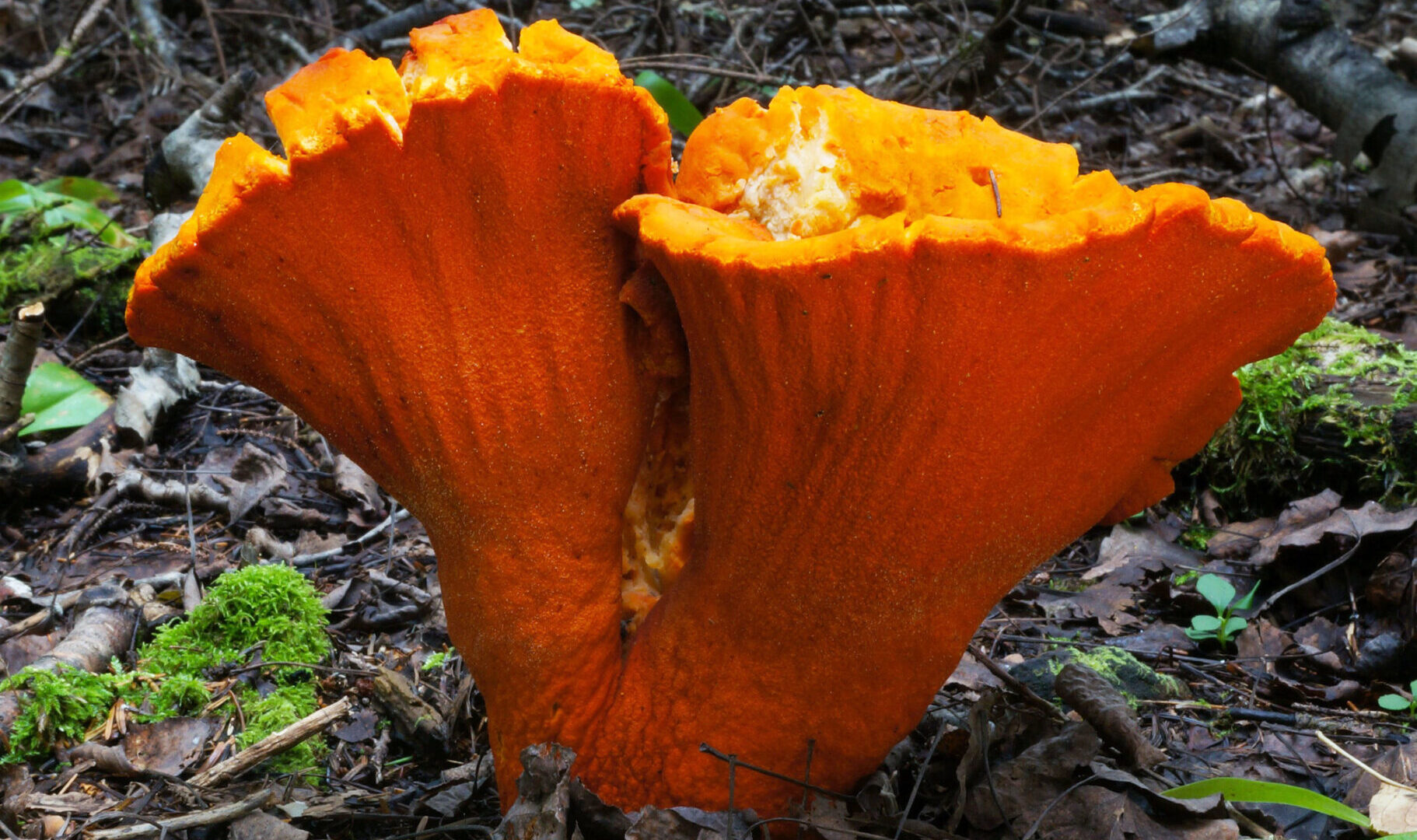
The lobster mushroom presents one of mycology’s most distinctive identification challenges because it’s not actually a single mushroom at all—it’s a parasitic fungus that has completely enveloped and transformed its host. When H. lactifluorum attacks species like Russula or Lactarius mushrooms, it creates something entirely new and unmistakable.
The transformed fruiting body blazes with vibrant orange to reddish-orange coloration that immediately calls to mind a cooked lobster shell. This brilliant hue covers the entire surface, from what was once the cap down to the base of the stem. The original gills of the host mushroom become completely obscured, replaced by a bumpy, irregular surface dotted with tiny pores where the parasitic fungus releases its spores.
Key identification features: • Intense orange to red-orange coloration throughout • Firm, dense texture much harder than typical mushrooms • No visible gills—surface appears bumpy or warty • Often retains the general shape of the original host mushroom • White to pale flesh when cut, sometimes with orange streaking • Distinctive seafood-like aroma when fresh
The texture becomes remarkably firm and meaty, completely unlike the soft, fragile nature of the original host. This transformation is so complete that the lobster mushroom feels more like a root vegetable than a typical fungus, making it one of the most texturally unique finds in the forest.
The life cycle of Hypomyces lactifluorum reads like a mycological thriller, beginning with microscopic spores that drift through the forest air in search of suitable victims. These specialized spores don’t germinate in soil or on decaying wood like most fungi—instead, they target living mushrooms, particularly members of the Russula and Lactarius families, landing on their surfaces and beginning an extraordinary transformation.
Once a spore finds its target, the parasitic mycelium rapidly colonizes the host mushroom, growing through its tissues with remarkable speed. Within days, the orange mycelium completely envelops the victim, fundamentally altering its cellular structure and appearance. This isn’t simply a surface coating—the parasite penetrates every part of the host, creating an entirely new organism that’s neither the original mushroom nor purely H. lactifluorum.
Growth characteristics: • Parasitizes living Russula and Lactarius species • Transformation occurs rapidly, often within a week • Fruiting bodies persist longer than typical mushrooms • Can continue growing even after host death • Produces spores from tiny pores across the surface
The resulting lobster mushroom often grows larger and lives longer than its original host would have, sometimes persisting for weeks in the forest. This extended lifespan gives foragers a generous window for discovery, unlike many ephemeral fungi that appear and disappear within days.
Lobster mushrooms paint the forests of North America with their distinctive orange hue, ranging from the boreal woodlands of Canada down through the United States into Mexico and Guatemala. This impressive distribution spans over 12,000 recorded occurrences, making it one of the more reliably encountered parasitic fungi across the continent. The species shows particular abundance in the Pacific Northwest, where the moist climate and diverse mushroom communities provide ideal conditions for both hosts and parasite.
These remarkable transformations occur wherever their preferred hosts thrive—primarily in mixed and coniferous forests where Russula and Lactarius species form mycorrhizal relationships with trees. From the hemlock and fir forests of British Columbia to the oak-pine woodlands of the southeastern United States, lobster mushrooms appear wherever suitable victims can be found. They show a particular fondness for areas with rich, well-drained soils and partial shade, often emerging along forest edges and in clearings where their host species naturally fruit.
Preferred habitats: • Mixed coniferous and deciduous forests • Areas with abundant Russula and Lactarius populations • Well-drained, organic-rich soils • Forest edges and partial clearings • Elevations from sea level to montane zones
Hypomyces lactifluorum occupies a fascinating ecological niche as a specialized parasite that fundamentally alters forest fungal communities. Rather than decomposing organic matter like saprophytic fungi or forming beneficial partnerships like mycorrhizal species, this remarkable organism has evolved to exploit other fungi as its primary resource. This parasitic lifestyle creates ripple effects throughout the ecosystem, reducing the reproductive success of its host species while simultaneously creating new food sources for forest animals.
The ecological impact extends beyond simple predator-prey relationships. By targeting Russula and Lactarius species—important mycorrhizal partners for forest trees—lobster mushrooms indirectly influence plant communities and soil health. However, their relatively low abundance compared to their hosts means they rarely cause significant ecological disruption. Instead, they represent one of nature’s many checks and balances, preventing any single fungal species from becoming too dominant.
Ecological interactions: • Reduces reproductive success of host mushroom species • Provides food for wildlife, including deer and small mammals • Creates longer-lasting fruiting bodies than original hosts • May influence forest fungal diversity patterns • Serves as indicator of healthy, diverse mushroom populations
The lobster mushroom stands as one of North America’s premier wild edibles, transforming from parasitic curiosity into culinary gold. Its firm, meaty texture and distinctive seafood-like flavor have earned it a devoted following among chefs and foragers alike. The mushroom’s dense flesh holds up beautifully to various cooking methods, from simple sautéing to complex braises, and its striking color adds visual drama to any dish.
Forager’s delight: The lobster mushroom’s unique parasitic nature actually makes it safer for novice foragers than many other wild species, as the transformation process eliminates most toxic compounds that might have existed in the original host.
Culinary applications range from simple preparations that highlight the mushroom’s natural flavors to elaborate dishes where it serves as a vegetarian substitute for seafood. Its ability to absorb flavors while maintaining structural integrity makes it particularly valuable in soups, stews, and pasta dishes. Many foragers prize it not just for its taste, but for its excellent keeping qualities—properly stored lobster mushrooms can remain fresh for over a week, far longer than most wild fungi.
Culinary and safety notes: • Excellent beginner forager mushroom due to distinctive appearance • Firm texture perfect for grilling, roasting, or sautéing • Natural seafood flavor enhances many dishes • Good preservation qualities for a wild mushroom • No known toxic look-alikes when properly identified • Always cook thoroughly before consumption
Traditionally, indigenous peoples of North America recognized and utilized lobster mushrooms, though specific cultural practices vary by region. Modern foraging communities have embraced this species as a gateway mushroom for newcomers to wild food gathering, combining safety with exceptional flavor.
• Arora, David. Mushrooms Demystified: A Comprehensive Guide to the Fleshy Fungi. Ten Speed Press, 1986. • Kuo, Michael. “Hypomyces lactifluorum.” MushroomExpert.Com, 2005. • Miller Jr., Orson K., and Hope H. Miller. North American Mushrooms: A Field Guide to Edible and Inedible Fungi. Falcon Press, 2006. • Bessette, Alan E., Arleen R. Bessette, and David W. Fischer. Mushrooms of Northeastern North America. Syracuse University Press, 1997. • Trudell, Steve, and Joe Ammirati. Mushrooms of the Pacific Northwest. Timber Press, 2009.