Animals
| Kingdom | Animalia |
|---|---|
| Phylum | Chordata |
| Class | Mammalia |
| Order | Macroscelidea |
| Family | Macroscelididae |
| Genus | Elephantulus |
| Species | Elephantulus rozeti |
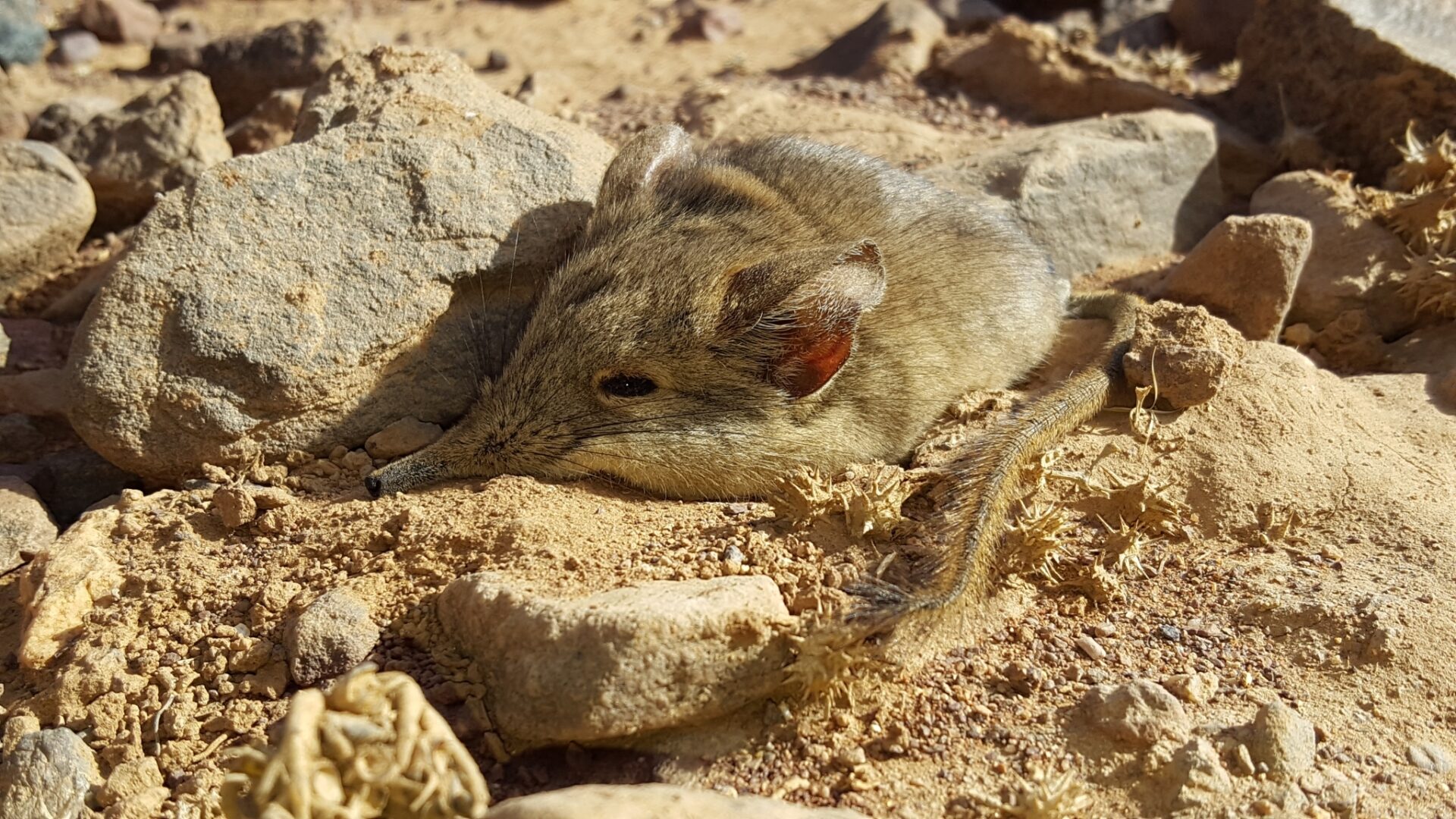
In the arid and rocky landscapes of North Africa, a remarkable creature scurries across sun-baked terrain with an almost comical gait—the North African Elephant Shrew, scientifically known as Petrosaltator rozeti. Despite its whimsical common name, this is no miniature pachyderm, but rather a fascinating member of the order Macroscelidea, a group of small, insectivorous mammals that have captivated naturalists since their formal description in 1833. With its elongated snout, twitching whiskers, and explosive jumping ability, this diminutive creature embodies the wild ingenuity of African evolution, perfectly adapted to thrive in some of the continent’s harshest environments.
The North African Elephant Shrew is a small, delicate mammal that exemplifies the principle of “form follows function” in nature. Its most striking feature is its characteristically elongated, mobile snout—a sensitive proboscis that gives the species its evocative common name, though it bears no actual relation to elephants beyond this superficial resemblance.
Key identification characteristics include:
Notable feature: The elephant shrew’s hind legs are disproportionately powerful compared to its front legs, giving it a rabbit-like silhouette and enabling remarkable jumping ability for an animal of its size.
Their coloration serves as excellent camouflage against the rocky, desert environments they inhabit, with subtle variations in shade helping individuals blend into their specific microhabitats. The fur is remarkably dense and fine, providing insulation against temperature extremes in their arid homes.
The North African Elephant Shrew is a creature of habit and routine, establishing well-worn pathways through its territory that it follows with almost ritualistic precision. These diminutive foragers are primarily diurnal, most active during the cooler hours of early morning and late afternoon, when they venture out to search for food across rocky outcrops and semi-arid scrubland.
Behavioral characteristics include:
Notable behavior: When threatened, these creatures perform spectacular leaping displays, bouncing erratically in multiple directions to confuse predators—a survival strategy that has earned them the alternative name “rock jumpers” in some regions.
Their lifestyle is intimately tied to the rocky terrain they inhabit, with individuals spending considerable time investigating crevices and under-rock spaces where they shelter and hunt. They maintain a heightened state of alertness, constantly pausing their foraging to listen and observe their surroundings for signs of danger.
The North African Elephant Shrew is endemic to the arid and semi-arid regions of northwestern Africa, with its range concentrated primarily in Morocco, Algeria, and Tunisia. This specialized distribution reflects the species’ adaptation to specific ecological conditions found in the Atlas Mountains, Anti-Atlas ranges, and surrounding desert plateaus.
Geographic and ecological details:
Distribution note: The species shows a strong preference for areas with exposed bedrock and rocky outcrops, avoiding flat, sandy desert plains and dense vegetation zones equally. Recent observations indicate the species remains relatively common throughout its core range in southwestern Morocco, with populations particularly concentrated in the Souss-Massa region and surrounding Anti-Atlas foothills.
The North African Elephant Shrew is a specialized insectivore, using its remarkable snout as a sophisticated sensory and feeding instrument. That elongated proboscis is far more than a curiosity—it represents a highly evolved adaptation for locating and capturing small invertebrates hidden within rock crevices and leaf litter.
Primary food sources and feeding strategies:
Feeding adaptation: The snout contains specialized sensory receptors that allow the animal to detect minute vibrations and chemical signals from prey organisms, essentially “seeing” with its nose in the darkness of rock crevices where visual predators cannot penetrate.
Their feeding ecology is intimately connected to seasonal availability of arthropods, with populations likely experiencing peaks and troughs in food availability corresponding to insect activity cycles. During periods of abundance, particularly in spring and early summer, these animals engage in intensive foraging, building energy reserves for leaner seasons when invertebrate prey becomes scarce.
Remarkably little is known about the reproductive biology of Petrosaltator rozeti, as these secretive creatures have resisted detailed scientific study of their intimate behaviors. What information exists suggests they follow patterns typical of small, solitary mammals adapted to arid environments.
Based on comparative knowledge of related elephant shrew species:
Research gap: The specific details of courtship behavior, mate selection, and parental care in this species remain largely undocumented, representing a significant opportunity for field researchers to contribute novel knowledge to mammalian reproductive biology.
Females likely establish secure den sites within rock crevices where they give birth and nurse their young, protecting them from the harsh desert environment and potential predators. Males probably maintain larger territories encompassing multiple female ranges, competing with rivals through scent marking and vocalizations rather than direct combat.
The current conservation status of Petrosaltator rozeti remains inadequately assessed, with insufficient population data to definitively determine whether the species faces significant threats. The species has not been formally evaluated by the IUCN Red List, leaving its conservation status classified as Data Deficient—a designation that itself indicates the need for urgent research attention.
Population trends and conservation considerations:
Conservation priority: The most urgent need is comprehensive population surveys and ecological research to establish baseline data, determine actual conservation status, and identify specific threats requiring management intervention.
The species’ dependence on rocky, arid habitats that have limited development pressure in many regions may provide some protection from human encroachment. However, the ongoing expansion of human settlements in North Africa, coupled with increasing water extraction and climate pressures, creates a precarious long-term outlook. Conservation efforts should focus on establishing protected areas encompassing key populations and conducting research to better understand this enigmatic creature’s ecology and population dynamics.
Sensory superstars: The North African Elephant Shrew’s snout contains approximately 2,000 sensory nerve endings, making it one of the most sensitive tactile organs in the mammal world—far more sophisticated than a human fingertip.
Explosive jumpers: Despite weighing less than 500 grams, these remarkable creatures can leap distances exceeding one meter in a single bound, a feat comparable to a human jumping the length of a school bus.
Ancient lineage: Elephant shrews represent one of the most primitive groups of placental mammals, with fossil evidence suggesting their lineage diverged over 80 million years ago, making them living relics of the age of dinosaurs.
Scent-marking architects: These territorial animals establish elaborate networks of scent-marked pathways through their territories, creating invisible maps that they navigate with remarkable precision even in complete darkness.
Desert specialists: The North African Elephant Shrew can survive extended periods without drinking water, obtaining most of their moisture from the bodies of arthropods they consume—a critical adaptation in arid environments.
Vocal communicators: Despite their small size, elephant shrews produce a surprising variety of vocalizations including sharp alarm calls, territorial chirps, and soft contact calls, suggesting a complex social communication system still largely undeciphered by science.
Taxonomic puzzle: The genus Petrosaltator formally established in 2017, with molecular studies revealing that what was once considered a single species of Elephantulus actually represents a distinct lineage—a reminder that even well-known African fauna still holds taxonomic surprises.
Smit, H. A., et al. (2017). “A new genus of elephant shrews from the Horn of Africa with a revision of Elephantulus.” ZooKeys, 686, 1-29. DOI: 10.3897/zookeys.686.12522
Rathbun, G. B. (2009). “Macroscelidea.” In Handbook of the Mammals of the World, Vol. 2: Insectivores, Sloths and Colugos. Lynx Edicions, Barcelona.
IUCN/SSC Afrotheria Specialist Group. Conservation assessments and habitat requirements for African small mammals and insectivores.
Kingdon, J., et al. (2013). Handbook of the Mammals of Africa: Insectivores, Elephant-shrews, Primates. Oxford University Press.
iNaturalist & GBIF Community Records (2007-2025). Species distribution and observation data for Petrosaltator rozeti across North Africa.