Animals

Pleurocodonellina longirostrata
| Kingdom | Animalia |
|---|---|
| Phylum | Bryozoa |
| Class | Gymnolaemata |
| Order | Cheilostomatida |
| Family | Smittinidae |
| Genus | Pleurocodonellina |
| Species | Pleurocodonellina longirostrata |
Key metrics will appear once data is available.
Bryozoa represents one of the ocean’s most mysterious and overlooked kingdoms of colonial life, and Pleurocodonellina longirostrata stands as a remarkable example of these microscopic architects. This tiny gymnolaemate bryozoan, belonging to the family Smittinidae, constructs intricate calcareous colonies that filter-feed from the surrounding waters with remarkable precision. Found along the coasts of North America, from the Pacific Northwest to the warm waters of Mexico and California, this species demonstrates the hidden complexity of marine ecosystems that most ocean visitors never notice.
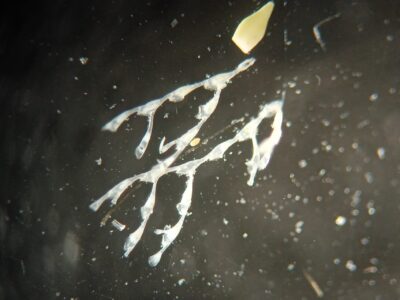
Pleurocodonellina longirostrata is a colonial bryozoan, meaning it exists not as a solitary individual but as a living community of genetically identical units called zooids. Each zooid is microscopic—visible only under magnification—yet collectively, the colonies form delicate, branching structures that encrust rocky substrates and other hard surfaces on the seafloor. The species is distinguished by its characteristic long rostrum (a beak-like projection), which gives it its scientific name and serves as a key identifying feature among its relatives.
The colonies display the typical architecture of cheilostomatid bryozoans, with individual zooids arranged in orderly patterns across a calcified skeleton. These structures are pale in coloration, often appearing white or cream-colored, though they may acquire tints from sediment and organic material in their marine environment. Sexual dimorphism in bryozoans is subtle; the species exhibits different zooid types for reproduction, with specialized ovicells (brood chambers) and male zooids interspersed among the feeding zooids that dominate the colony.
As a sessile filter-feeder, Pleurocodonellina longirostrata remains permanently attached to its substrate once it settles as a larva. The colony extends delicate lophophores—crown-like feeding structures—from each zooid’s aperture to capture microscopic food particles suspended in the water column. This is not a life of inactivity; rather, it is one of constant vigilance, with thousands of zooids working in concert to draw water through the colony and extract nourishment.
The species exhibits the rhythmic feeding behavior characteristic of bryozoans, with zooids extending and retracting their lophophores in response to water movement and food availability. When conditions become unfavorable—such as during periods of strong currents or predatory pressure—the zooids withdraw completely into their protective chambers. This synchronized behavior across the colony represents a form of collective decision-making that occurs without any central nervous system, a testament to the sophistication of colonial organization.
Pleurocodonellina longirostrata inhabits the rocky intertidal and subtidal zones along the Pacific coast of North America, with recorded occurrences from Washington state to Baja California and the Gulf of California. The species thrives in areas where rocky substrates provide secure attachment points and where nutrient-rich waters support abundant plankton populations. Its presence has been documented at multiple locations along the California coast and in the waters off Mexico, indicating a preference for temperate to warm Pacific waters.
The species appears to favor exposed rocky shores and reefs where wave action maintains healthy water circulation. Its distribution pattern reflects the availability of suitable hard substrate—a critical requirement for bryozoan settlement and colony establishment. The occurrences recorded from both the Pacific Northwest and Southern California suggest the species tolerates a range of temperature conditions, though it remains primarily a marine species of the western North American coast.
Pleurocodonellina longirostrata is a suspension feeder, drawing its sustenance from the microscopic life that drifts through ocean currents. The colony captures diatoms, copepod nauplii, and other planktonic organisms, along with organic detritus, using the coordinated filtering action of thousands of lophophores. This feeding strategy requires no hunting, no stalking, no competition for territory—only patience and the rhythmic extension of feeding structures.
Feeding efficiency varies with water movement and food concentration. During periods of high plankton abundance, the colony experiences rapid growth and energy accumulation, allowing for increased reproductive investment. Conversely, during lean seasons, the colony reduces its metabolic demands and relies on stored reserves. The species’ success along nutrient-rich Pacific coasts demonstrates its adaptation to variable food availability in marine environments.
Bryozoan reproduction combines both asexual and sexual strategies, and Pleurocodonellina longirostrata exemplifies this dual approach. New colonies arise through asexual budding, where existing zooids generate daughter zooids in a process of endless repetition that can continue indefinitely. This allows a single larva to establish a colony that may eventually encompass thousands or millions of genetically identical individuals.
Sexual reproduction occurs seasonally, with male and female zooids producing sperm and eggs that unite within specialized ovicells. The fertilized embryos develop within these protective chambers before being released as free-swimming larvae. These larvae drift through the water column, seeking suitable hard substrate upon which to settle and establish new colonies, completing the species’ remarkable life cycle.
Little specific data exists regarding the population size or conservation status of Pleurocodonellina longirostrata, reflecting the general lack of attention paid to bryozoans in conservation assessments. The species likely maintains stable populations where suitable habitat remains available, particularly along protected rocky coastlines. However, the encroachment of coastal development, pollution, and climate-driven changes to ocean conditions pose potential threats to its long-term persistence.
As a marine species dependent on hard substrate and healthy water quality, Pleurocodonellina longirostrata benefits indirectly from marine protected areas and coastal conservation efforts. The species’ role in rocky reef ecosystems—filtering nutrients and providing food for small predators—underscores its ecological importance despite its microscopic size. Future monitoring of bryozoan populations may reveal important insights into the health of Pacific coastal marine communities.
Invisible architects: Each individual zooid is smaller than the period at the end of this sentence, yet colonies can span several centimeters—a remarkable scaling of complexity from microscopic to visible.
Ancient lineage: Bryozoans have existed for over 500 million years, making them older than dinosaurs and surviving multiple mass extinction events.
Living filters: A single bryozoan colony can filter hundreds of times its own volume of seawater daily, making these tiny creatures significant players in nutrient cycling.
No brain required: Despite lacking a brain or nervous system, bryozoan colonies exhibit sophisticated coordinated behavior and can respond to environmental changes across the entire colony.
Eternal youth through budding: Individual zooids are effectively immortal through asexual reproduction, with colonies potentially persisting indefinitely if conditions remain favorable.
Colonial consciousness: The zooids within a colony share a common blood-like fluid system called the coelom, allowing chemical communication and nutrient distribution throughout the colony.
Fossil record: Bryozoan fossils are so abundant and diverse that paleontologists use them as key indicators for dating and understanding ancient marine environments.