Fungi
| Kingdom | Fungi |
|---|---|
| Phylum | Basidiomycota |
| Class | Agaricomycetes |
| Order | Agaricales |
| Family | Tricholomataceae |
| Genus | Pseudobaeospora |
| Species | Pseudobaeospora celluloderma |
What makes a fungus worth knowing? Pseudobaeospora celluloderma is a diminutive yet botanically fascinating member of the Tricholomataceae family, distinguished by its delicate architecture and the remarkable cellular structures that give it its scientific name. This tiny agaric inhabits the cool forests of northern Europe and parts of North America, thriving in habitats where moisture and decomposing matter create the perfect conditions for its mysterious life cycle. Though small enough to fit on a fingernail, this species represents an entire world of fungal complexity that reveals itself only to patient observers.
Pseudobaeospora celluloderma is characterized by small mycenoid white-spored basidiomes with a pileus measuring 1.5–4.5 mm in diameter and a stipe 10–55 mm tall and 0.5–3.0 mm thick. The cap presents a delicate hemispherical to slightly conical form, often with a subtle umbo at the center—a tiny button of tissue that catches the light like a miniature jewel.
The color palette of P. celluloderma speaks to its ecological niche. This species lacks cheilocystidia and pileocystidia, distinguishing it from related species. The gills are adnexed, running nearly to the stem but not quite touching it, and they display a pale coloration that matches the delicate cap. The basidiospores are small—ranging from 2.5 µm to rarely more than 6.5 µm long—subglobose to broadly ellipsoid, colorless, and smooth.
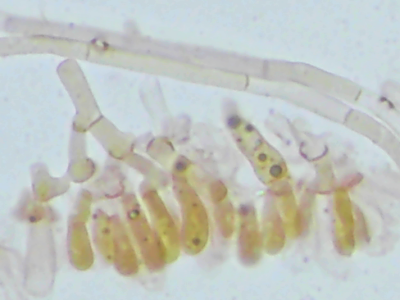
Identification tip: The most reliable character for identifying P. celluloderma lies in its microscopic architecture. The pileipellis displays erected chains of inflated cells forming a transition between hymeniderm and epithelium, creating a distinctive cellular pattern visible only under magnification. This structural arrangement is what earned the species its name—celluloderma literally refers to these cell-based dermal features.
The life cycle of P. celluloderma unfolds through the seasons in a delicate dance with its forest environment. The fungus exists primarily as mycelium—an invisible network of threadlike hyphae—colonizing the soil and organic matter of woodland floors. The genus Pseudobaeospora is characterized by a gymnocarpic mycenoid/collybioid habit and the presence of crassobasidia, meaning the fruiting bodies develop without a protective partial veil, and their basidia—the spore-producing cells—are unusually thick-walled.
When conditions align—typically during cool, moist periods in autumn—the mycelium directs its energy into fruiting body formation. Tiny primordia begin to swell, pushing through the leaf litter and moss. Within days, the complete fruiting body emerges: a miniature umbrella barely visible to the casual observer. The fungus produces spores with remarkable efficiency, their minute size allowing them to drift on air currents and colonize new substrates.
The reproductive strategy of P. celluloderma emphasizes abundance through diminishment. By remaining exceptionally small, the species can produce numerous fruiting bodies from limited resources, each releasing thousands of spores into the forest air. This approach contrasts sharply with larger fungi that invest heavily in a few substantial fruiting bodies.
Pseudobaeospora celluloderma has been recorded in northern European countries including Denmark (where it is known as Ametyst-røghat), Finland (rikkakarikka), and across Scandinavia. The species also occurs in Central Europe—Switzerland, Germany, Austria, Slovakia—and has been documented in the United Kingdom and France. In North America, records exist from the United States, though occurrences appear more sporadic than in Europe.
The species grows in woodland settings on slightly acid soil, with documented records from 25-year-old Oak, Hazel, and Willow woodland, where the fruiting bodies emerge directly from the soil with caps measuring 9mm and featuring granular texture with an umbo. P. celluloderma prefers temperate, cool-climate forests with consistent moisture—the kind of places where moss thrives and organic matter accumulates steadily. The fungus appears particularly associated with mixed deciduous and coniferous woodlands, where the forest floor remains undisturbed and rich with decomposing leaves and wood fragments.
Though diminutive, P. celluloderma plays a meaningful role in forest nutrient cycling. The species functions primarily as a saprotroph, breaking down dead organic matter in the soil and leaf litter. Most species in the Tricholomataceae family are saprophytic, consuming old wood or forest duff, a role that P. celluloderma fulfills with quiet efficiency.
As the fungal mycelium colonizes decaying plant material, it secretes enzymes that break down complex polymers—cellulose, lignin, and other structural compounds—into simpler molecules that can be reabsorbed and incorporated into fungal tissue. When the fruiting bodies finally appear and release their spores, they complete a cycle of decomposition and regeneration. The nutrients locked in dead leaves and fallen branches are gradually liberated, becoming available to living plants and other organisms. In this way, P. celluloderma contributes to the fundamental process that transforms yesterday’s forest into tomorrow’s growth.
The edibility status of P. celluloderma remains unknown, and for good reason: the species is far too small and inconspicuous to be of culinary interest. Few would notice these tiny fruiting bodies, let alone consider harvesting them. The fungus produces no known medicinal compounds of commercial value, nor does it appear in folklore or traditional uses.
Edibility warning: Given the genus Pseudobaeospora’s diversity and the difficulty in distinguishing species microscopically, no species in this genus should be consumed without expert identification. The risk of misidentification far outweighs any potential nutritional benefit from such minute fruiting bodies.
Instead, the true value of P. celluloderma lies in its scientific interest. The species represents an entire ecological strategy—the miniaturization of fungal fruiting bodies as an adaptation to specific niches. For mycologists and forest ecologists, P. celluloderma serves as a window into the hidden complexity of woodland ecosystems and the remarkable diversity of form that evolution has produced within the fungal kingdom.
Microscopic marvels: At just 1-4.5 mm across, P. celluloderma is so small that it can easily be overlooked during forest walks, yet each fruiting body is a complete organism capable of producing thousands of spores.
Nordic nomenclature: The species earned Danish and Finnish common names—Ametyst-røghat and rikkakarikka—suggesting it has been recognized by European naturalists for centuries, even if formal scientific description came much later.
Cellular sophistication: The genus Pseudobaeospora is defined by small-sized spores with thick and dextrinoid walls and the presence of crassobasidia, meaning even at the microscopic level, this fungus exhibits specialized structures that reflect its unique evolutionary lineage.
Recent reclassification: Based on molecular and morphological evidence, the new subfamily Pseudobaeosporoideae was established within the Tricholomataceae specifically to accommodate the unique features of Pseudobaeospora, demonstrating that this genus represents a distinct evolutionary branch worthy of its own subfamily designation.
Temperate specialist: The species shows a clear preference for cool, northern forests, with the vast majority of records coming from Scandinavia and Central Europe, suggesting it may be sensitive to warming temperatures and forest disturbance.
Soil architect: As a saprotroph, P. celluloderma participates in the slow but essential work of converting forest litter into humus, helping to build the fertile soil that supports entire woodland communities.
Hidden abundance: Despite its minute size, the species can fruit prolifically when conditions are right, with dozens or even hundreds of tiny fruiting bodies emerging from a single patch of forest floor, creating an ephemeral garden invisible to the untrained eye.
Bas, C. (2002, 2003). Monographic studies on European Pseudobaeospora species with emphasis on morphological and ecological characterization.
Adamčík, S. & Bas, C. (2002). Re-evaluation of morphological variability of Pseudobaeospora group Celluloderma (Agaricales, Basidiomycota). Nature Conservation Research.
Consiglio, G., Adamčíková, K., Setti, L., & Adamčík, S. (2025). Pseudobaeosporoideae, a new subfamily within the Tricholomataceae for the genus Pseudobaeospora based on morphological and molecular inference. IMA Fungus, 16: e144994.
Desjardin, D. E. (2004). Type studies and taxonomic evaluation of North American species of Pseudobaeospora and related genera. Mycotaxon and related publications.
Funga Nordica (1899-updated). Comprehensive guide to fungi of northern Europe with detailed species descriptions and distribution data.