Animals
| Kingdom | Animalia |
|---|---|
| Phylum | Arthropoda |
| Class | Diplopoda |
| Order | Polydesmida |
| Family | Paradoxosomatidae |
| Genus | Scolodesmus |
| Species | Scolodesmus securis |
From the lush forests of West Africa emerges Scolodesmus securis, a remarkable millipede that represents one of the lesser-known wonders of the arthropod world. This species, first described by Cook in 1896, belongs to the family Paradoxosomatidae—one of the most diverse groups of millipedes on Earth. Though little known to science, S. securis carries within its segmented body the ancient legacy of creatures that have walked the forest floor for over 300 million years.
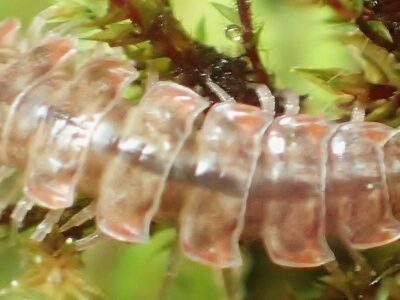
Scolodesmus securis is a flat-backed millipede, displaying the characteristic body structure of the Paradoxosomatidae family. As a member of the flat-backed millipedes in the order Polydesmida, this species can be distinguished by dorsal grooves on most body segments and a dumb-bell shaped gonopod aperture. Like other paradoxosomatids, the body is cylindrical to slightly flattened, typically measuring 10–50 mm in length, with prominent dorsal transverse grooves on each segment and keeled lateral margins contributing to their distinctive “flat-backed” appearance.
The species likely displays the dark coloration typical of its family. Paradoxosomatid coloration is predominantly dark brown to black, providing camouflage in leaf litter. Like all millipedes, S. securis possesses the defining characteristic of its class: two pairs of jointed legs on most body segments. Millipedes differ from centipedes in that their legs are paired in each body segment (except for the first three).
Sensory perception in this species relies heavily on touch rather than vision. Antennae are short, usually reaching only to the third segment when extended, and serve as primary sensory organs, though some taxa are blind and rely entirely on antennal touch. The millipede’s body is encased in a tough exoskeleton, providing both protection and structural support for its numerous legs.
As a member of the Paradoxosomatidae, S. securis is adapted for life in humid forest environments. These millipedes exhibit nocturnal activity patterns and frequently burrow into the topsoil for refuge during the day, particularly in areas with high humidity. The species moves with the characteristic slow, deliberate pace of millipedes, using its segmented body to navigate through the complex leaf litter and soil of its habitat.
When threatened, S. securis likely employs the defensive strategies common to its family. Some paradoxosomatid species can roll into a tight coil as a defensive behavior, protecting their vulnerable underside. Their bright coloration can sometimes be a warning signal to predators that they produce toxic chemicals. Additionally, most millipedes defend themselves with a variety of chemicals secreted from pores along the body.
The daily rhythm of S. securis reflects its role as a forest floor dweller. During daylight hours, it remains hidden beneath logs, rocks, and leaf litter. As darkness falls, the millipede emerges to forage, crawling through the decomposing organic matter that sustains it. This nocturnal lifestyle minimizes exposure to visual predators while maximizing access to food resources.
Scolodesmus securis is known from Togo, a West African nation with rich tropical forest ecosystems. The species has been recorded in the region around coordinates 6.93142°N, 0.57307°E, representing a limited geographical range. Only three occurrences of this species have been documented in scientific records, suggesting either a genuinely restricted distribution or that the species remains poorly studied and undersampled.
Few millipede species are widespread; they have very poor dispersal abilities, depending as they do on terrestrial locomotion and humid habitats, which have favoured genetic isolation and rapid speciation, producing many lineages with restricted ranges. This pattern of limited distribution is typical for millipedes, particularly in tropical forest regions where localized endemism is common. The Togolese forests where S. securis occurs provide the humid, organic-rich environment essential for millipede survival.
Scolodesmus securis is a detritivore, playing a vital ecological role as a decomposer. As a detritivore, it feeds mainly on decaying plant material and contributes to nutrient cycling in ecosystems. The millipede’s diet consists of:
Millipedes are detritivores, feeding on leaf litter and other debris, and prefer moist habitats such as flower beds and leaf piles, also scraping calcium carbonate off the surfaces of sidewalks and rocks. This feeding behavior is crucial for forest health. By consuming dead organic matter, S. securis accelerates decomposition and returns essential nutrients to the soil, supporting plant growth and maintaining the productivity of its ecosystem.
The species forages primarily at night, using its antennae to locate food sources in the darkness. Millipedes usually search for food at night and prefer to remain in dark places. Its mandibles are adapted for chewing through tough plant material, allowing it to process the fibrous content of decaying leaves and wood.
Reproduction in S. securis follows the pattern characteristic of millipedes. Reproduction in most millipede species is carried out by modified male legs called gonopods, which transfer packets of sperm to females. The male uses these specialized reproductive appendages to clasp and stabilize the female during mating, ensuring successful transfer of sperm.
Adult males have a pair of modified legs called gonopods that act as reproductive organs, leaving that diplosegment with a single pair of legs and another pair of gonopods, and adults may mate several times, after which females lay their eggs in moist soil. The female, once fertilized, deposits her eggs in protected microhabitats—typically in moist soil or leaf litter where conditions favor development.
Development from egg to adult involves multiple molts. Millipedes must go through a series of molts (shedding of their exoskeletons), and each time they molt, they add two pairs of legs per body segment, which gives them the appearance of having hundreds of legs. This gradual development, called hemianamorphosis, allows the young millipede to grow progressively larger while adding segments and legs with each molt until it reaches adult size and reproductive maturity.
The conservation status of S. securis remains undetermined, reflecting the limited scientific attention this species has received. With only three recorded occurrences in the scientific literature, the true population size and distribution remain unknown. The species may be genuinely rare, or it may simply be undersampled due to the challenges of millipede survey work in remote tropical forests.
The primary threat to S. securis and other forest millipedes is habitat loss. Deforestation for agriculture, logging, and human settlement reduces the humid forest environments essential for millipede survival. The species’ apparent restriction to West African forests makes it potentially vulnerable to the significant forest loss occurring throughout the region.
Conservation note: Further research is urgently needed to establish the true distribution, population status, and ecological requirements of S. securis. Surveys in Togolese forests could reveal whether the species is truly rare or simply overlooked. Protecting the remaining forest habitats in West Africa is essential for the survival of this and countless other millipede species that depend on intact forest ecosystems.
Ancient Lineage: Millipedes first appeared in the Silurian period, making them some of the oldest known land animals.
Leg Addition: Unlike humans, S. securis is not born with its full complement of legs—it adds new leg pairs with each molt throughout its life.
Chemical Defense Arsenal: Millipedes exhibit protective behavior by coiling together and employing chemical defenses, such as the release of toxic compounds from glands along their bodies, and are characterized by the production of deterrent substances, including highly poisonous hydrogen cyanide and various alkaloids.
Ecological Engineers: By breaking down dead plant material and returning nutrients to soil, S. securis and its relatives perform an essential ecosystem service that supports forest productivity.
Sensory Specialists: Despite being blind or nearly blind, millipedes like S. securis navigate their complex environments with remarkable precision using only their antennae as sensory organs.
Slow and Steady: The scientific name “millipede” comes from Latin meaning “thousand feet,” though S. securis has far fewer—but each one is precisely coordinated for efficient movement through soil and leaf litter.
Forest Floor Architects: By creating tunnels as they burrow and decomposing organic matter, millipedes improve soil structure and water infiltration, enhancing habitat quality for countless other organisms.
Cook, O.F. (1896). “Scolodesmus and related genera.” Proceedings of the United States National Museum, 19, 149-161.
Jeekel, C.A.W. (1968). “On the Classification and Geographical Distribution of the Family Paradoxosomatidae (Diplopoda, Polydesmida).” Rotterdam, privately published.
Hoffman, R.L. (1953). “Scolodesmus and related African millipede genera.” Proceedings of the Biological Society of Washington, 66, 75-84.
Global Biodiversity Information Facility (GBIF). “Scolodesmus securis.” Retrieved from www.gbif.org
Golovatch, S.I. & Korsós, Z. (2012). “Millipedes (Diplopoda) of the Caucasus: An overview.” Arthropoda Selecta, 21(3), 187-213.