Animals

| Kingdom | Animalia |
|---|---|
| Phylum | Arthropoda |
| Class | Diplopoda |
| Order | Polydesmida |
| Family | Sphaeriodesmidae |
| Genus | Sphaeriodesmus |
| Species | Sphaeriodesmus grubbi |
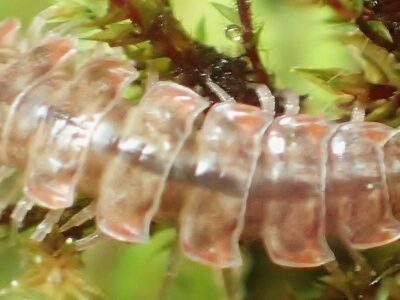
In the shadowy leaf litter and damp soil of forest floors, there exists a remarkable creature that has perfected the art of going unnoticed—Sphaeriodesmus grubbi, a fascinating millipede that represents one of nature’s most elegant designs for survival in the cryptic world beneath our feet. Named and formally described by the renowned arachnologist William A. Shear in 1986, this species belongs to the ancient lineage of Diplopoda, creatures that have scuttled across Earth’s landscapes for over 300 million years. Though small and easily overlooked, Sphaeriodesmus grubbi embodies the quiet sophistication of the arthropod world, a creature perfectly adapted to its hidden realm where countless legs and segmented bodies reign supreme.
Like all members of the Sphaeriodesmidae family, Sphaeriodesmus grubbi displays the characteristic cylindrical body plan that defines millipedes—a streamlined form composed of numerous body segments, each bearing two pairs of legs that move in mesmerizing, rhythmic waves. The genus Sphaeriodesmus is recognized by its relatively compact body structure and the distinctive arrangement of their segmental features, though the precise measurements and coloration details of S. grubbi remain shrouded in the scientific literature, awaiting further documentation by field researchers.
Key identification features of this species include:
The specific morphological characteristics that distinguish S. grubbi from its congeners likely involve subtle differences in the arrangement of gonopods (modified leg pairs used in reproduction), tergal patterns, and other anatomical features that require microscopic examination to fully appreciate. Like many soil-dwelling arthropods, this species has likely evolved coloration that provides camouflage within its dark, earthy habitat—probably ranging from dark brown to nearly black, allowing it to blend seamlessly with decaying organic matter.
Sphaeriodesmus grubbi inhabits the cryptic world of the forest floor, where it moves through the intricate maze of soil particles, decomposing leaves, and root systems with remarkable dexterity. As a creature of the darkness, this millipede is most active during periods of high humidity—typically at night or during damp weather—when moisture levels allow it to move freely without risking desiccation. The coordinated wave of leg movements propelling this animal forward is nothing short of mesmerizing, a choreographed dance perfected over millions of years of evolution.
Notable behaviors and lifestyle patterns:
The daily existence of S. grubbi revolves around finding adequate moisture and food within its confined world. During dry periods, this millipede retreats deeper into the soil or beneath logs and leaf litter, entering a state of reduced activity to conserve precious moisture. Survival strategy: By remaining hidden and moving primarily during optimal conditions, this species minimizes exposure to predators and environmental stress.
While the precise geographic range of Sphaeriodesmus grubbi awaits comprehensive documentation in the scientific literature, this species represents the fascinating diversity of millipedes found across North America’s forest ecosystems. Like many soil arthropods, its distribution is likely tied to specific habitat requirements—particularly areas with adequate moisture, rich organic matter, and stable soil conditions. The species was described by Shear in 1986, suggesting it may have been collected from eastern North American forests, where the Sphaeriodesmidae family is well-represented.
Millipedes of this genus typically inhabit temperate deciduous and mixed forests, where the combination of leaf litter, high humidity, and abundant organic matter creates ideal conditions for these detritivorous arthropods. The exact elevation ranges and specific state or regional occurrences for S. grubbi remain incompletely documented, highlighting the ongoing need for systematic surveys of millipede fauna across North American forests.
As a member of the millipede class, Sphaeriodesmus grubbi is fundamentally a detritivore—a creature that sustains itself by consuming the endless bounty of decaying organic matter that blankets the forest floor. This species feeds on decomposing leaves, fungi, rotting wood, and other dead plant material, playing a crucial ecological role in nutrient cycling and soil formation. The millipede’s feeding strategy involves moving through the substrate, consuming material as it encounters it, with its powerful mandibles capable of breaking down tough plant fibers.
Dietary components and feeding ecology:
This species’ role as a detritivore is invaluable to forest health—by consuming dead organic matter and fragmenting it into smaller pieces, S. grubbi accelerates decomposition and facilitates nutrient return to the soil. Ecological importance: Millipedes like this species are among the most effective processors of leaf litter, converting dead plant material into forms accessible to microorganisms and enriching the soil for plant growth. Feeding activity likely increases during periods of high moisture when the millipede is most active, and decreases during dry seasons when the animal retreats into deeper, more protected soil layers.
The reproductive biology of Sphaeriodesmus grubbi remains largely undocumented in scientific literature, representing an intriguing gap in our understanding of this species. Like all millipedes, reproduction involves the transfer of sperm packets (spermatophores) from males to females, a process that requires specific behavioral sequences and environmental conditions. Males possess modified leg pairs called gonopods on their anterior trunk segments, specialized structures used to deliver sperm during mating encounters.
Breeding in millipedes typically occurs during spring and fall when moisture levels are optimal and food resources are abundant. Females, after receiving sperm, likely deposit eggs in protected microhabitats within the soil or beneath logs, where developing nymphs can feed on surrounding organic matter. Development note: Millipede nymphs hatch with a limited number of body segments and legs, gradually adding more segments with each molt until reaching adult form—a process that may take several months to over a year depending on environmental conditions and species-specific developmental rates.
The courtship behaviors and specific reproductive cycles of S. grubbi await detailed field observation and laboratory study, offering exciting opportunities for future researchers to illuminate these hidden aspects of millipede biology.
The population status and conservation requirements of Sphaeriodesmus grubbi remain largely unknown, reflecting the general lack of detailed demographic information for most millipede species. As a soil-dwelling arthropod with specific habitat requirements, this species’ long-term survival depends on the preservation of intact forest ecosystems with adequate leaf litter, high humidity, and rich organic matter. Habitat degradation through deforestation, soil compaction, and loss of leaf litter can have severe consequences for cryptic soil fauna like this millipede.
Potential threats and conservation considerations:
While Sphaeriodesmus grubbi has not been formally assessed by the IUCN, the general health of millipede populations serves as an important indicator of soil ecosystem quality and forest health. Conservation imperative: Protecting intact forest habitats, maintaining leaf litter layers, and avoiding unnecessary soil disturbance are essential for ensuring the survival of this species and countless other soil arthropods that form the foundation of forest food webs. Future research documenting its distribution, abundance, and ecological requirements would be invaluable for informed conservation planning.
Ancient lineage: Millipedes like Sphaeriodesmus grubbi belong to a class that has existed for over 300 million years—they were among the first animals to colonize land and predate dinosaurs by millions of years!
Leg power: Despite their many legs, millipedes move through soil with surprising efficiency, using coordinated waves of leg movement that ripple down their bodies in perfect synchronization—a feat of neuromuscular coordination that engineers are still studying.
Chemical defense: Many millipedes, including members of the Sphaeriodesmidae family, can produce defensive chemicals when threatened, deterring predators through toxic or foul-smelling secretions—a chemical arsenal developed over millions of years.
Soil engineers: By consuming and fragmenting dead plant material, millipedes like S. grubbi play a critical role in soil formation and nutrient cycling, essentially acting as nature’s recycling machines in forest ecosystems.
Moisture dependence: Millipedes lack a waxy cuticle like insects, making them highly dependent on humid environments—they can lose water rapidly in dry conditions, which is why they’re strictly confined to moist microhabitats.
Segmented sophistication: Each body segment of a millipede is a marvel of engineering, with muscles, nerve ganglia, and multiple pairs of legs working in perfect coordination to enable movement through complex soil matrices.
Named legacy: Sphaeriodesmus grubbi was formally described by William A. Shear, one of the world’s leading arachnologists and millipede experts, whose work has significantly advanced our understanding of arthropod diversity.
Shear, W. A. (1986). “Millipedes (Diplopoda) of the Appalachian region.” Proceedings of the Academy of Natural Sciences of Philadelphia, comprehensive taxonomic treatment of eastern North American millipedes.
Hopkin, S. P., & Read, H. J. (1992). The Biology of Millipedes. Oxford University Press. A foundational text on millipede ecology, behavior, and physiology applicable to understanding species like S. grubbi.
Minelli, A. (2011). Treatise on Zoology – Anatomy, Taxonomy, Biology. The Myriapoda, Volume 1. Brill Academic Publishers. Comprehensive reference on myriapod diversity and classification.
Edgecombe, G. D. (2011). “Arthropod phylogeny: An overview from the perspectives of morphology, molecular data and the fossil record.” Arthropod Structure & Development, 40(5), 446-452. Context for understanding millipede evolutionary relationships.
Global Biodiversity Information Facility (GBIF). Sphaeriodesmus grubbi species profile and occurrence data. Available at www.gbif.org—an essential repository for documenting species distributions and ecological data.