Animals
Home »
Upeneus sulphureus
| Kingdom | Animalia |
|---|---|
| Phylum | Chordata |
| Order | Perciformes |
| Family | Mullidae |
| Genus | Upeneus |
| Species | Upeneus sulphureus |
Key metrics will appear once data is available.
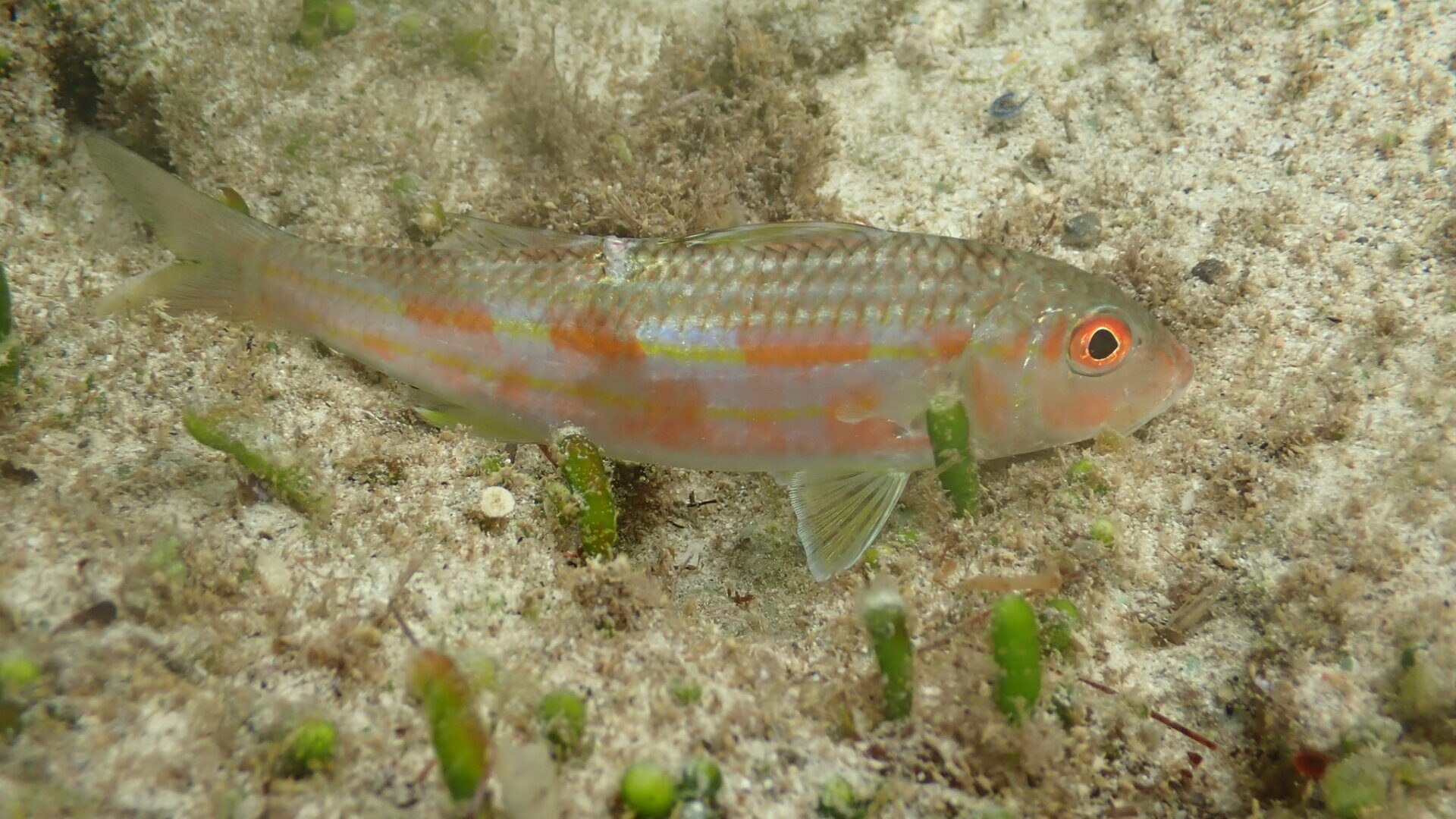
Meet Upeneus sulphureus, a small but intrepid hunter that patrols the sandy and muddy bottoms of tropical and subtropical seas across the Indo-Pacific, Indian, and Atlantic oceans. Known variously as the sulphur goatfish or sunrise goatfish, this unassuming fish possesses one of the marine world’s most sophisticated sensory systems—a pair of delicate barbels dangling from its chin that transform the seabed into a feast of hidden flavors. With nearly 5,900 recorded observations spanning from Southeast Asia to Australia, from the coasts of India to the waters of New Zealand, this species has proven itself a cosmopolitan survivor of coastal ecosystems worldwide.
Goatfish are characterized by their two chin barbels, which are often referred to as a goatee, and these barbels contain chemosensory organs that are used for probing the sand or reef holes in search of food. Upeneus sulphureus shares these defining features with its relatives, sporting an elongated, laterally compressed body built for agility through tight spaces and complex reef structures.
These fish have deep and elongated bodies, with forked tails and widely separated dorsal fins, with the first dorsal fin typically having 6-8 spines, while the second dorsal fin has one spine and 8-9 soft rays, which are shorter than the anal fin, and the anal fin usually has 1 or 2 spines, with 5-8 soft rays. The coloration of the sulphur goatfish varies across its range, reflecting local environmental conditions and individual variation—a characteristic adaptation that helps these fish blend seamlessly with sandy and muddy substrates.
Goatfish are benthic feeders, using a pair of long chemosensory barbels (whiskers) protruding from their chins to feel through the sediments in search of prey. The sulphur goatfish conducts its daily business with methodical precision, sweeping its sensitive barbels across the ocean floor like a living metal detector, detecting the faintest chemical signals that betray the presence of hidden invertebrates.
By day, many goatfish will form large schools of inactive (nonfeeding) fish; these aggregates may contain both conspecifics and heterospecifics, for example, the yellowfin goatfish (Mulloidichthys vanicolensis) is often seen congregating with bluestripe snappers (Lutjanus kasmira). This schooling behavior provides safety in numbers while conserving energy during daylight hours. All goatfish have the ability to change their coloration depending on their current activity. When feeding intensifies, the sulphur goatfish may shift its coloration subtly, a living advertisement of its behavioral state.
The sulphur goatfish commands an impressive geographic range, occurring across the Indo-Pacific region and beyond. Sulphur Goatfish (Upeneus sulphureus) have been recorded in Pahang & Terengganu in Malaysia, and its presence extends throughout the tropical waters of Thailand, Indonesia, Singapore, the Philippines, Vietnam, South Korea, China, India, Bangladesh, Myanmar, and Australia. The species has even been documented in the western Indian Ocean off South Africa and Mozambique, and in the Atlantic, including records from Cuba and the eastern Mediterranean near Israel and Turkey. This wide distribution reflects the sulphur goatfish’s remarkable adaptability to diverse coastal environments.
Twenty eight species of organisms were found in the digestive system of the sunrise goatfish dominated by the phytoplankton genus Thallasiothrix, and the sunrise goatfish has significant dietary changes with increasing total length and time, developing mix feeding strategies; specialist and generalist, with generalist strategy developed for all prey, except Thallasiothrix obtained by spesialist strategy. This dietary flexibility allows young and juvenile fish to maximize available resources, shifting their feeding focus as they grow.
The food items mainly include shrimps (31.56%), crabs (27.93%), teleostean fish remains (14.51%), bivalve molluscs (13.51%) and the remaining (12.49%) consisted of unidentified food items. The sulphur goatfish’s preference for crustaceans makes it a vital player in controlling invertebrate populations on the seafloor. The gonadosomatic index indicated that U. sulphureus spawns twice a year during January–May and August–October. This dual spawning strategy ensures reproductive success across varying seasonal conditions.
Goatfish are pelagic spawners; they release many buoyant eggs into the water, which become part of the plankton, the eggs float freely with the currents until hatching, and the larvae drift in oceanic waters or in the outer shelf for a period of 4–8 weeks until they metamorphose and develop barbels. This pelagic larval stage disperses young fish across vast distances, allowing populations to colonize new habitats and maintain genetic diversity.
Most species take on a bottom-feeding lifestyle, although other species remain in the open water as juveniles or feed on plankton, juvenile goatfish often prefer soft bottoms, in seagrass beds to mangroves, and they change habitat preference as they develop, coinciding with changes in feeding habits, social behavior, and the formation of association with other species. This ontogenetic shift—the dramatic change in habitat and behavior as the fish matures—represents a critical transition in the sulphur goatfish’s life history.
Most goatfish reach reproductive maturity after 1-2 years. The relatively rapid maturation of Upeneus sulphureus allows populations to recover quickly from fishing pressure and environmental disturbances.
The sulphur goatfish maintains a status of Least Concern according to conservation assessments, reflecting its wide distribution and relatively stable populations across its range. Resilience (Ref. 120179): Medium, minimum population doubling time 1.4 – 4.4 years (K=0.5-1.3; tmax=4.6). This moderate resilience indicates the species can sustain moderate fishing pressure, though populations require monitoring to ensure sustainability.
Goatfish species are economically important and can be found in many fisheries around the world. The sulphur goatfish is commonly caught as both target and bycatch in artisanal and industrial fisheries throughout its range, particularly in Southeast Asia and the Indian Ocean. While Fishing Vulnerability (Ref. 59153): Low vulnerability (15 of 100) suggests the species is not overly susceptible to fishing pressure, habitat degradation and coastal development pose ongoing threats. Maintaining healthy seagrass beds and mangrove nurseries remains critical for sustaining juvenile populations.
Goatfish are characterized by their two chin barbels, which are often referred to as a goatee, and these barbels contain chemosensory organs that are used for probing the sand or reef holes in search of food.
Fecundity of the fish was positively correlated with the body and gonad weight, and varied from 15 128–97 274 eggs with fish weight 11.30–58.73 g.
Other fish shadow the active goatfish, waiting patiently for any overlooked prey, for example, in Indonesia large schools of the goldsaddle goatfish (Parupeneus cyclostomus) and moray eels hunt together, a behavior known as shadow feeding or cooperative hunting.
The larvae then spend 4-8 weeks drifting in oceanic waters or in the outer shelf before undergoing metamorphosis and developing barbels, and following this, most species adopt a bottom-feeding lifestyle, though some remain in the open water as juveniles or feed on plankton.
Trophic level (Ref. 69278): 3.1 ±0.1 se; based on diet studies. This places the sulphur goatfish at an intermediate trophic level, making it an important link between primary producers and larger predatory fish.
Twenty eight species of organisms were found in the digestive system of the sunrise goatfish dominated by the phytoplankton genus Thallasiothrix. Young sulphur goatfish consume microscopic organisms, demonstrating dietary specialization based on size and developmental stage.
Juvenile goatfish commonly prefer soft bottoms and can be found in seagrass beds or mangroves, and as they develop, their habitat preference changes along with their feeding habits, social behavior, and associations with other species.