Animals
| Kingdom | Animalia |
|---|---|
| Phylum | Arthropoda |
| Class | Diplopoda |
| Order | Polydesmida |
| Family | Paradoxosomatidae |
| Genus | Tylopus |
| Species | Tylopus strongylosomoides |
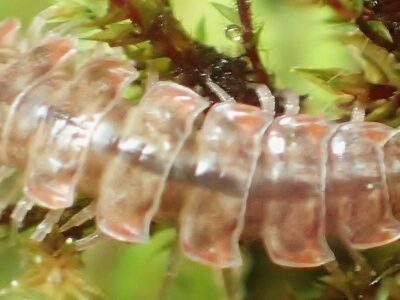
From the misty mountains of northern Vietnam emerges Tylopus strongylosomoides, a millipede species that exemplifies the remarkable diversity of Southeast Asian arthropods. Found at Tam Dao in northern Vietnam, this diminutive creature represents one of many species within the genus Tylopus, which dominates millipede communities across Indochina and southern China.
Despite its modest presence in scientific literature, this species carries important clues about the evolutionary adaptations and ecological roles of flat-backed millipedes in tropical forest ecosystems.
Paradoxosomatids are generally distinguished by dorsal grooves on most body segments and a dumb-bell shaped gonopod aperture. Tylopus strongylosomoides shares these characteristic features with its family members. Members of Paradoxosomatidae are characterized by a flattened dorsal surface and typically possess around 20 body segments, with some species reaching lengths of up to 50 mm.
The genus Tylopus is known for its distinctive gonopod structure. The gonopod telopodite in Tylopus usually shows a distinct transverse ring, or cingulum, demarcating the postfemoral region which starts at the base of a free, flagelliform solenomere, with the solenomere largely sheathed by a slender and sigmoid solenophore usually bearing a number of outgrowths at its base. Process h is absent from T. strongylosomoides, making this species distinctly recognizable from its congeners through careful microscopic examination.
Species of Tylopus are predominantly forest-dwellers, especially in montane habitats where up to 9–10 species can coexist per faunule. Tylopus strongylosomoides shares this preference for forested environments, where it navigates the complex three-dimensional world of leaf litter and soil.
Typically forest floor dwellers, millipedes live in leaf litter, dead wood, or soil, with a preference for humid conditions, and in temperate zones, millipedes are most abundant in moist deciduous forests. The species employs the burrowing strategies characteristic of its family, moving through soil and organic matter using muscular contractions of its segmented body. Its primary defence mechanism is to curl into a tight coil, thereby protecting its legs and other vital delicate areas on the body behind a hard exoskeleton.
Tylopus strongylosomoides has been recorded from Tam Dao in northern Vietnam, a mountainous region known for its rich biodiversity and subtropical forest ecosystems. The genus Tylopus is distributed from Southern China down to Indonesia and Malaysia, and from Myanmar to Vietnam. Little is documented about the precise distribution limits of this species or whether it occurs in adjacent regions.
Most millipedes are slow-moving detritivores, eating decaying leaves and other dead plant matter; however, some eat fungi or drink plant fluid. Tylopus strongylosomoides likely follows this detritivorous lifestyle, feeding on the abundant leaf litter and decomposing organic material found on tropical forest floors.
Paradoxosomatids are detritivores, feeding mainly on decaying plant material and contributing to nutrient cycling in ecosystems. Through their feeding activities, these millipedes play a crucial ecological role in breaking down dead plant matter and returning nutrients to the soil, supporting the health and fertility of forest ecosystems.
Reproduction in most species is carried out by modified male legs called gonopods, which transfer packets of sperm to females. Tylopus strongylosomoides males possess the characteristic complex gonopod structure typical of their genus, which they use to transfer sperm during mating encounters.
After mating, females lay their eggs in moist soil. Eggs are laid in moist soil or leaf litter, and juveniles resemble miniature adults and undergo multiple moults. The species likely undergoes a series of developmental stages similar to other paradoxosomatids, with young millipedes gradually increasing in size and segment number through successive molts until reaching reproductive maturity.
Little is documented about the population status or conservation requirements of Tylopus strongylosomoides. The species remains poorly studied, with only scattered records from its known localities in northern Vietnam. The number of Tylopus species known for Vietnam is still far from representing the true diversity of the genus in Vietnam, and more intensive surveys will reveal more new discoveries, especially in the diverse high mountainous regions of Vietnam, which remain underexplored.
As a forest-dwelling species dependent on humid montane habitats, Tylopus strongylosomoides may be vulnerable to habitat degradation, deforestation, and climate change affecting Southeast Asian mountain ecosystems. The preservation of intact tropical forests in northern Vietnam remains essential for the long-term survival of this and many other endemic arthropod species.
Tylopus is considered the most species-rich genus within the family Paradoxosomatidae, containing more species than any other millipede genus in this massive family.
Species within the family Paradoxosomatidae are commonly referred to as dragon millipedes because of their vibrant colors and interesting external structures, though Tylopus strongylosomoides remains undescribed in terms of its coloration.
Some species moult within specially prepared chambers of soil or silk, and may also shelter in these during wet weather, and most species eat the discarded exoskeleton after moulting—a remarkable recycling behavior that conserves nutrients.
Millipedes may live from one to ten years, depending on species, giving them relatively long lifespans for arthropods.
Millipedes grow continuously until they reach adulthood, adding a new segment with each molt, a process that allows them to increase in size throughout their development.
The bright coloration of some Paradoxosomatidae can sometimes be a warning signal to predators that they produce toxic chemicals, and some species can roll into a tight coil as a defensive behavior, protecting their vulnerable underside.
Likhitrakarn, N., Golovatch, S. I., Prateepasen, R., & Panha, S. (2010). Review of the genus Tylopus Jeekel, 1968, with descriptions of five new species from Thailand. ZooKeys, 72, 23–68.
Korsós, Z., & Golovatch, S. I. (1989). Addenda to the millipede fauna of Vietnam. Acta Zoologica Hungarica, 35(3-4), 211–220.
Golovatch, S. I., & Enghoff, H. (1993). Review of the genus Tylopus, with descriptions of new species from Thailand. Steenstrupia, 19(3), 85–125.
Sierwald, P., Decker, P., & Spelda, J. (2024). MilliBase: Tylopus Jeekel, 1968. Retrieved from https://www.millibase.org/
Jeekel, C. A. W. (1968). On the classification and geographical distribution of the family Paradoxosomatidae. Academic Press, Amsterdam.