
Agaricomycetes · Phallales
Bridal Veil Stinkhorn
Phallus indusiatus
Also known as: long net stinkhorn
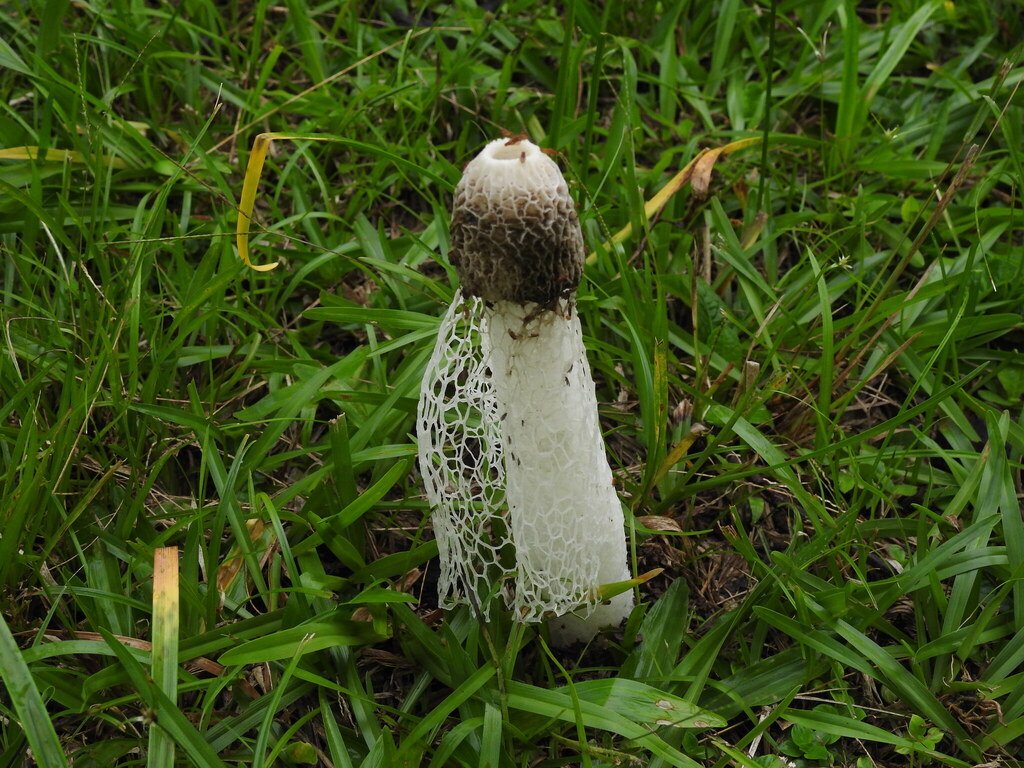
© Aline Fernanda Antunes · iNaturalist · CC BY-SA 4.0
Scientific Classification & Quick Facts
Classification
Known For
Detailed measurements for this species are still being verified.
Phallus indusiatus, commonly known as the Bridal Veil Stinkhorn, is one of the most visually arresting fungi in the world. When fully fruited, it produces an elaborate, lace-like skirt of tissue that drapes from beneath its spore-bearing cap—a structure so delicate and ornate it resembles a bride’s wedding veil. This striking appearance belies a far less romantic ecological role: the fungus relies on foul-smelling compounds to attract carrion-feeding insects that disperse its spores across tropical and subtropical landscapes.
The species occurs across at least 37 countries, primarily in warm regions of Asia, Africa, and beyond, though its exact conservation status remains undocumented by the International Union for Conservation of Nature. P. indusiatus is a saprotroph—a decomposer that breaks down woody debris in moist, shaded habitats—and plays a quiet but essential role in nutrient cycling. Its combination of extreme visual drama and ecological significance has made it a subject of fascination for mycologists, food foragers, and nature enthusiasts worldwide.
Identification and Appearance
Phallus indusiatus is instantly recognizable by its elaborate net-like indusium—a delicate, skirt-like structure that hangs from the mushroom’s cap. The species begins life entirely underground within an egg-shaped, peridium-enclosed structure that measures up to 6 cm in diameter. This “witches’ egg” is whitish to buff or reddish-brown, typically anchored to the soil by a thick mycelial cord at its base.
As the fruit body matures, internal pressure causes the peridium to split and the mushroom erupts with remarkable speed. The mature fruiting body reaches up to 25 cm in height and is distinguished by its net-like indusium—a gossamer veil of interconnected tissue that hangs like a bridal gown around the fertile head. This distinctive reticulated structure is the source of both the common name and the scientific epithet indusiatus (Latin for “clothed” or “cloaked”). The cap itself is typically olive or dark-brown, often slimy or gelatinous, and releases a carrion-like odour that attracts flies and other insects for spore dispersal.
Distribution and Habitat
Phallus indusiatus, the Bridal Veil Stinkhorn, occurs across 37 countries spanning multiple continents, with a notably uneven distribution pattern. Australia and Brazil dominate the record counts, together accounting for over half of documented observations. The species appears widely across the Americas, with significant populations in the United States, Argentina, Costa Rica, Colombia, Mexico, and Peru. Smaller populations exist in Indonesia and Canada, reflecting a distribution that favours warm and temperate climates but extends into cooler regions.
Geographic Range
The highest concentration of records comes from Australia (65 observations), followed by Brazil (44), and the United States (31). Argentina, Costa Rica, Colombia, Mexico, Peru, Indonesia, and Canada round out the top ten, each contributing 6 to 29 records. This global footprint suggests the species thrives in both hemispheres and across diverse climatic zones, though exact elevation preferences remain undocumented in available records.
Seasonal Presence
Fruiting activity peaks in May, with observation counts rising through spring months (March–May) in the Northern Hemisphere. A secondary rise occurs in autumn (September–October), likely corresponding to fruiting conditions in the Southern Hemisphere. Winter months consistently show lower observation numbers, dropping to single-digit or low double-digit counts from June through August and again in December, indicating reduced fruiting or reduced observer activity during cooler periods.
Biology
Lifecycle
Phallus indusiatus begins its lifecycle as vegetative mycelium colonizing decaying wood and plant organic matter in soil. The fungus persists in this stage until environmental conditions—particularly moisture and temperature—trigger fruiting. In its native Asian habitats among bamboo forests, fruiting typically occurs following heavy rains, when water availability spikes. The mycelium then rapidly develops into a mature fruit body.
The fruiting body emerges with distinctive morphology: a phallic stipe supporting a cap topped by the characteristic indusium—a delicate, lace-like veil structure that gives the species its common name. At maturity, the fungus produces a gleba, a sticky spore mass coating the cap. This gleba carries the defining characteristic of stinkhorn reproduction: rather than forcibly ejecting spores as typical agarics do, P. indusiatus relies on dispersal by insects attracted to the carrion-like odour. Once spores are consumed by insect visitors, they pass through the insect’s digestive system intact and are deposited elsewhere in excrement, establishing new infection sites for mycelial growth.
Ecological Role
Phallus indusiatus functions as a saprobe, deriving all its nutrients from the decomposition of dead wood and plant matter. By breaking down cellulose and lignin in decaying substrates, the fungus accelerates nutrient cycling and returns carbon and minerals to soil ecosystems. It typically fruits singly or in clusters on disturbed ground and among wood chips, habitats where organic debris accumulates.
The fungus maintains a specialized mutualistic relationship with specific insect groups. Stingless bees of the genus Trigona, along with flies from the families Drosophilidae and Muscidae, visit the mature fruit body to consume the spore mass. The cloying odour—detectable from considerable distances—acts as a reliable attractant. In return for this feeding opportunity, these insects provide efficient spore dispersal over distances far exceeding wind or water transport alone. The indusium, though its precise function remains uncertain, may serve a visual attraction role complementing the olfactory signal.
Uses
In traditional Asian cuisine and medicine, P. indusiatus holds cultural and commercial significance. The species is cultivated for food in several countries and appears in culinary preparations, though specific nutritional or medicinal claims require clinical substantiation. The distinctive appearance and rarity of wild fruit bodies make it a prized find for foragers and collectors in regions where it occurs naturally.
Beyond culinary interest, the fungus has attracted scientific attention for its unusual reproductive strategy and insect-mediated spore dispersal mechanism, making it valuable for mycological research and understanding how fungi adapt to tropical and subtropical ecosystems.
Conservation and Threats
Phallus indusiatus, the Bridal Veil Stinkhorn, has not been formally assessed by the International Union for Conservation of Nature (IUCN). Without an official Red List designation, the species’ global conservation status remains unknown. This absence of assessment is common for fungi, particularly tropical species with limited geographic distribution data and inconsistent documentation of their occurrence across regions.
Threats
The primary threat to P. indusiatus is habitat loss in tropical and subtropical forests where the species fruits. The fungus depends on intact forest ecosystems, particularly in Southeast Asia and other regions where it occurs. Deforestation for agriculture, timber extraction, and urban development continues to fragment and reduce suitable fungal habitat. Because P. indusiatus is a saprotroph that colonises decaying wood and organic matter in undisturbed forest floors, the removal of deadwood during forest management also diminishes ideal fruiting conditions.
Collection pressure from local communities and commercial harvesters presents a secondary threat. In regions where P. indusiatus is harvested for food or traditional medicine, intensive picking can reduce reproductive output and limit spore dispersal. Overcollection in accessible areas may suppress local populations, though the species’ capacity to recolonise suitable substrates and its reliance on wind-dispersed spores mean impacts vary by location and harvest intensity.
Conservation Efforts
No dedicated conservation programmes or international legal protections specifically target P. indusiatus. The species benefits indirectly from forest protection initiatives and national parks in tropical regions where it occurs, though these safeguards are not designed with fungal conservation in mind. Broader efforts to preserve primary and secondary tropical forest systems in Southeast Asia offer the most practical protection for the species and its habitat requirements.
Cultural Significance
Phallus indusiatus holds diverse cultural significance across multiple continents, reflecting both spiritual reverence and practical utility. According to ethnomycologist R. Gordon Wasson, the species was consumed in Mexican divinatory ceremonies, valued for its distinctive phallic appearance. This association with divination speaks to how the fungus’s striking morphology has shaped its role in ritual practices and symbolic interpretation.
In New Guinea, indigenous peoples regard the mushroom as sacred, while in Nigeria, the Yoruba people know it by the name Akufodewa—a term constructed from Yoruba words meaning “die for hunter search.” This name references the mushroom’s powerful odour, which mimics the scent of carrion and can attract hunters mistaking it for a dead animal. The Yoruba have historically incorporated P. indusiatus into protective charms designed to render hunters less visible during dangerous situations, demonstrating its integration into traditional spiritual practices and hunting culture.
The phallic form of the fungus connects it to broader symbolic traditions. Across cultures, phallic imagery has represented fertility and vital life force—associations that likely contributed to the species’ prominence in ceremonial and medicinal contexts. Its distinctive appearance, combined with its ecological role as a carrion-mimicking fungus, made it a potent symbol in both metaphysical and practical domains of human experience.
Fun Facts
- 1.The “veil” is a specialized net structure: The latticed skirt surrounding the fruiting body, called the indusium, is composed of thin fungal tissue woven into an intricate honeycomb pattern. This structure is unique to Phallus indusiatus and a handful of related species.
- 2.It smells like carrion to attract fly pollinators: Rather than relying on wind dispersal like most fungi, the Bridal Veil Stinkhorn produces a putrid odour that mimics decaying flesh. Carrion-feeding flies and beetles are drawn to the smell and inadvertently transfer spores from the gleba (spore-bearing tissue) to other locations.
- 3.The fruiting body emerges fully formed from an “egg”: The entire fungus develops inside a white, egg-like structure called a universal veil. When conditions are right—typically after rain in warm, humid climates—the fruiting body elongates rapidly and breaks through, sometimes doubling in height within hours.
- 4.It is native to tropical and subtropical regions of Asia: The species occurs naturally across southern China, Southeast Asia, and the Indian subcontinent, where it fruits in forests and wooded areas during the warm, wet season. It has become naturalized in other tropical regions around the world.
- 5.The fungus is edible and prized in some Asian cuisines: In traditional Chinese and Southeast Asian cooking, the young fruiting bodies (particularly the egg stage) are harvested as a delicacy. The flavour is mild and slightly nutty, bearing little resemblance to the putrid smell of the mature fruiting body.
- 6.The spore slime is dispersed by insects, not air: The dark, sticky spore mass (gleba) coating the fruiting body does not dry out and become airborne. Instead, insects attracted by the odour feed on the gleba and carry spores internally, depositing them in their faeces far from the parent fungus.
- 7.Temperature and humidity trigger fruiting: The fruiting body will only develop and expand in warm, humid conditions, which is why Phallus indusiatus typically fruits in the early morning hours after overnight rain. A sudden drop in humidity can halt development mid-emergence.
Sources and References
- Global Biodiversity Information Facility (GBIF)View source
- iNaturalistView source
- WikidataView source
- WikipediaView source
- Encyclopedia of Life (EOL)View source
Photo Gallery
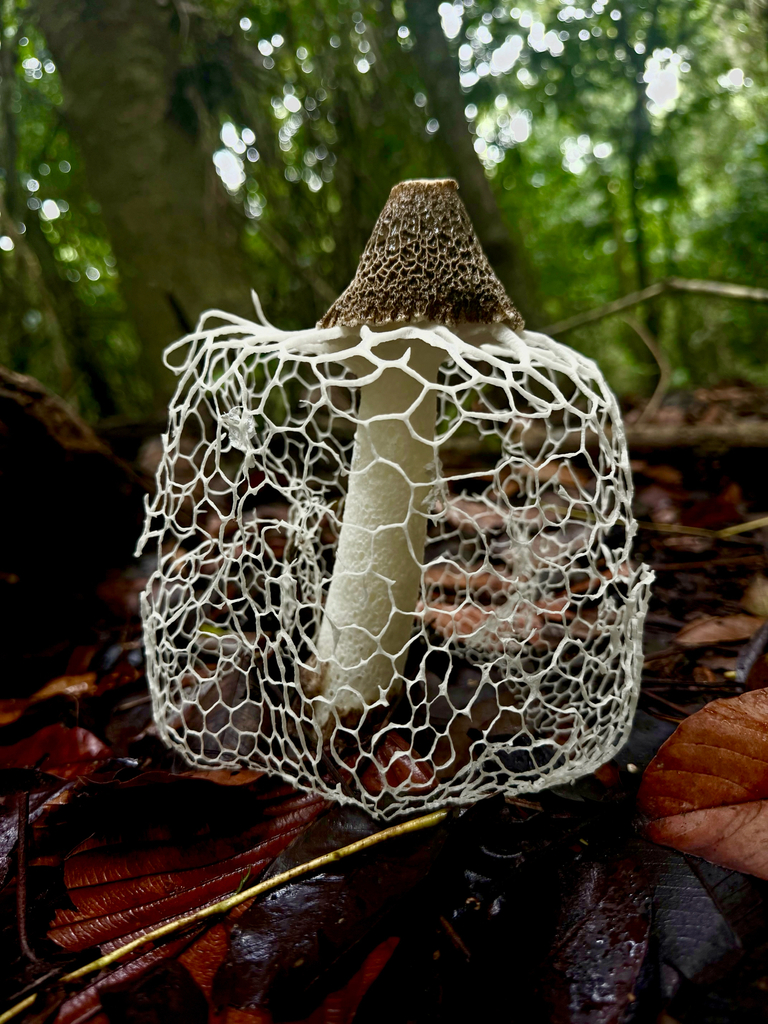
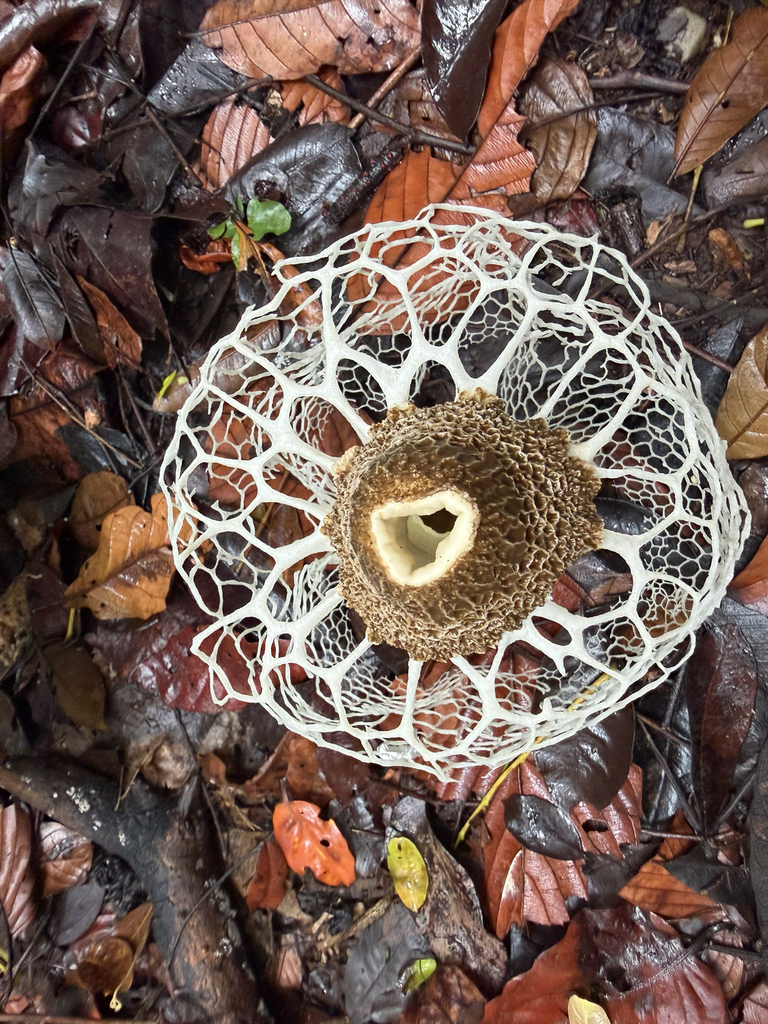
Aline Fernanda Antunes · CC BY-SA 4.0
Related Species
Was this profile helpful?