The Italian maple, Acer opalus, is a medium-sized deciduous tree native to the hills and mountains of southern and western Europe, ranging from the Balkans to Spain and reaching as far north as southwestern Germany, with an outlying population in northwest Africa's Algeria.
It belongs to the soapberry family, Sapindaceae, and is classified as Least Concern. Its combination of glossy foliage, peeling bark, and early spring flowers gives it a distinctive presence in the mixed broadleaf woodlands it inhabits.
Identification and Appearance
The most useful field mark for Acer opalus is its bark: grey and pinkish, it peels away in distinct square plates, a texture that sets it apart from many other maples with smoother or more fissured bark.
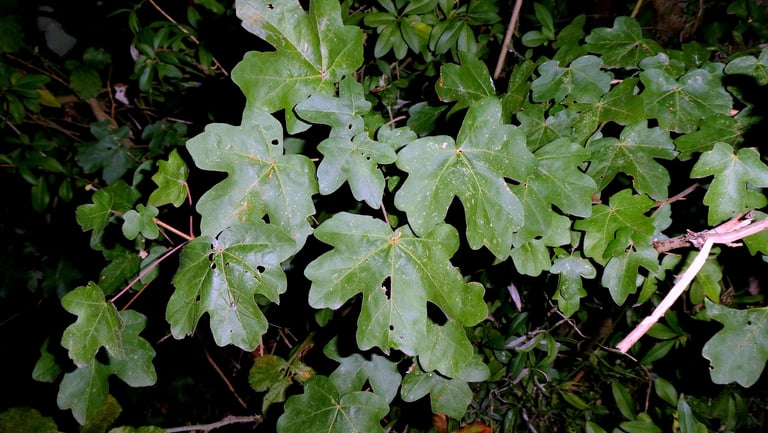
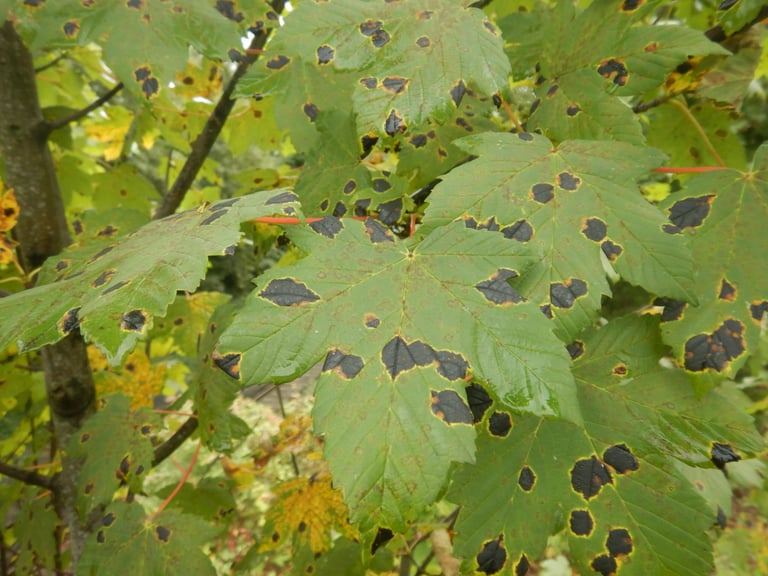
This is a medium-sized tree, reaching up to 20 meters tall with a trunk as wide as 1 meter in diameter. Its leaves are glossy green, palmately lobed with blunt teeth, and measure 7 to 13 centimeters long and 5 to 16 centimeters across. They turn yellow in autumn.
Small yellow flowers open before the leaves emerge in spring, a timing that makes the bare branches briefly dotted with color. The fruit is a pair of winged samaras, each seed up to 1 centimeter in diameter attached to a wing 1.5 to 2.5 centimeters long.
Distribution and Habitat
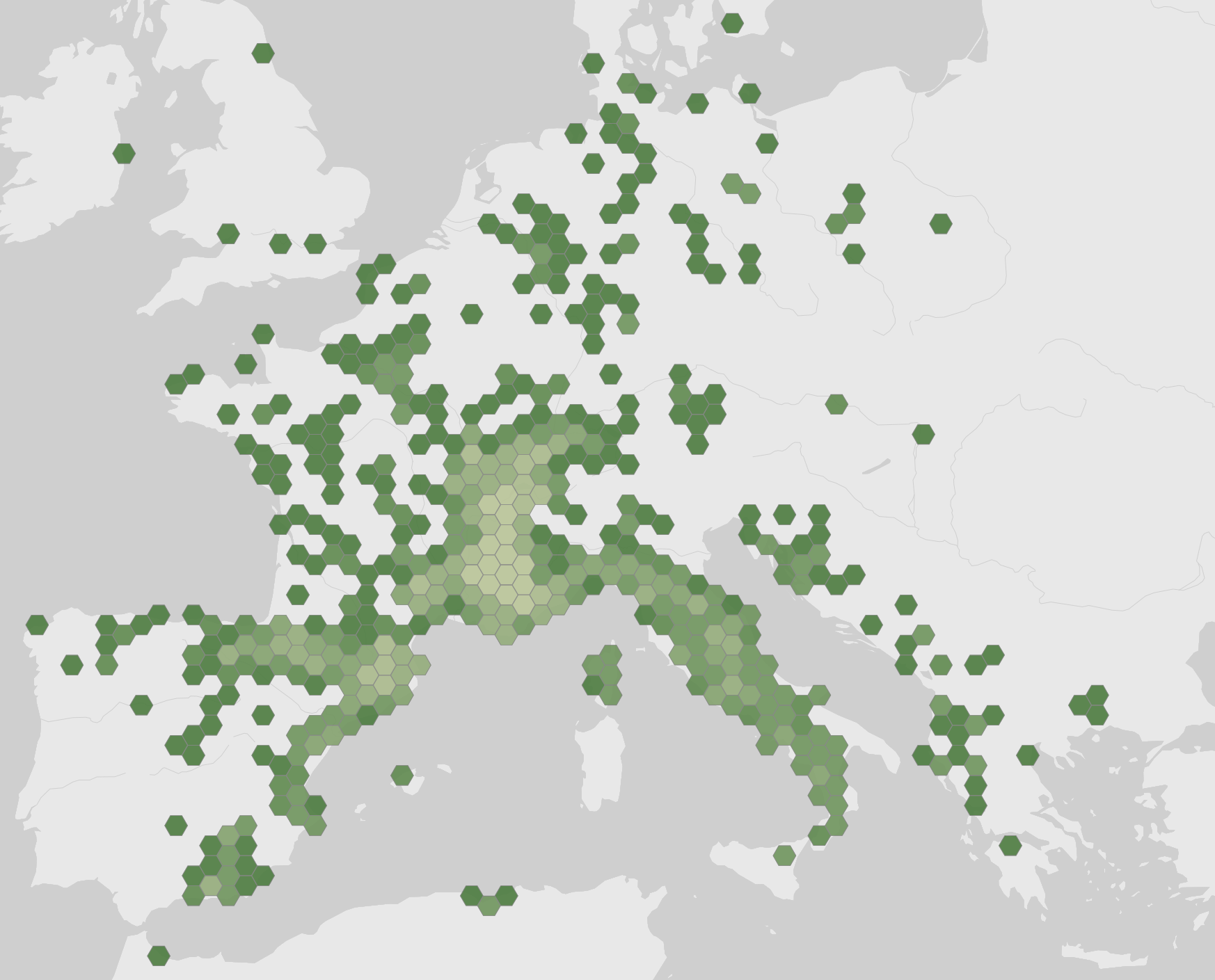
Acer opalus occurs across a broad swath of southern and western Europe, with its native range spanning Albania, Algeria, the Balearic Islands, Corsica, France, Germany, Greece, Hungary, Italy, Morocco, the northwestern Balkan Peninsula, Sicily, Spain, Switzerland, the Transcaucasus, and Türkiye, within a temperate climate zone.
The species grows from sea level up to 2,100 meters above sea level, favoring limestone soils on both stony substrates and well-developed ground. It can form small pure stands or grow mixed with other broadleaved trees such as oaks (Quercus spp.), whitebeams and rowans (Sorbus spp.), and other maple species.
Observation records show a pronounced seasonal pattern, with counts rising through spring and peaking around June, consistent with the period when the tree's foliage is most conspicuous and observers are most active outdoors; these figures reflect when the species is recorded, not its actual abundance or full range.
Growth and Form
Acer opalus grows as a tree, developing the broad, rounded crown typical of medium-sized maples over time as it reaches its mature height.
Ecology and Relationships
Acer opalus grows within mixed broadleaf woodlands on limestone soils, sharing habitat with oaks, whitebeams, rowans, and other maples, often on stony or well-developed ground up to 2,100 meters elevation.
Its flowers attract a range of insect visitors, including bumblebees such as Bombus terrestris, solitary bees of the genus Lasioglossum, and mason bees like Osmia bicornis, along with lacewings and ladybird beetles; a visit to the flowers, however, does not confirm that pollination occurred.
The tree also supports a variety of animals that feed on it, most notably birds such as redpolls (Acanthis flammea), skylarks (Alauda arvensis), rock partridges (Alectoris graeca), and waterfowl including mallards (Anas platyrhynchos) and greylag geese (Anser anser), alongside weevils and other beetles.
Uses and Human Relationships
Acer opalus, commonly known as the Italian maple, is valued chiefly as an ornamental and shade tree in gardens and parks across its range. Its compact form and attractively lobed leaves make it a popular choice for landscaping where a smaller-statured maple is desired.
Fun Facts
- Acer opalus can grow at elevations up to 2,100 meters above sea level, higher than many maples reach within the same mountainous regions of southern Europe.
- Its native range stretches from the Balkan Peninsula and Greece across the Mediterranean to Morocco and Algeria in North Africa, an unusually wide spread for a European maple.
- Small yellow flowers open on its branches before the leaves unfurl each spring, giving the bare tree a brief burst of color.
Photos
Photographs from via iNaturalist, licensed under CC0 1.0., by Vasileia Sef via iNaturalist, licensed under CC BY 4.0., by Lídia Carrera via iNaturalist, licensed under CC BY 4.0., by Patrick Delhalt via iNaturalist, licensed under CC BY 4.0., by Yves Bas via iNaturalist, licensed under CC BY 4.0., by mycoroco via iNaturalist, licensed under CC BY 4.0., by Leonardo Rapisarda via iNaturalist, licensed under CC BY 4.0., by Louis Aureglia via iNaturalist, licensed under CC BY 4.0., by frangp via iNaturalist, licensed under CC BY 4.0., by Clément Maouche via iNaturalist, licensed under CC BY 4.0., by yellowplant via iNaturalist, licensed under CC BY 4.0., by Moe Meikle via iNaturalist, licensed under CC BY 4.0., by Tom W via iNaturalist, licensed under CC BY 4.0., and by Anis Dris via iNaturalist, licensed under CC BY 4.0., credited on each photo.
Ecology and classification
Classification
- Phylum
- Tracheophyta
- Class
- Magnoliopsida
- Order
- Sapindales
- Family
- Sapindaceae
- Genus
- Acer
- Species
- Acer opalus
Sources
- GBIF Species names and classification
- iNaturalist Photos
- Wikidata Common names and conservation status
- Wikipedia Summary extract
- Plants of the World Online Native range, life form and climate (WCVP)
- GloBI What it eats, what eats it, parasites and pollinators
- trophiCH