Bright orange, cup-shaped fruiting bodies scattered across bare ground give Aleuria aurantia its common name: the orange peel fungus. The resemblance is uncanny enough that foragers regularly mistake discarded citrus rinds for the real thing, and vice versa.
This is an ascomycete fungus, a member of the order Pezizales, and one of the most widespread and recognizable cup fungi in the world. It grows on the ground rather than on wood, favoring disturbed soils across a broad range of climates.
Its unmistakable color and shape make it one of the easiest fungi for beginners to spot and learn, even though the group of fungi it belongs to includes many far less obvious relatives.
Fruiting Body and Identification
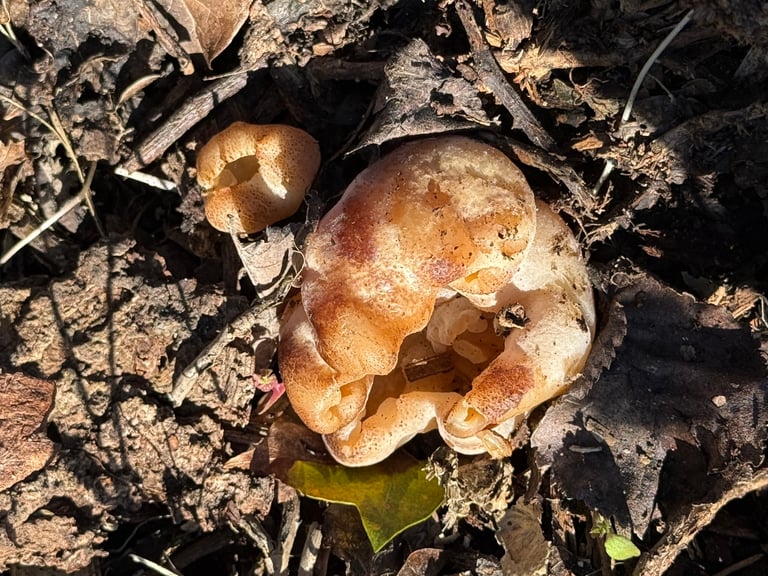
The fruiting body is the clearest way to identify Aleuria aurantia: a bright orange, cup- or saucer-shaped structure measuring 1 to 10 centimeters (about 1/2 to 4 inches) across. The outer surface is fuzzy to the touch, and because the cups often grow crowded together, they frequently end up misshapen and irregular rather than forming a clean, symmetrical bowl.
The flesh is thin and fragile, tearing easily when handled. Spores are produced on the inner surface and leave a white spore print; when the fruiting body is disturbed, it releases visible clouds of spores into the air, a trait distinctive enough to notice in the field without a microscope. A variety with smaller spores has been documented in the Pacific Northwest.
Few fungi share its exact look, but caution is warranted with a handful of similar species: Aleuria rhenana, Melastiza chateri, and various Otidea species can appear vaguely similar, as can Acervus epispartius, Caloscypha fulgens, Sarcoscypha coccinea, Sowerbyella rhenana, and members of Peziza, Pithya, and Pulvinula.
Distribution and Habitat
Aleuria aurantia grows on dead organic matter, appearing on dead trees and in nutrient-rich soil, but it is most closely associated with bare clay and disturbed ground. It turns up along roadsides, in gardens, and especially where soil has become compacted by foot traffic, such as along paths.
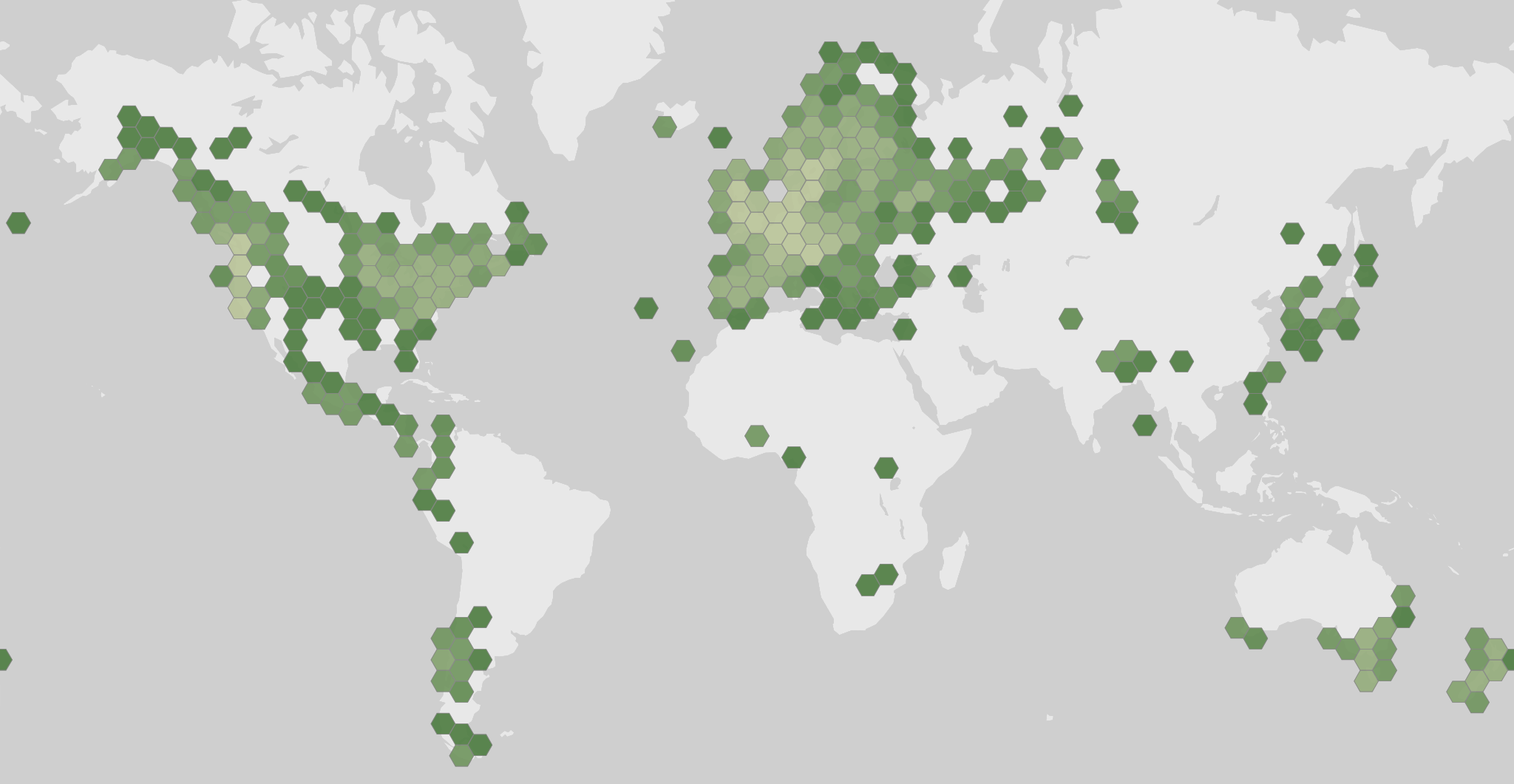
The species is found throughout North America, fruiting from November to March in the West and from May to November in the East. It also occurs in southern Chile and across Europe, always favoring exposed or disturbed clay-rich soils over undisturbed forest floor.
Monthly observation counts show a sharp rise from summer into autumn, peaking in October with over 10,000 recorded observations before declining through the winter months. This pattern suggests a strong seasonal presence in fall across the regions sampled, though these counts reflect where the fungus has been observed rather than a measure of its total abundance or complete range.
Uses and Cultural History
Aleuria aurantia is generally regarded as edible, though it is not considered a choice edible and is notoriously difficult to collect intact given its thin, fragile cups. When used, it can be served in thin slices, and it can be preserved by drying for later use.
Culturally, the orange peel fungus has stayed largely out of the spotlight. Unlike psilocybin mushrooms or reishi, which hold prominent places in spiritual and healing traditions across many cultures, Aleuria aurantia has not featured in the mysticism or mythology of most societies and remains relatively uncelebrated by comparison.
Fun Facts
- Christiaan Hendrik Persoon first described the species in 1800, naming it Peziza aurantia.
- Karl Wilhelm Gottlieb Leopold Fuckel later placed it in the genus Aleuria in 1870, giving the fungus its current scientific name.
- The epithet aurantia comes from the Latin word for "orange," describing its vivid color.
- Despite the rich folklore surrounding many fungi, the orange peel fungus has largely remained outside the mythology and spiritual traditions attached to species like psilocybin mushrooms or reishi.
Ecology
Habitat
- Woodland
- Urban
- Disturbed Ground