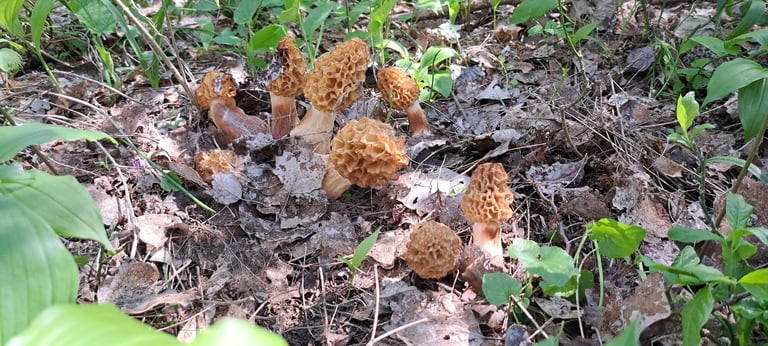
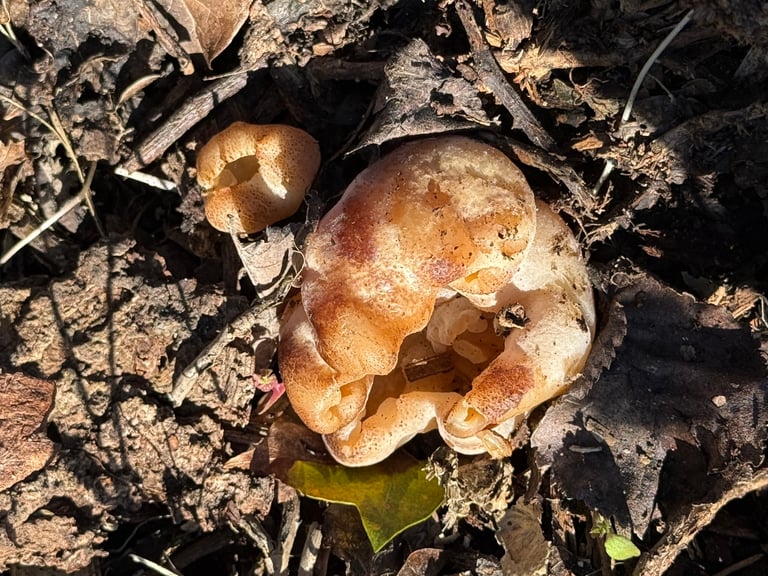
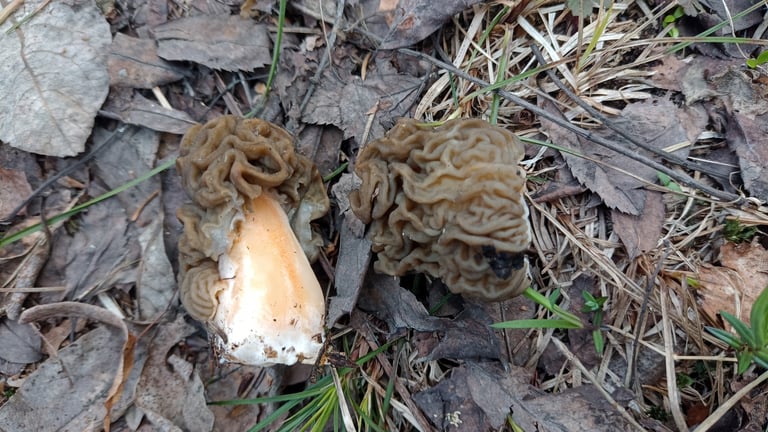
Few mushrooms carry a name as misleading as Gyromitra esculenta — the species epithet means "edible," yet the fungus is now recognized as potentially deadly. Its fruiting body is an irregular, brain-shaped cap, dark brown to reddish or purplish in color, that can grow up to 10 centimeters high and 15 centimeters wide, set on a stout white stipe reaching 6 centimeters.
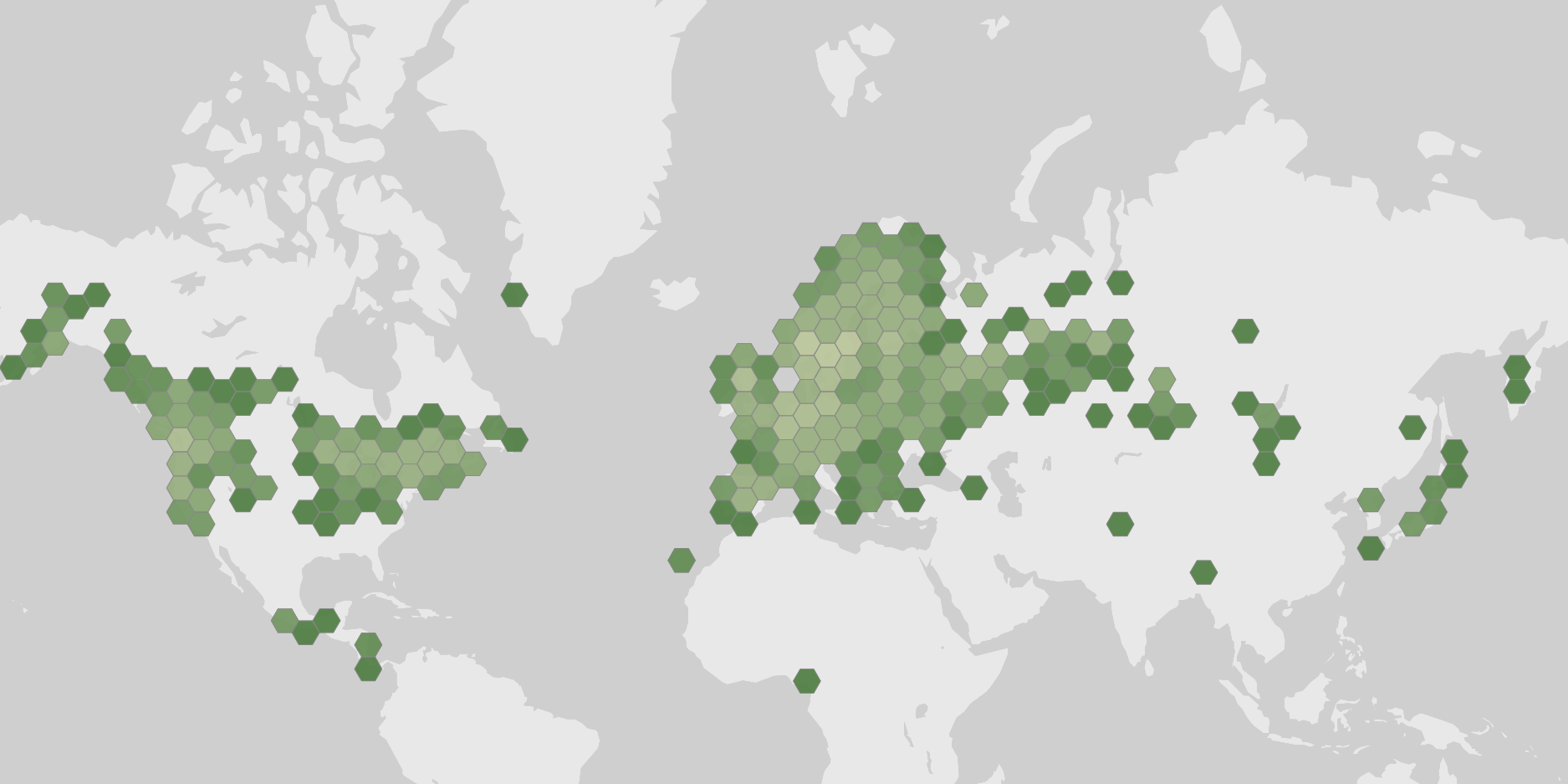
The species is widely distributed across Europe and North America, fruiting in sandy soils beneath coniferous trees during spring and early summer. Its striking appearance, unpredictable toxicity, and long history of human consumption despite the risks make it one of the more curious and cautionary fungi encountered in the woods.
Fruiting Body and Identification
The most reliable identifying feature of Gyromitra esculenta is its irregularly lobed, brain-like cap, which starts out smooth but becomes progressively more convoluted and wrinkled as it matures. The cap can reach 12 centimeters or more in both height and width, and its color ranges from brownish to reddish, chestnut, purplish, or golden, darkening to nearly black with age. Specimens from California tend toward more reddish-brown caps.
The stipe is attached to the cap at several points rather than centrally, and measures 3 to 6 centimeters high and 1 to 5 centimeters wide. Sources disagree on whether the stipe is solid or hollow, with older reports describing it as solid — unlike the hollow stems of true morels — while more recent sources describe it as hollow as well. The flesh has a mild taste and a smell that has been described as pleasant and fruity. The spore print is whitish, with transparent, elliptical spores measuring 17 to 22 micrometers long.
Distribution and Habitat
Gyromitra esculenta grows on sandy soil in temperate coniferous forest, and occasionally in deciduous woodlands. Among conifers, it is found mostly under pines, though sometimes under aspens. The fungus favors ground that has been disturbed — openings, rivulets, washes, timber clearings, plowed ground, forest fire clearings, and roadsides — and can appear in abundance in some years while being scarce in others.
In North America it is more abundant in montane and northern coniferous woodlands, such as the Sierra Nevada and the Cascade Range, but ranges widely across the continent as far south as Mexico. In Europe it is common in Central Europe, less abundant toward the east, and more frequent in montane areas than in lowlands. Records also exist from Northern Ireland, western Turkey's Uşak Province, and the Antalya Province coast near Kaş.
Monthly presence observations show a sharp rise from March into a strong peak in May, tapering off through June and dropping to low levels by midsummer, consistent with a spring and early-summer fruiting season that can begin as early as the snow melts. These figures reflect where the species has been recorded, not its abundance or the full extent of its range.
Uses and Cultural History
Despite its dangerous reputation today, Gyromitra esculenta has a long history of human consumption, particularly in Finland, where toxic reactions were documented for at least a century before the fungus was widely recognized as potentially deadly. Early observers were puzzled by wildly inconsistent outcomes — some diners fell severely ill or died while others sharing the same dish showed no symptoms, and some people ate the mushroom for years without harm, leading to early theories of individual allergy rather than inherent toxicity.
The toxin responsible, gyromitrin, was not isolated until 1968. Its concentration varies significantly by geography: intoxications are frequent in eastern Europe and Scandinavia but rare in North America and western Europe. A 1971 Polish study found the species responsible for up to 23% of annual mushroom fatalities at the time, though death rates have since declined; Sweden recorded no fatalities over the 50 years from 1952 to 2002 despite common poisoning cases. In Spain, poisonings are rare thanks to the widespread practice of drying the mushrooms before eating them, though when poisoning does occur there the mortality rate is around 25%. Toxin levels also appear to fall with altitude, according to a French study, and mushrooms from west of the Rocky Mountains may contain less toxin than those from the east.
Estimated lethal doses of gyromitrin range from 10 to 30 mg/kg in children and 20 to 50 mg/kg in adults, corresponding to roughly 0.2–0.6 kilograms of fresh mushroom for children and 0.4–1 kilogram for adults, with children apparently more severely affected. These figures come from toxicological research rather than any indication that consumption is advisable.
Fun Facts
- In Scandinavia, Gyromitra esculenta carries the nickname "edible rock morel," a label that undersells the risk — it has been compared to the pufferfish as a food that is technically edible but fraught with danger.
- Researchers have identified strains of the fungus with much lower gyromitrin concentrations and have successfully grown Gyromitra esculenta to fruiting in culture, opening the possibility of future breeding toward safer strains.
- The mushroom became culturally embedded in post-war traditional cooking, and was even considered a spring delicacy in some Finnish communities.
- Modern food-safety awareness and mycological research have gradually pushed Gyromitra esculenta out of mainstream food culture in the regions where it was once prized.
Ecology
Habitat
- Forest
- Woodland
- Mountain
- Disturbed Ground