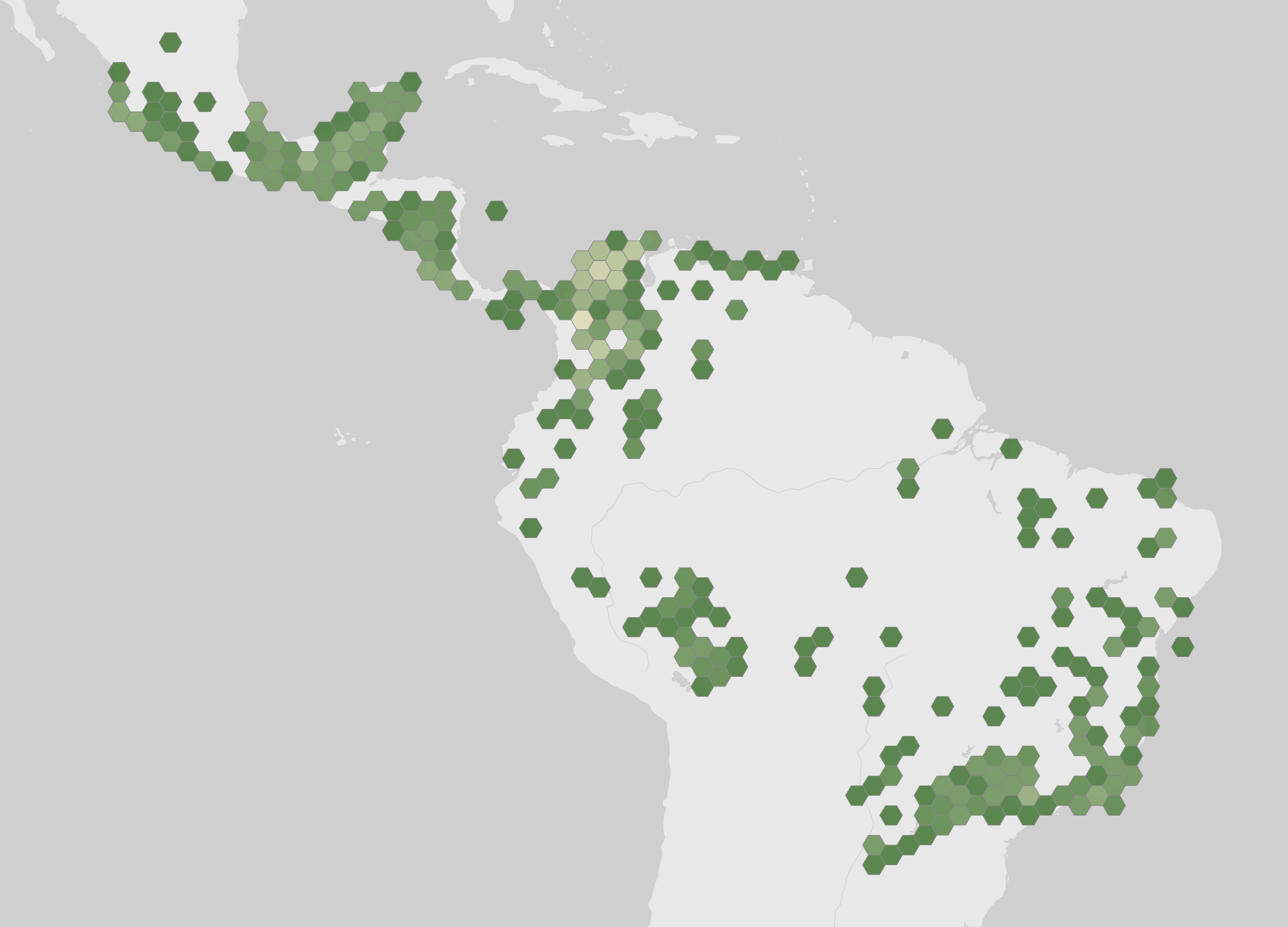
This hardwood tree is known by several names, including glassywood, tigerwood, ronrón, aroeira and gonçalo alves. It belongs to the cashew family, Anacardiaceae, and grows naturally from Mexico through Central America to South America as far south as Bolivia.
Its range covers a wide stretch of the Americas, and the tree is classed as Least Concern on the IUCN Red List. In Portuguese, it is grouped with two other species of Astronium, which are often sold under the same timber names.
The tree is worth reading about because it combines a tall, straight trunk with a wide native range, making it one of the more recognizable large trees of the Neotropics.
Identification and Appearance
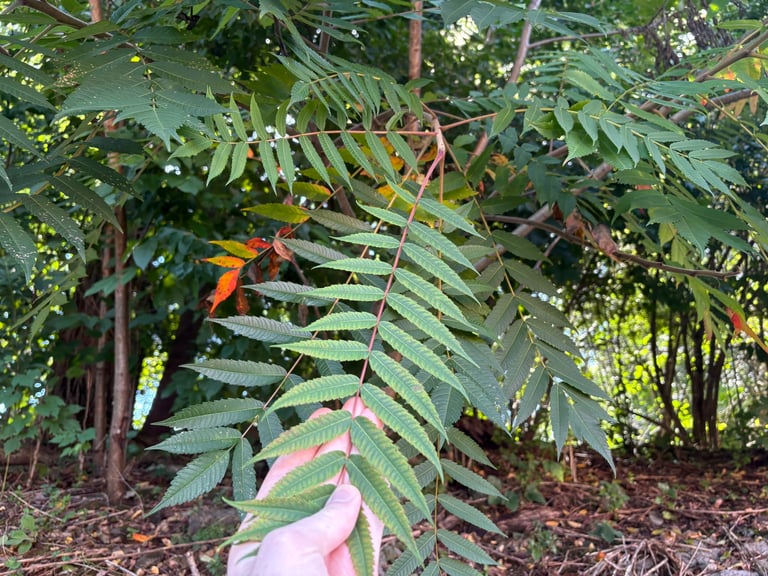
The most useful field mark is the leaf. Each leaf is pinnate, with five to seven oblong or obovate leaflets that end in pointed tips.
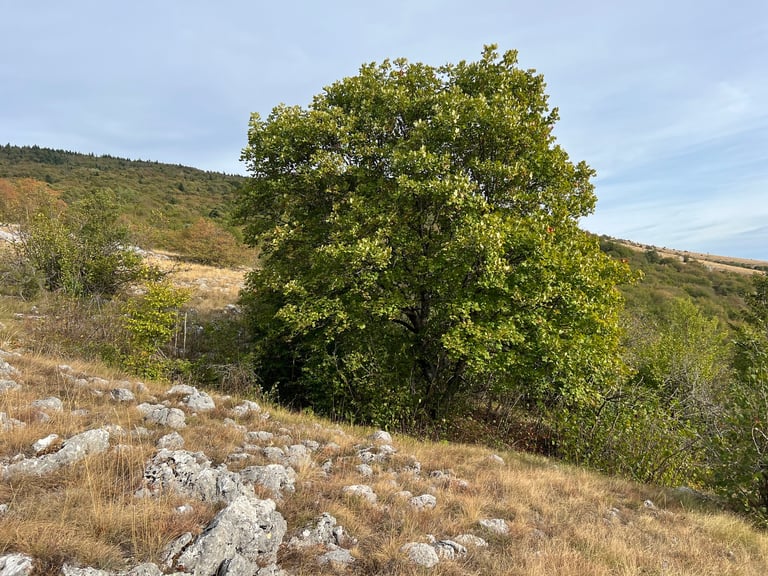
The tree is large, reaching 35 meters tall. Its trunk can reach a diameter of up to 1 meter and is straight and cylindrical, with buttresses at the base that may stand about 2 meters high. The crown is rounded, with irregular branches.
The bark is grey, shiny and smooth, with paler patches where pieces have peeled away. These pale patches are a helpful way to separate a mature trunk from other trees.
The small, hermaphrodite flowers are yellowish-green and grow in axillary or terminal panicles. The fruit is a drupe-like nut that turns from blue to black as it ripens, with semi-bitter flesh around a single seed.
Distribution and Habitat
Astronium graveolens is native to Mexico, Central America and South America. Its recorded range includes Belize, Costa Rica, El Salvador, Guatemala, Honduras, Nicaragua and Panama, along with Colombia, Ecuador, Peru, Venezuela, Bolivia and Paraguay.
In Brazil, the tree occurs across the North, Northeast, West-Central, Southeast and South regions. Mexico's Gulf, Northeast, Southeast and Southwest regions also fall within its native range.
The tree grows in a seasonally dry tropical climate. Its occurrences cluster most strongly in October and November.
No introduced populations are documented, so the tree is found only within its native range.
Growth and Form
Astronium graveolens is a tree, and it grows tall and straight. Mature individuals reach about 35 meters in height.
The trunk is the main feature of its growth. It can reach up to 1 meter in diameter and is straight and cylindrical. Near the ground, buttresses about 2 meters tall give the base additional support.
The crown is rounded, with irregular branches spreading from the upper trunk.
Photos
Photographs from via iNaturalist, licensed under CC0 1.0., by reagan peschke via iNaturalist, licensed under CC BY 4.0., by Carlos Domínguez-Rodríguez via iNaturalist, licensed under CC BY 4.0., by Noland Martin via iNaturalist, licensed under CC BY 4.0., by Diogo Luiz via iNaturalist, licensed under CC BY 4.0., by nasua via iNaturalist, licensed under CC BY 4.0., by Andrea Gantzer via iNaturalist, licensed under CC BY 4.0., by Gabriel Fernandes via iNaturalist, licensed under CC BY 4.0., by Raúl A. Ruiz M. via iNaturalist, licensed under CC BY 4.0., by Anthony Mora Aguilar via iNaturalist, licensed under CC BY 4.0., by sumathiprakash via iNaturalist, licensed under CC BY 4.0., and by Thomaz Ricardo Favreto Sinani via iNaturalist, licensed under CC BY 4.0., credited on each photo.
Ecology and classification
Growth habit
- Tree
Classification
- Phylum
- Tracheophyta
- Class
- Magnoliopsida
- Order
- Sapindales
- Family
- Anacardiaceae
- Genus
- Astronium
- Species
- Astronium graveolens
Sources
- GBIF Species names and classification
- iNaturalist Photos
- Wikidata Common names and conservation status
- Wikipedia Summary extract
- Plants of the World Online Native range, life form and climate (WCVP)