Its rubbery, brown, ear-shaped lobes give Auricularia auricula-judae one of the most distinctive silhouettes of any fungus growing on dead wood in Europe. The species is a jelly fungus, a basidiomycete that forms soft, gelatinous fruit bodies rather than the familiar cap-and-stem mushroom shape, and it grows almost exclusively on the wood of broadleaf trees, above all elder.
Beyond its macabre name, the species has a long, tangled history of mistaken identity: fungi sold and eaten as "A. auricula-judae" in China and North America have turned out, on closer genetic inspection, to be entirely different species. That confusion, together with its centuries of use as a folk remedy in Britain and Ireland, makes this modest woodland jelly fungus far more interesting than its unassuming appearance suggests.
Fruiting Body and Identification
The single most reliable clue to this species is its shape: a floppy, ear- or cup-like lobe, up to 9 cm (3½ in) across and only about 3 mm (⅛ in) thick, attached to its wood substrate laterally or by a very short stalk. Fresh fruit bodies are tough, elastic, and gelatinous to the touch, but they dry into a hard, brittle shell that rehydrates when wetted again.
The upper surface is reddish-tan to purplish-brown, covered in a fine grey down of tiny hairs, and can be smooth in young specimens or increasingly wrinkled and undulating as they age, darkening in color over time. The underside is a lighter grey-brown, smooth or lightly folded, sometimes showing vein-like ridges that heighten the ear-like impression. Occasional pure-white forms occur, once classified as a separate species, Auricularia lactea, but these are now recognized as simple unpigmented variants that often grow alongside normally colored fruit bodies.
Microscopically, the spores are sausage-shaped (allantoid), measuring 15–22 by 5–7 μm, produced on cylindrical basidia 65–85 by 4–5.5 μm that bear three internal cross-walls. The surface hairs measure 100–150 μm long and 5–7.5 μm wide, with thick walls and rounded to pointed tips.
In Europe the only real look-alike is Auricularia cerrina, found on oak and told apart by its much darker, near-black fruit bodies. The Asian Auricularia heimuer and North American Auricularia angiospermarum are near-identical in the field but can only be separated microscopically, by their shorter basidia and smaller spores.
Distribution and Habitat
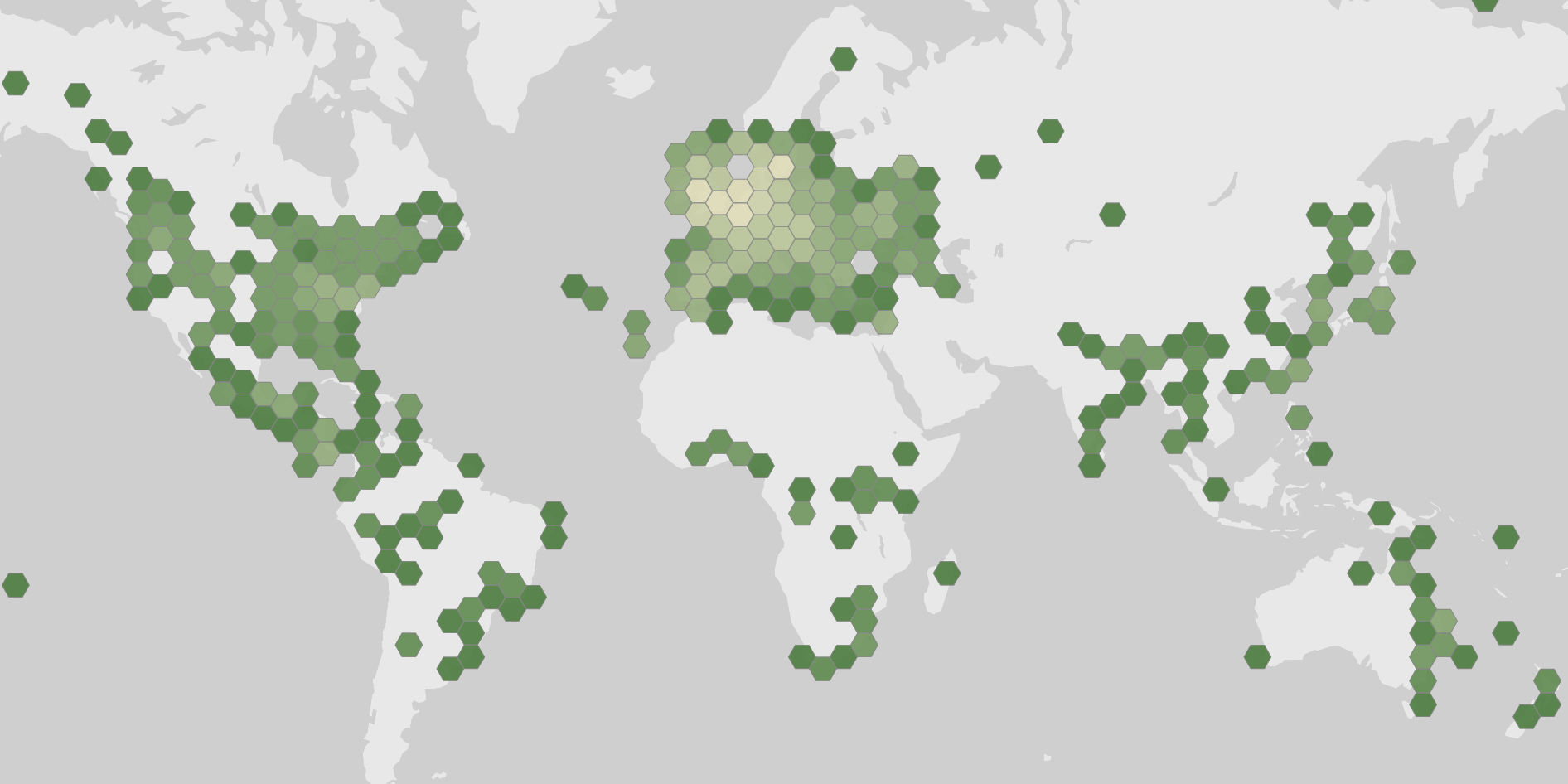
Auricularia auricula-judae is widespread across Europe but, despite older assumptions of a worldwide range, molecular studies have shown it does not occur elsewhere; superficially identical fungi in China and East Asia belong to Auricularia heimuer (and to a lesser extent A. villosula), while North American populations on broadleaf trees are Auricularia angiospermarum, with conifer-associated Auricularia americana forming a further distinct species.
Within Europe it grows on the dead wood of broadleaf trees and shrubs, most characteristically elder (Sambucus nigra), but also sycamore, beech, ash, and spindle. It very rarely appears on conifers, and it has even been recorded on worked timber, such as a sycamore draining board in an old sink. It favors older branches and acts as a saprotroph on dead wood or occasionally as a weak parasite on living wood, causing a white rot.
Fruit bodies can occur solitarily, in loose groups, or in dense tufts, and they can be found in any month. GBIF presence-observation counts, which reflect recorded sightings rather than true abundance, rise sharply from September through February, peaking around October–January, and drop to their lowest point in June through August. This pattern points to autumn and winter as the seasons when fruit bodies are most conspicuous, though the fungus itself is described as occurring year-round.
Uses and Cultural History
People have used Auricularia auricula-judae far more for medicine than for the table, at least in Britain. The 16th-century herbalist John Gerard recommended boiling the fruit bodies in milk or steeping them in beer as a slow-sipped cure for sore throats, and later writers such as Carolus Clusius and John Parkinson described similar gargles made by boiling in milk or steeping in vinegar. John Pechey, writing in 1694, gave nearly identical instructions and also noted its use, infused in water, for diseases of the eyes. The fungus was also applied as a poultice for eye inflammation and used in Scotland as a throat gargle and in Ireland, boiled in milk, in attempts to treat jaundice. This medicinal trade persisted long enough that the species was still sold at Covent Garden market as late as 1860, at a time when it was explicitly not regarded as edible in the United Kingdom.
As food, the species is edible but has never been held in high regard: its soft, jelly-like texture has been compared to "eating an Indian rubber with bones in it," and 19th-century British writers denied it was an edible fungus at all. It is said to be more commonly eaten in Poland. The flavor is mild to bland, and it is not eaten raw, requiring thorough cooking; dried specimens can swell to three or four times their size on rehydration, and a 100 g dried serving supplies about 370 kilocalories, 10.6 g of protein, 0.2 g of fat, and 65 g of carbohydrate. Ground dried fungus has also been used to thicken soups and stews. Much of the fungus consumed in East Asian cooking under a similar name is actually the related species Auricularia heimuer, long confused with A. auricula-judae.
The fungus also has a cultural footprint tied to its Judas legend: it appears in Christopher Marlowe's play The Jew of Malta, where a character claims Judas left his hat "under the elder when he hanged himself," and its folklore likely influenced Emily Dickinson's poem describing the mushroom as "the Elf of Plants" and an "ultimate betrayer."
Fun Facts
- Pure-white fruit bodies occasionally occur and were once classified as their own species, Auricularia lactea, but they are simply unpigmented forms that grow alongside ordinary brown ones.
- The undersides of the fruit bodies can eject several hundred thousand spores an hour, and they keep releasing spores even after losing about 90% of their weight to drying.
- One specimen was recorded growing on the sycamore draining board of an old sink in Hatton Garden, London, far from any living tree.
- DNA analysis revealed that the "Auricularia auricula-judae" long cultivated and sold in China is actually a different species, Auricularia heimuer, and that North American populations belong to yet another species, Auricularia angiospermarum.
- The fungus very rarely grows on conifers, showing a strong preference for the wood of broadleaf trees and shrubs such as elder, sycamore, beech, and ash.
Ecology
Habitat
- Forest
- Woodland