Exidia glandulosa has haunted the European imagination for centuries under the name witch's butter, its jet-black, jelly-like lumps on dead branches once read as a sign that a witch had cursed the tree or the farm nearby.
It is a species of fungus in the family Auriculariaceae, order Auriculariales, forming gelatinous, top-shaped (turbinate) fruit bodies up to 5 cm across on dead wood of broadleaf trees. In North America it goes by names such as black witches' butter, black jelly roll, or warty jelly fungus. No conservation status has been established for it.
What makes it worth a closer look is how easily it is confused with several near-identical black jelly fungi, and how dramatically its texture shifts between a firm, shiny lump and a limp, waterlogged blob depending on the weather.
Fruiting Body and Identification
The most reliable identifying feature of Exidia glandulosa is its turbinate, top-shaped fruit body: a rubbery-gelatinous lump up to 5 cm (2 in) across, colored dark sepia to blackish, growing singly or in small groups on dead wood. It is firm when fresh but becomes lax and distorted with age or in wet weather.
The upper, spore-bearing surface is shiny and studded with small pimples or pegs, while the undersurface is hirsute, covered with a dense layer of tiny gelatinous spines. The spore print is white. When the fruit bodies dry out, they shrink dramatically, collapsing into a flattened black crust on the bark.
Microscopically, the basidia are ellipsoid and septate, measuring 15–25 by 9–13 μm, and the spores are allantoid (sausage-shaped), 11–18 by 4–6.5 μm.
Several fungi look similar. Exidia truncata is very close but has a rough, punctate or pimply undersurface and slightly longer spores under the microscope. Exidia pithya produces button-shaped fruit bodies that quickly merge into a large, effused, lobed mass up to 30 cm across, unlike the discrete lumps of E. glandulosa. The unrelated ascomycete Bulgaria inquinans, which grows on oak, forms similarly rubbery black fruit bodies, but its upper surface is entirely smooth and it releases copious black, not white, spore prints that can stain the hand.
Distribution and Habitat
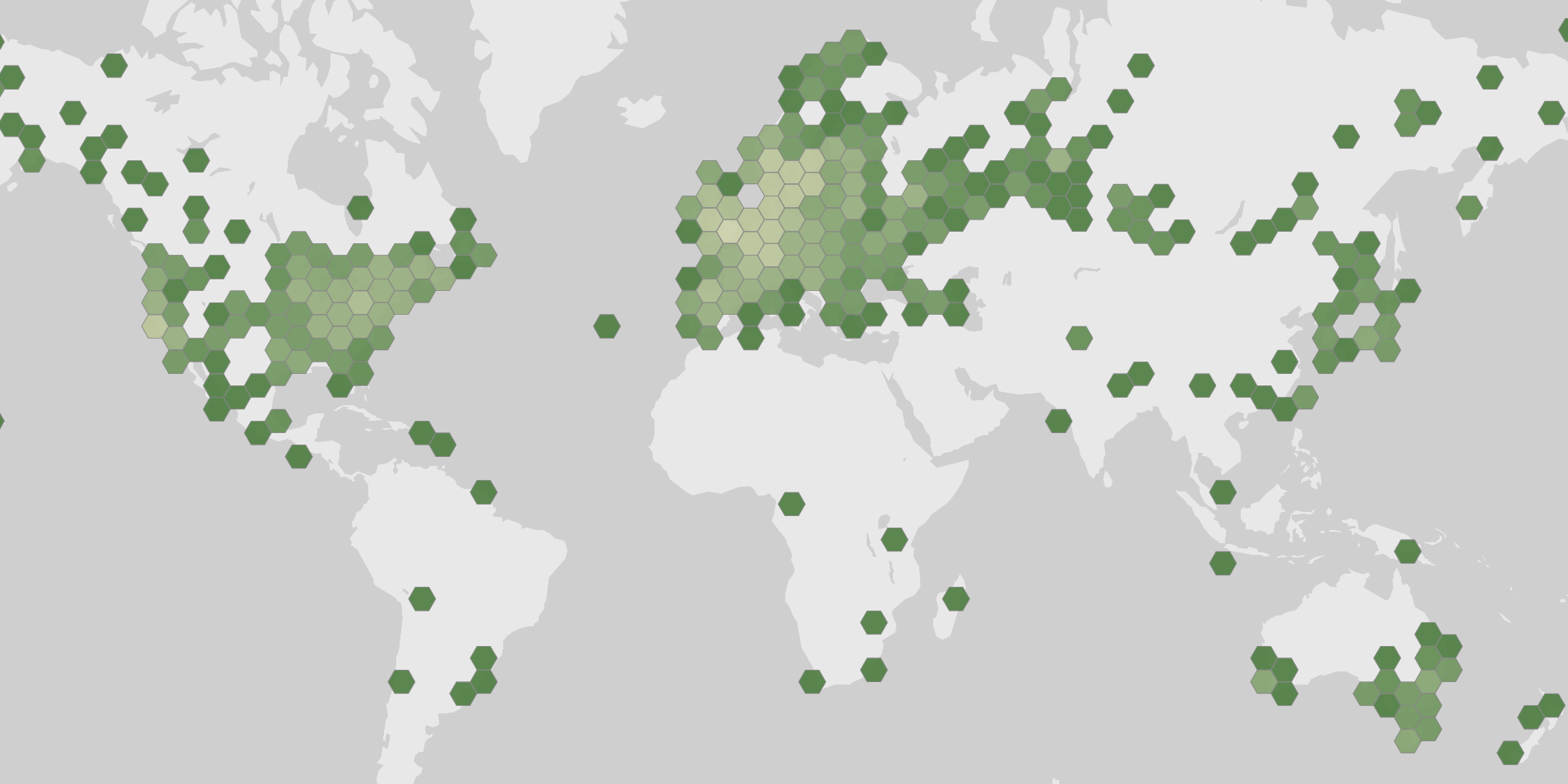
Exidia glandulosa is a wood-rotting fungus found on dead attached branches of broadleaf trees, especially oak, and occasionally hazel, beech, alder, and other hardwoods. Its global range outside Europe is uncertain.
It behaves as a pioneer species, capable of colonizing living or recently dead wood before other fungi arrive. A study of decay in attached oak branches identified it as part of a community of eight basidiomycete fungi consistently associated with the dying-back of branches on living trees; its specific role is to disintegrate the vascular cambium, which loosens the attached bark. It can persist for some time afterward on fallen branches and logs.
Fruit bodies are normally produced in autumn. Monthly observation counts (a measure of recorded presence, not abundance) show the highest numbers from November through February, tapering sharply through spring and reaching a low in July and August, consistent with a fungus that fruits in autumn and lingers into winter before drying up in the warmer months.
Uses and Cultural History
Cultural interest in Exidia glandulosa centers on European folklore, which linked the fungus to witchcraft: its dark, gelatinous, blob-like form on dead branches was taken as a sign of sorcerous activity, giving rise to the enduring name witch's butter (or black witch's butter).
Beyond this folkloric association, the fungus continues to draw attention chiefly for its strange, shape-shifting appearance in winter woodland, rather than for any documented practical or culinary use.
Fun Facts
- Its common names shift by region: witch's butter in the UK, and black witches' butter, black jelly roll, or warty jelly fungus in North America.
- European folklore linked its dark, jelly-like lumps on dead branches to witchcraft, believing their appearance signaled a curse.
- It is frequently confused with the closely related Exidia nigricans; one distinguishing clue is that E. glandulosa tends to form discrete, non-overlapping, ear-shaped droplet fruit bodies rather than a fused mass.
Ecology
Habitat
- Forest
- Woodland