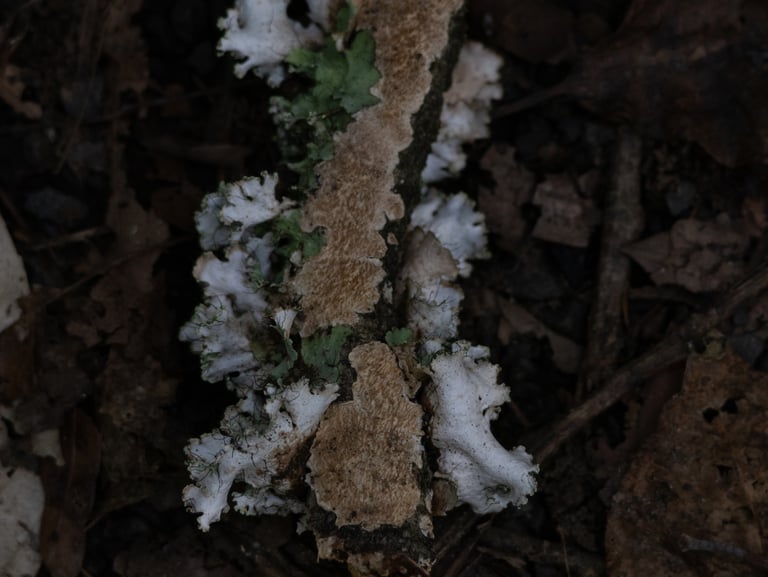
Calicium viride, known as the green stubble lichen, is the type species of its genus, Calicium. It belongs to the pin lichens in the family Caliciaceae.
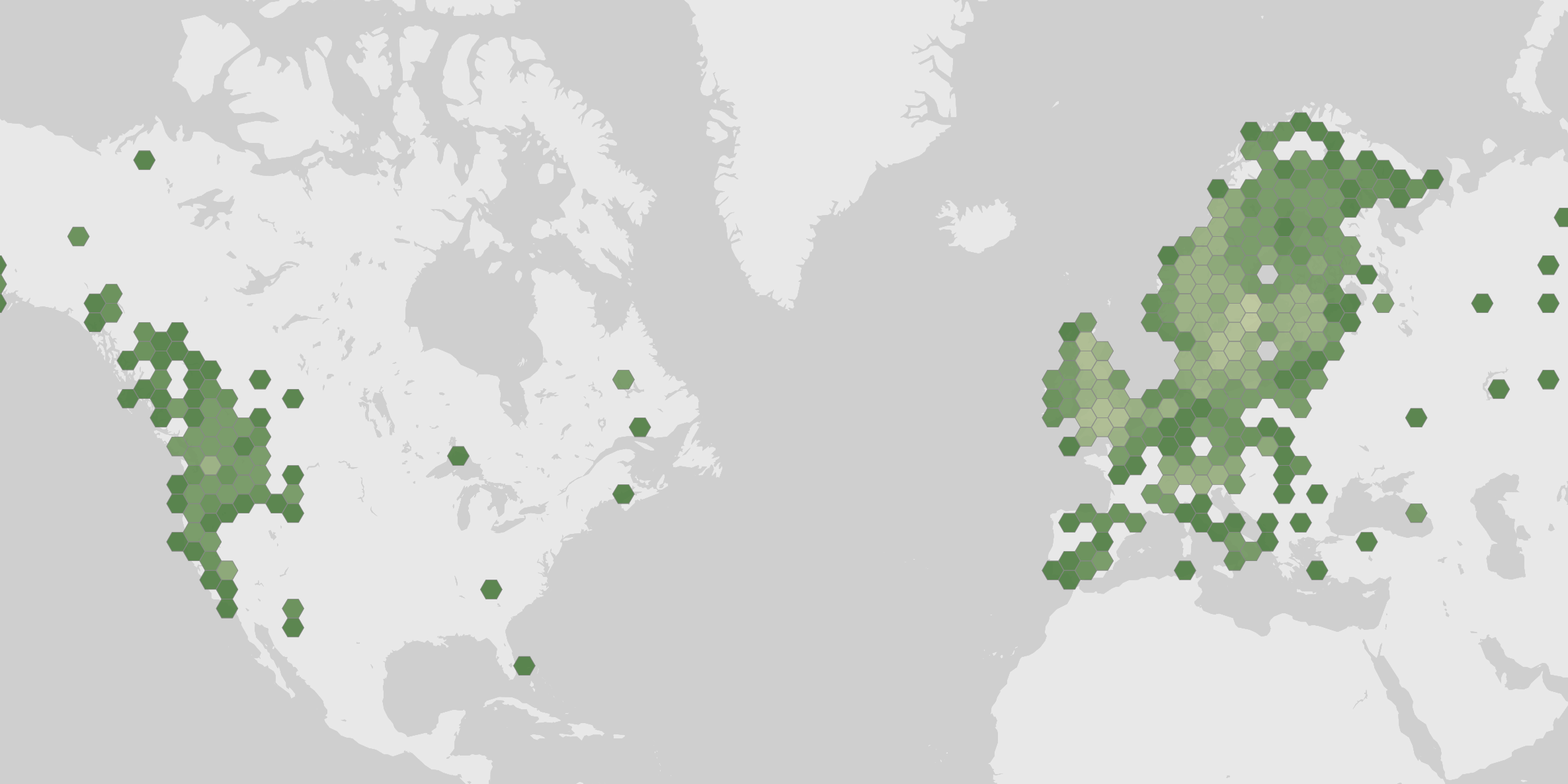
The species is common and widely distributed in temperate areas of the Northern Hemisphere and in southern South America. It grows as a crust on bark and wood, with its spore-bearing stalks rising from the surface.
Its diagnostic features are a brown excipulum and a green, granular crust. Its small stalked fruiting bodies make it a distinctive pin lichen to recognize on trees.
Fruiting Body and Identification
The most reliable way to identify Calicium viride is its greenish-yellow, granular crust with tiny black stalks rising from it. Each stalk is 1.5–2.5 mm long and roughly 0.1–0.15 mm thick.
At the tip of each stalk sits a spherical apothecium, called a capitulum. The capitula are black with a brownish underside, and the apothecia are typically 9–16 times taller than the stalk is wide.
The brown ascospores are elliptical and have a single internal septum that divides each spore into two cells. Spores measure 12–14 by 6–7 μm. The lichen also contains the secondary chemicals rhizocarpic acid and epanorin.
The look-alike Calicium corynellum is rarer and grows on rock rather than wood or bark. Its stalks are shorter, typically 0.5–0.6 mm long, and its fruiting bodies are often almost stalkless with a greyish-white pruina. Its spores are smaller, measuring 13–17 by 4–5 μm, compared with 15–21 by 4–6 μm in C. viride. Checking the substrate and the pruina color helps separate the two in the field.
Distribution and Habitat
Calicium viride is common on the bark and wood of conifer trees in montane forests. It also grows on some deciduous trees, but conifers are its main host.
The species prefers bark that is weakly acidic to neutral. Its frequent lichen associate is Chaenotheca trichialis, which often grows in the same places.
In Nepal, the species has been reported from 3,000 to 3,300 m elevation, showing that it reaches high mountain forests.
The species occurs across temperate areas of the Northern Hemisphere and southern South America. Records peak in July and August, which suggests the lichen is most often noticed in midsummer.
Photos
Photographs from via iNaturalist, licensed under CC0 1.0., by Jared Shorma via iNaturalist, licensed under CC BY 4.0., by Andreas Schneider via iNaturalist, licensed under CC BY 4.0., and by Julie Hilligsøe Lisby via iNaturalist, licensed under CC BY 4.0., credited on each photo.
Ecology and classification
Classification
- Phylum
- Ascomycota
- Class
- Lecanoromycetes
- Order
- Caliciales
- Family
- Caliciaceae
- Genus
- Calicium
- Species
- Calicium viride
Sources
- GBIF Species names and classification
- iNaturalist Photos
- Wikidata Common names and conservation status
- Wikipedia Summary extract